 Add to Chrome
 Add to Firefox
 Add to Edge
Clinical-Prior Guided Multi-Modal Learning with Latent Attention Pooling for Gait-Based Scoliosis Screening
Feb 06, 2026
Adolescent Idiopathic Scoliosis (AIS) is a prevalent spinal deformity whose progression can be mitigated through early detection. Conventional screening methods are often subjective, difficult to scale, and reliant on specialized clinical expertise. Video-based gait analysis offers a promising alternative, but current datasets and methods frequently suffer from data leakage, where performance is inflated by repeated clips from the same individual, or employ oversimplified models that lack clinical interpretability. To address these limitations, we introduce ScoliGait, a new benchmark dataset comprising 1,572 gait video clips for training and 300 fully independent clips for testing. Each clip is annotated with radiographic Cobb angles and descriptive text based on clinical kinematic priors. We propose a multi-modal framework that integrates a clinical-prior-guided kinematic knowledge map for interpretable feature representation, alongside a latent attention pooling mechanism to fuse video, text, and knowledge map modalities. Our method establishes a new state-of-the-art, demonstrating a significant performance gap on a realistic, non-repeating subject benchmark. Our approach establishes a new state of the art, showing a significant performance gain on a realistic, subject-independent benchmark. This work provides a robust, interpretable, and clinically grounded foundation for scalable, non-invasive AIS assessment.

Literature Mining System for Nutraceutical Biosynthesis: From AI Framework to Biological Insight
Dec 23, 2025The extraction of structured knowledge from scientific literature remains a major bottleneck in nutraceutical research, particularly when identifying microbial strains involved in compound biosynthesis. This study presents a domain-adapted system powered by large language models (LLMs) and guided by advanced prompt engineering techniques to automate the identification of nutraceutical-producing microbes from unstructured scientific text. By leveraging few-shot prompting and tailored query designs, the system demonstrates robust performance across multiple configurations, with DeepSeekV3 outperforming LLaMA2 in accuracy, especially when domain-specific strain information is included. A structured and validated dataset comprising 35 nutraceutical-strain associations was generated, spanning amino acids, fibers, phytochemicals, and vitamins. The results reveal significant microbial diversity across monoculture and co-culture systems, with dominant contributions from Corynebacterium glutamicum, Escherichia coli, and Bacillus subtilis, alongside emerging synthetic consortia. This AI-driven framework not only enhances the scalability and interpretability of literature mining but also provides actionable insights for microbial strain selection, synthetic biology design, and precision fermentation strategies in the production of high-value nutraceuticals.
A KAN-based Interpretable Framework for Process-Informed Prediction of Global Warming Potential
Nov 01, 2024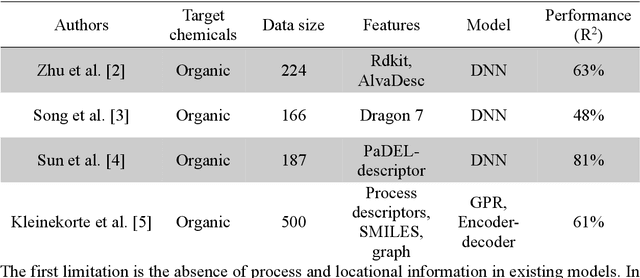
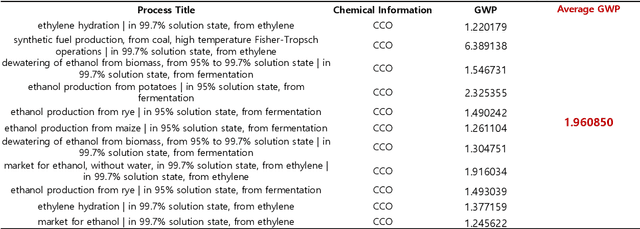
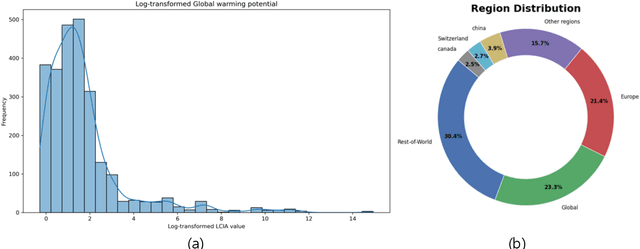
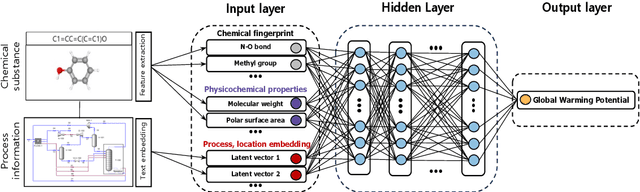
Accurate prediction of Global Warming Potential (GWP) is essential for assessing the environmental impact of chemical processes and materials. Traditional GWP prediction models rely predominantly on molecular structure, overlooking critical process-related information. In this study, we present an integrative GWP prediction model that combines molecular descriptors (MACCS keys and Mordred descriptors) with process information (process title, description, and location) to improve predictive accuracy and interpretability. Using a deep neural network (DNN) model, we achieved an R-squared of 86% on test data with Mordred descriptors, process location, and description information, representing a 25% improvement over the previous benchmark of 61%; XAI analysis further highlighted the significant role of process title embeddings in enhancing model predictions. To enhance interpretability, we employed a Kolmogorov-Arnold Network (KAN) to derive a symbolic formula for GWP prediction, capturing key molecular and process features and providing a transparent, interpretable alternative to black-box models, enabling users to gain insights into the molecular and process factors influencing GWP. Error analysis showed that the model performs reliably in densely populated data ranges, with increased uncertainty for higher GWP values. This analysis allows users to manage prediction uncertainty effectively, supporting data-driven decision-making in chemical and process design. Our results suggest that integrating both molecular and process-level information in GWP prediction models yields substantial gains in accuracy and interpretability, offering a valuable tool for sustainability assessments. Future work may extend this approach to additional environmental impact categories and refine the model to further enhance its predictive reliability.