 Add to Chrome
 Add to Firefox
 Add to Edge
Camera Control for Text-to-Image Generation via Learning Viewpoint Tokens
Apr 21, 2026
Current text-to-image models struggle to provide precise camera control using natural language alone. In this work, we present a framework for precise camera control with global scene understanding in text-to-image generation by learning parametric camera tokens. We fine-tune image generation models for viewpoint-conditioned text-to-image generation on a curated dataset that combines 3D-rendered images for geometric supervision and photorealistic augmentations for appearance and background diversity. Qualitative and quantitative experiments demonstrate that our method achieves state-of-the-art accuracy while preserving image quality and prompt fidelity. Unlike prior methods that overfit to object-specific appearance correlations, our viewpoint tokens learn factorized geometric representations that transfer to unseen object categories. Our work shows that text-vision latent spaces can be endowed with explicit 3D camera structure, offering a pathway toward geometrically-aware prompts for text-to-image generation. Project page: https://randdl.github.io/viewtoken_control/

Polygon Intersection-over-Union Loss for Viewpoint-Agnostic Monocular 3D Vehicle Detection
Sep 13, 2023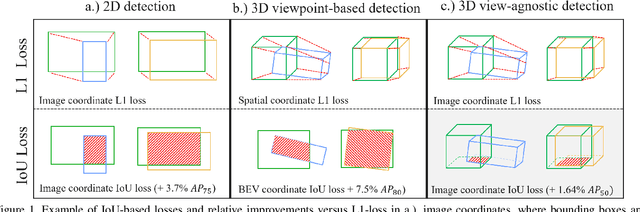
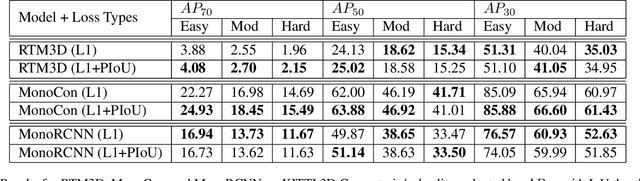
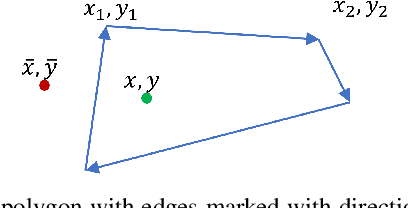
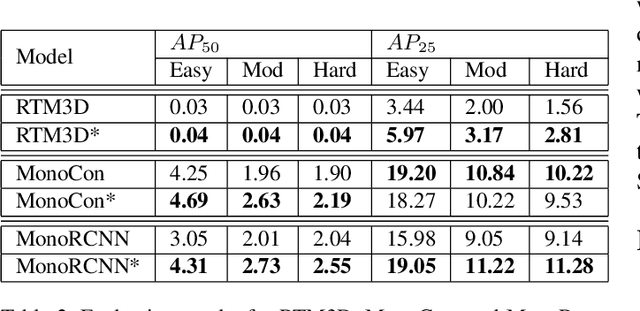
Monocular 3D object detection is a challenging task because depth information is difficult to obtain from 2D images. A subset of viewpoint-agnostic monocular 3D detection methods also do not explicitly leverage scene homography or geometry during training, meaning that a model trained thusly can detect objects in images from arbitrary viewpoints. Such works predict the projections of the 3D bounding boxes on the image plane to estimate the location of the 3D boxes, but these projections are not rectangular so the calculation of IoU between these projected polygons is not straightforward. This work proposes an efficient, fully differentiable algorithm for the calculation of IoU between two convex polygons, which can be utilized to compute the IoU between two 3D bounding box footprints viewed from an arbitrary angle. We test the performance of the proposed polygon IoU loss (PIoU loss) on three state-of-the-art viewpoint-agnostic 3D detection models. Experiments demonstrate that the proposed PIoU loss converges faster than L1 loss and that in 3D detection models, a combination of PIoU loss and L1 loss gives better results than L1 loss alone (+1.64% AP70 for MonoCon on cars, +0.18% AP70 for RTM3D on cars, and +0.83%/+2.46% AP50/AP25 for MonoRCNN on cyclists).