 Add to Chrome
 Add to Firefox
 Add to Edge
Adaptive Testing for Segmenting Watermarked Texts From Language Models
Nov 10, 2025
The rapid adoption of large language models (LLMs), such as GPT-4 and Claude 3.5, underscores the need to distinguish LLM-generated text from human-written content to mitigate the spread of misinformation and misuse in education. One promising approach to address this issue is the watermark technique, which embeds subtle statistical signals into LLM-generated text to enable reliable identification. In this paper, we first generalize the likelihood-based LLM detection method of a previous study by introducing a flexible weighted formulation, and further adapt this approach to the inverse transform sampling method. Moving beyond watermark detection, we extend this adaptive detection strategy to tackle the more challenging problem of segmenting a given text into watermarked and non-watermarked substrings. In contrast to the approach in a previous study, which relies on accurate estimation of next-token probabilities that are highly sensitive to prompt estimation, our proposed framework removes the need for precise prompt estimation. Extensive numerical experiments demonstrate that the proposed methodology is both effective and robust in accurately segmenting texts containing a mixture of watermarked and non-watermarked content.

Segmenting Watermarked Texts From Language Models
Oct 28, 2024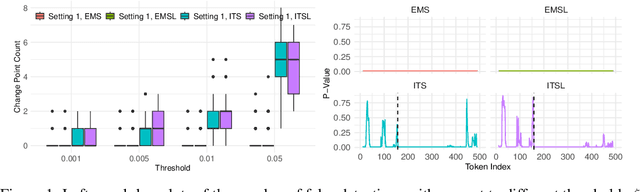


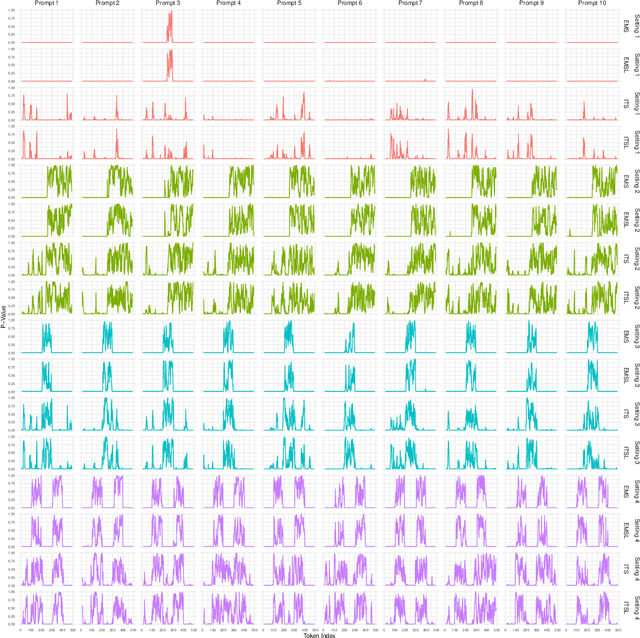
Watermarking is a technique that involves embedding nearly unnoticeable statistical signals within generated content to help trace its source. This work focuses on a scenario where an untrusted third-party user sends prompts to a trusted language model (LLM) provider, who then generates a text from their LLM with a watermark. This setup makes it possible for a detector to later identify the source of the text if the user publishes it. The user can modify the generated text by substitutions, insertions, or deletions. Our objective is to develop a statistical method to detect if a published text is LLM-generated from the perspective of a detector. We further propose a methodology to segment the published text into watermarked and non-watermarked sub-strings. The proposed approach is built upon randomization tests and change point detection techniques. We demonstrate that our method ensures Type I and Type II error control and can accurately identify watermarked sub-strings by finding the corresponding change point locations. To validate our technique, we apply it to texts generated by several language models with prompts extracted from Google's C4 dataset and obtain encouraging numerical results. We release all code publicly at https://github.com/doccstat/llm-watermark-cpd.