 Add to Chrome
 Add to Firefox
 Add to Edge
Anchored Variational Inference for Personalized Sequential Latent-State Models
Apr 25, 2026
Sequential latent-variable models with subject-specific random effects provide a flexible framework for modeling temporally structured data with both local latent dynamics and stable between-subject heterogeneity. In such models, conditional inference for the local latent process is often tractable, but integrating over subject-specific random effects can be computationally demanding. We propose an anchored variational inference framework for efficient approximate inference in this setting. The central idea is to replace the full conditional posterior of the local latent process with its evaluation at a representative value of the subject-specific latent effect, called the anchor point, thereby preserving tractable local inference while substantially reducing computational cost. This approximation is especially appealing in sequential settings, where the posterior distribution of the random effect becomes increasingly concentrated as the sequence length grows. Under suitable conditions, we show that the posterior mean is a nearly optimal anchor point and that the resulting anchored variational EM (AVEM) algorithm approximately preserves the local monotonicity behavior of standard variational inference. We instantiate the framework in two representative classes of sequential latent-variable models, namely mixed hidden Markov models and mixed-effects state-space models, derive the corresponding AVEM algorithms, and use simulation studies to indicate that the resulting methods achieve accurate estimation with substantial computational gains. We also discuss a partially anchored variant of the framework, in which only the components of the subject-specific latent effect whose posteriors are well concentrated are anchored.

Reinforcement Learning with Hidden Markov Models for Discovering Decision-Making Dynamics
Jan 25, 2024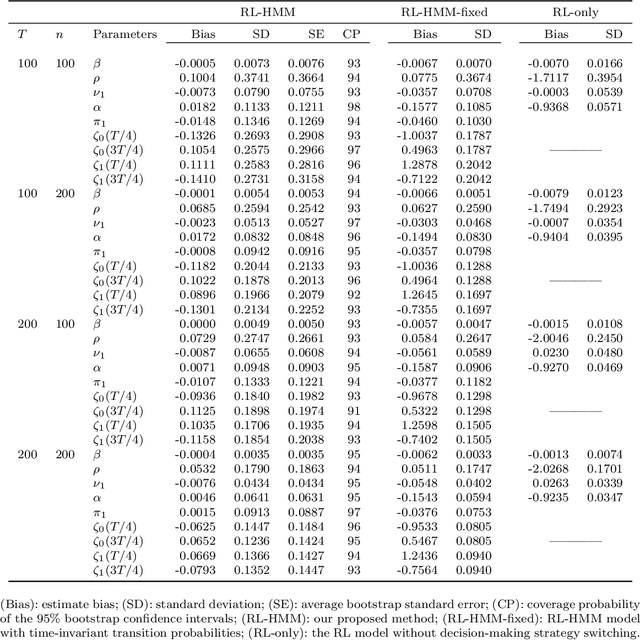


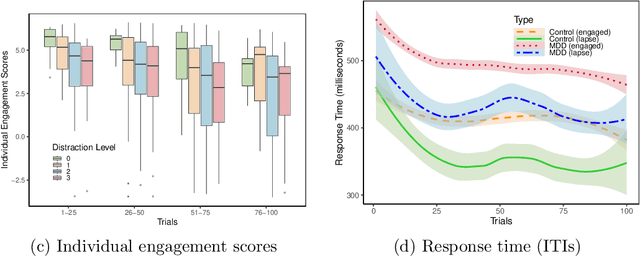
Major depressive disorder (MDD) presents challenges in diagnosis and treatment due to its complex and heterogeneous nature. Emerging evidence indicates that reward processing abnormalities may serve as a behavioral marker for MDD. To measure reward processing, patients perform computer-based behavioral tasks that involve making choices or responding to stimulants that are associated with different outcomes. Reinforcement learning (RL) models are fitted to extract parameters that measure various aspects of reward processing to characterize how patients make decisions in behavioral tasks. Recent findings suggest the inadequacy of characterizing reward learning solely based on a single RL model; instead, there may be a switching of decision-making processes between multiple strategies. An important scientific question is how the dynamics of learning strategies in decision-making affect the reward learning ability of individuals with MDD. Motivated by the probabilistic reward task (PRT) within the EMBARC study, we propose a novel RL-HMM framework for analyzing reward-based decision-making. Our model accommodates learning strategy switching between two distinct approaches under a hidden Markov model (HMM): subjects making decisions based on the RL model or opting for random choices. We account for continuous RL state space and allow time-varying transition probabilities in the HMM. We introduce a computationally efficient EM algorithm for parameter estimation and employ a nonparametric bootstrap for inference. We apply our approach to the EMBARC study to show that MDD patients are less engaged in RL compared to the healthy controls, and engagement is associated with brain activities in the negative affect circuitry during an emotional conflict task.