 Add to Chrome
 Add to Firefox
 Add to Edge
Weighted Bayesian Conformal Prediction
Apr 07, 2026
Conformal prediction provides distribution-free prediction intervals with finite-sample coverage guarantees, and recent work by Snell \& Griffiths reframes it as Bayesian Quadrature (BQ-CP), yielding powerful data-conditional guarantees via Dirichlet posteriors over thresholds. However, BQ-CP fundamentally requires the i.i.d. assumption -- a limitation the authors themselves identify. Meanwhile, weighted conformal prediction handles distribution shift via importance weights but remains frequentist, producing only point-estimate thresholds. We propose \textbf{Weighted Bayesian Conformal Prediction (WBCP)}, which generalizes BQ-CP to arbitrary importance-weighted settings by replacing the uniform Dirichlet $\Dir(1,\ldots,1)$ with a weighted Dirichlet $\Dir(\neff \cdot \tilde{w}_1, \ldots, \neff \cdot \tilde{w}_n)$, where $\neff$ is Kish's effective sample size. We prove four theoretical results: (1)~$\neff$ is the unique concentration parameter matching frequentist and Bayesian variances; (2)~posterior standard deviation decays as $O(1/\sqrt{\neff})$; (3)~BQ-CP's stochastic dominance guarantee extends to per-weight-profile data-conditional guarantees; (4)~the HPD threshold provides $O(1/\sqrt{\neff})$ improvement in conditional coverage. We instantiate WBCP for spatial prediction as \emph{Geographical BQ-CP}, where kernel-based spatial weights yield per-location posteriors with interpretable diagnostics. Experiments on synthetic and real-world spatial datasets demonstrate that WBCP maintains coverage guarantees while providing substantially richer uncertainty information.

GeoConformal prediction: a model-agnostic framework of measuring the uncertainty of spatial prediction
Dec 05, 2024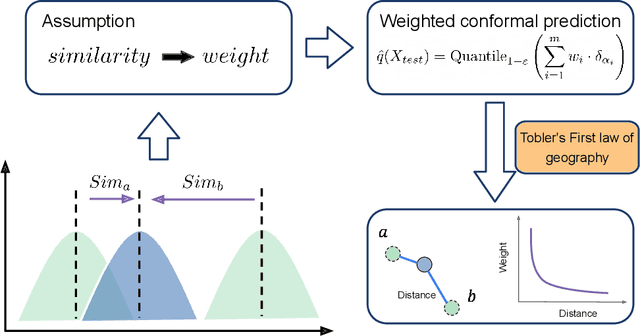
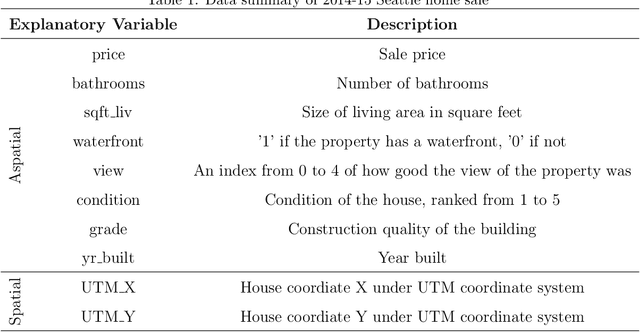
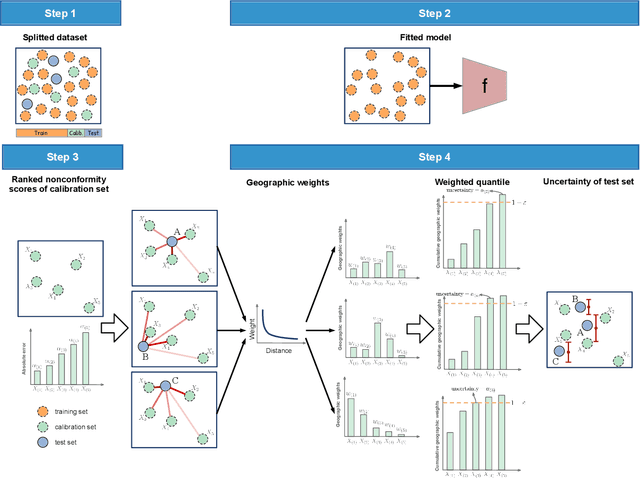
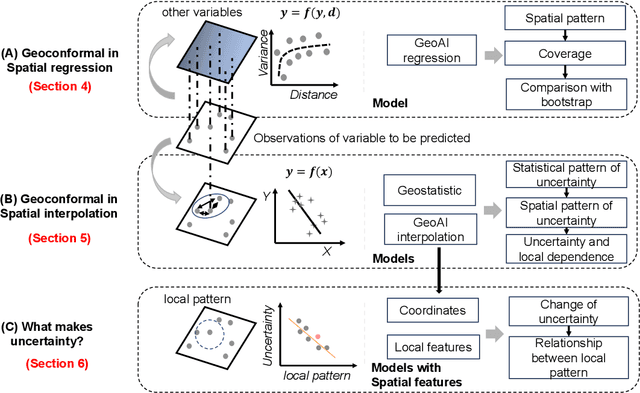
Spatial prediction is a fundamental task in geography. In recent years, with advances in geospatial artificial intelligence (GeoAI), numerous models have been developed to improve the accuracy of geographic variable predictions. Beyond achieving higher accuracy, it is equally important to obtain predictions with uncertainty measures to enhance model credibility and support responsible spatial prediction. Although geostatistic methods like Kriging offer some level of uncertainty assessment, such as Kriging variance, these measurements are not always accurate and lack general applicability to other spatial models. To address this issue, we propose a model-agnostic uncertainty assessment method called GeoConformal Prediction, which incorporates geographical weighting into conformal prediction. We applied it to two classic spatial prediction cases, spatial regression and spatial interpolation, to evaluate its reliability. First, in the spatial regression case, we used XGBoost to predict housing prices, followed by GeoConformal to calculate uncertainty. Our results show that GeoConformal achieved a coverage rate of 93.67%, while Bootstrap methods only reached a maximum coverage of 68.33% after 2000 runs. Next, we applied GeoConformal to spatial interpolation models. We found that the uncertainty obtained from GeoConformal aligned closely with the variance in Kriging. Finally, using GeoConformal, we analyzed the sources of uncertainty in spatial prediction. We found that explicitly including local features in AI models can significantly reduce prediction uncertainty, especially in areas with strong local dependence. Our findings suggest that GeoConformal holds potential not only for geographic knowledge discovery but also for guiding the design of future GeoAI models, paving the way for more reliable and interpretable spatial prediction frameworks.