 Add to Chrome
 Add to Firefox
 Add to Edge
SplineNet: An Isogeometric Deep Learning Method for Complex Shells
Jul 07, 2026
We present a novel isogeometric deep learning method, termed SplineNet, for the seamless design and analysis of shell structures with complex geometries. The proposed approach is built upon watertight spline representations, e.g., analysis-suitable unstructured T-splines, and features exact geometric descriptions of Computer-Aided Design (CAD) models in neural networks. Bézier extraction is used to build the network architecture, where Bernstein polynomials serve as the nonlinear activation functions. SplineNet can be applied in a data-free or data-driven way. In the data-free case, energy-based formulations can be naturally incorporated as loss terms, which fulfill the need of Computer-Aided Engineering (CAE) and can be accurately calculated. In particular, the Kirchhoff--Love (KL) model is adopted to solve for the mechanical behaviors of shell structures. This way, CAD and CAE can be tightly integrated in a deep neural network without the time-consuming model/data exchange process. In the data-driven case, SplineNet can be used as the trunk net of Deep Operator Networks (DeepONet) to provide interpretability. Given such a trained network and unseen input data, results can be immediately obtained without retraining the network or repeatedly performing the traditional workflow for analysis. In the end, a variety of numerical examples are studied to demonstrate the effectiveness of the proposed method, especially when real-world complex geometries are involved.

eCNNTO: A Highly Generalizable ConvNet for Accelerating Topology Optimization
Jun 18, 2026This work proposes an element-based Convolutional Neural Network (CNN) to accelerate density-based Topology Optimization (TO), termed eCNNTO. TO generally undergoes a large number of iterations, where finite element analysis is performed in every iteration, leading to the efficiency bottleneck especially when dense meshes are used to achieve high-resolution designs. To address this limitation, eCNNTO is proposed to build upon Kallioras et al. (2020), where a Deep Belief Network (DBN) was trained for every element to predict its near-optimal density from its early history, thereby skipping the great majority of iterations and significantly accelerating the TO procedure. However, the method lacks spatial correlations among neighboring elements and may lead to disconnected features in the final structure. The proposed method employs CNN with residual connections to address this issue. On top of it, a novel training strategy is introduced to further enhance the optimization efficiency, where the training dataset consists of the final stage density histories rather than early ones. This change can also help reduce the required training data size. eCNNTO requires only a small dataset to train and yet it can be generalized to problems with largely different boundary conditions, loading cases, design domain geometries, mesh resolutions, as well as non-design domains. In the end, the generalization capabilities and efficiency of eCNNTO are demonstrated through a variety of examples in two and three dimensions, achieving up to 90% and 97% reduction of iterations, respectively.
PolyCrysDiff: Controllable Generation of Three-Dimensional Computable Polycrystalline Material Structures
Mar 12, 2026The three-dimensional (3D) microstructures of polycrystalline materials exert a critical influence on their mechanical and physical properties. Realistic, controllable construction of these microstructures is a key step toward elucidating structure-property relationships, yet remains a formidable challenge. Herein, we propose PolyCrysDiff, a framework based on conditional latent diffusion that enables the end-to-end generation of computable 3D polycrystalline microstructures. Comprehensive qualitative and quantitative evaluations demonstrate that PolyCrysDiff faithfully reproduces target grain morphologies, orientation distributions, and 3D spatial correlations, while achieving an $R^2$ over 0.972 on grain attributes (e.g., size and sphericity) control, thereby outperforming mainstream approaches such as Markov random field (MRF)- and convolutional neural network (CNN)-based methods. The computability and physical validity of the generated microstructures are verified through a series of crystal plasticity finite element method (CPFEM) simulations. Leveraging PolyCrysDiff's controllable generative capability, we systematically elucidate how grain-level microstructural characteristics affect the mechanical properties of polycrystalline materials. This development is expected to pave a key step toward accelerated, data-driven optimization and design of polycrystalline materials.
Small-Footprint Keyword Spotting with Multi-Scale Temporal Convolution
Oct 20, 2020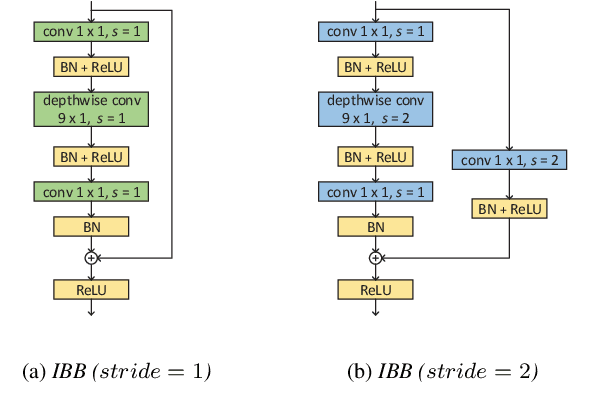
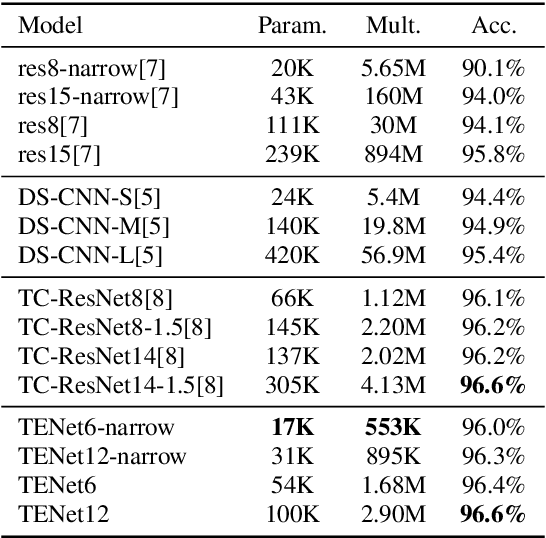
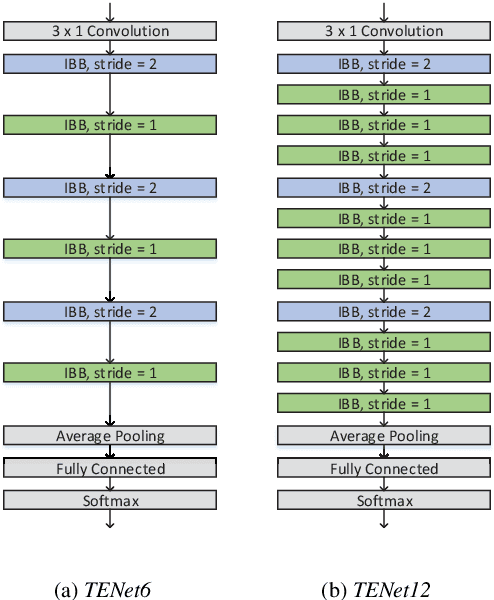
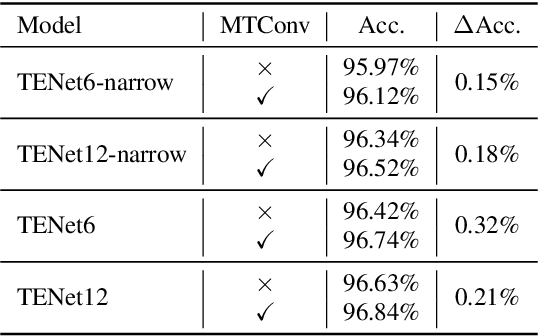
Keyword Spotting (KWS) plays a vital role in human-computer interaction for smart on-device terminals and service robots. It remains challenging to achieve the trade-off between small footprint and high accuracy for KWS task. In this paper, we explore the application of multi-scale temporal modeling to the small-footprint keyword spotting task. We propose a multi-branch temporal convolution module (MTConv), a CNN block consisting of multiple temporal convolution filters with different kernel sizes, which enriches temporal feature space. Besides, taking advantage of temporal and depthwise convolution, a temporal efficient neural network (TENet) is designed for KWS system. Based on the purposed model, we replace standard temporal convolution layers with MTConvs that can be trained for better performance. While at the inference stage, the MTConv can be equivalently converted to the base convolution architecture, so that no extra parameters and computational costs are added compared to the base model. The results on Google Speech Command Dataset show that one of our models trained with MTConv performs the accuracy of 96.8% with only 100K parameters.