 Add to Chrome
 Add to Firefox
 Add to Edge
Phonemes vs. Projectors: An Investigation of Speech-Language Interfaces for LLM-based ASR
Apr 10, 2026
Integrating pretrained speech encoders with large language models (LLMs) is promising for ASR, but performance and data efficiency depend on the speech-language interface. A common choice is a learned projector that maps encoder features into the LLM embedding space, whereas an alternative is to expose discrete phoneme sequences to the LLM. Using the same encoder and LLM backbones, we compare phoneme-based and vanilla projector-based interfaces in high-resource English and low-resource Tatar. We also propose a BPE-phoneme interface that groups frequent local phoneme patterns while preserving explicit word-boundary cues for phoneme-to-grapheme generation. On LibriSpeech, the phoneme-based interface is competitive with the vanilla projector, and the BPE-phoneme interface yields further gains. On Tatar, the phoneme-based interface substantially outperforms the vanilla projector. We further find that phoneme supervision yields a phoneme-informed hybrid interface that is stronger than the vanilla projector.

Advancing LLM-based phoneme-to-grapheme for multilingual speech recognition
Mar 31, 2026Phoneme-based ASR factorizes recognition into speech-to-phoneme (S2P) and phoneme-to-grapheme (P2G), enabling cross-lingual acoustic sharing while keeping language-specific orthography in a separate module. While large language models (LLMs) are promising for P2G, multilingual P2G remains challenging due to language-aware generation and severe cross-language data imbalance. We study multilingual LLM-based P2G on the ten-language CV-Lang10 benchmark. We examine robustness strategies that account for S2P uncertainty, including DANP and Simplified SKM (S-SKM). S-SKM is a Monte Carlo approximation that avoids CTC-based S2P probability weighting in P2G training. Robust training and low-resource oversampling reduce the average WER from 10.56% to 7.66%.
Improving End-to-End Training of Retrieval-Augmented Generation Models via Joint Stochastic Approximation
Aug 25, 2025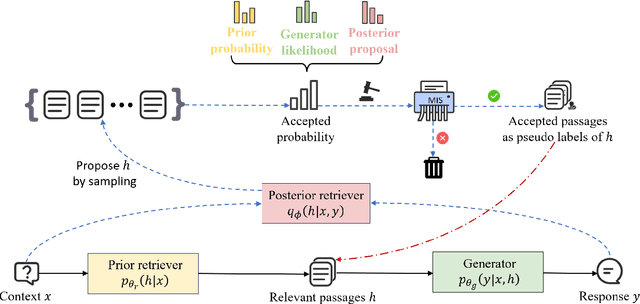
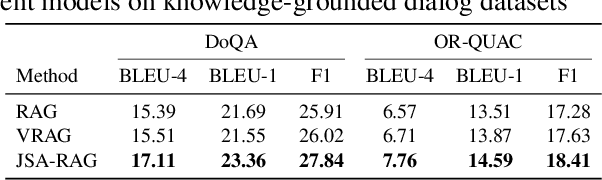
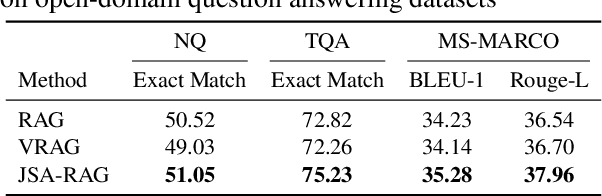
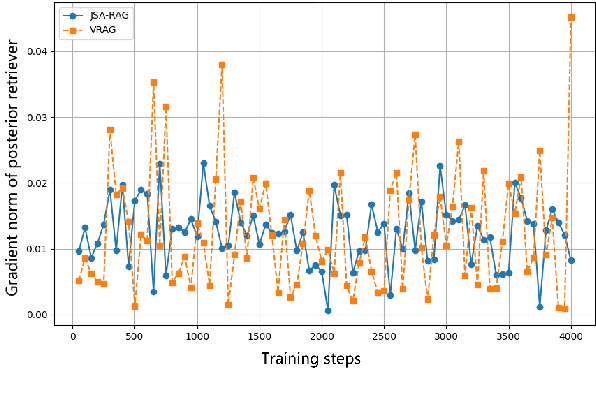
Retrieval-augmented generation (RAG) has become a widely recognized paradigm to combine parametric memory with non-parametric memories. An RAG model consists of two serial connecting components (retriever and generator). A major challenge in end-to-end optimization of the RAG model is that marginalization over relevant passages (modeled as discrete latent variables) from a knowledge base is required. Traditional top-K marginalization and variational RAG (VRAG) suffer from biased or high-variance gradient estimates. In this paper, we propose and develop joint stochastic approximation (JSA) based end-to-end training of RAG, which is referred to as JSA-RAG. The JSA algorithm is a stochastic extension of the EM (expectation-maximization) algorithm and is particularly powerful in estimating discrete latent variable models. Extensive experiments are conducted on five datasets for two tasks (open-domain question answering, knowledge-grounded dialogs) and show that JSA-RAG significantly outperforms both vanilla RAG and VRAG. Further analysis shows the efficacy of JSA-RAG from the perspectives of generation, retrieval, and low-variance gradient estimate.
An Empirical Study of Retrieval Augmented Generation with Chain-of-Thought
Jul 22, 2024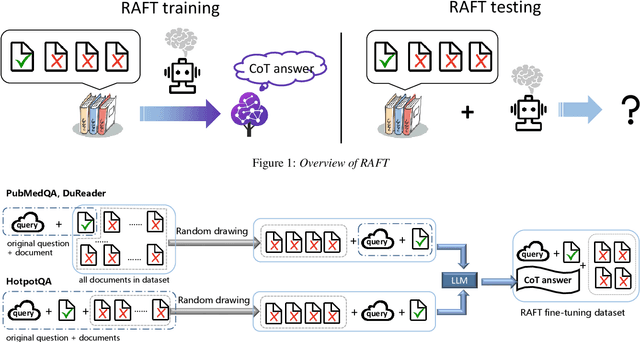


Since the launch of ChatGPT at the end of 2022, generative dialogue models represented by ChatGPT have quickly become essential tools in daily life. As user expectations increase, enhancing the capability of generative dialogue models to solve complex problems has become a focal point of current research. This paper delves into the effectiveness of the RAFT (Retrieval Augmented Fine-Tuning) method in improving the performance of Generative dialogue models. RAFT combines chain-of-thought with model supervised fine-tuning (SFT) and retrieval augmented generation (RAG), which significantly enhanced the model's information extraction and logical reasoning abilities. We evaluated the RAFT method across multiple datasets and analysed its performance in various reasoning tasks, including long-form QA and short-form QA tasks, tasks in both Chinese and English, and supportive and comparison reasoning tasks. Notably, it addresses the gaps in previous research regarding long-form QA tasks and Chinese datasets. Moreover, we also evaluate the benefit of the chain-of-thought (CoT) in the RAFT method. This work offers valuable insights for studies focused on enhancing the performance of generative dialogue models.