 Add to Chrome
 Add to Firefox
 Add to Edge
Unifying Optimization and Dynamics to Parallelize Sequential Computation: A Guide to Parallel Newton Methods for Breaking Sequential Bottlenecks
Mar 17, 2026
Massively parallel hardware (GPUs) and long sequence data have made parallel algorithms essential for machine learning at scale. Yet dynamical systems, like recurrent neural networks and Markov chain Monte Carlo, were thought to suffer from sequential bottlenecks. Recent work showed that dynamical systems can in fact be parallelized across the sequence length by reframing their evaluation as a system of nonlinear equations, which can be solved with Newton's method using a parallel associative scan. However, these parallel Newton methods struggled with limitations, primarily inefficiency, instability, and lack of convergence guarantees. This thesis addresses these limitations with methodological and theoretical contributions, drawing particularly from optimization. Methodologically, we develop scalable and stable parallel Newton methods, based on quasi-Newton and trust-region approaches. The quasi-Newton methods are faster and more memory efficient, while the trust-region approaches are significantly more stable. Theoretically, we unify many fixed-point methods into our parallel Newton framework, including Picard and Jacobi iterations. We establish a linear convergence rate for these techniques that depends on the method's approximation accuracy and stability. Moreover, we give a precise condition, rooted in dynamical stability, that characterizes when parallelization provably accelerates a dynamical system and when it cannot. Specifically, the sign of the Largest Lyapunov Exponent of a dynamical system determines whether or not parallel Newton methods converge quickly. In sum, this thesis unlocks scalable and stable methods for parallelizing sequential computation, and provides a firm theoretical basis for when such techniques will and will not work. This thesis also serves as a guide to parallel Newton methods for researchers who want to write the next chapter in this ongoing story.

Towards Scalable and Stable Parallelization of Nonlinear RNNs
Jul 26, 2024
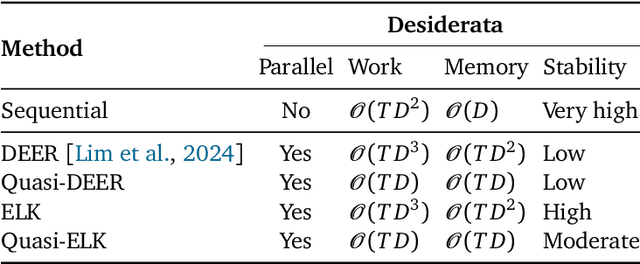
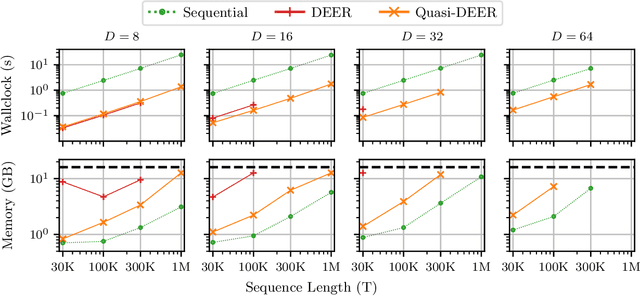
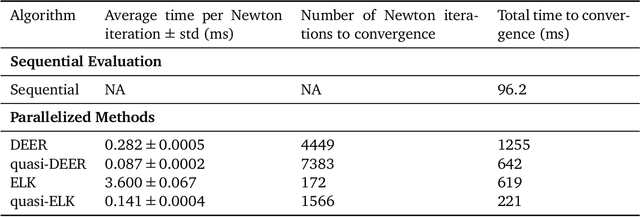
Conventional nonlinear RNNs are not naturally parallelizable across the sequence length, whereas transformers and linear RNNs are. Lim et al. [2024] therefore tackle parallelized evaluation of nonlinear RNNs by posing it as a fixed point problem, solved with Newton's method. By deriving and applying a parallelized form of Newton's method, they achieve huge speedups over sequential evaluation. However, their approach inherits cubic computational complexity and numerical instability. We tackle these weaknesses. To reduce the computational complexity, we apply quasi-Newton approximations and show they converge comparably to full-Newton, use less memory, and are faster. To stabilize Newton's method, we leverage a connection between Newton's method damped with trust regions and Kalman smoothing. This connection allows us to stabilize Newtons method, per the trust region, while using efficient parallelized Kalman algorithms to retain performance. We compare these methods empirically, and highlight the use cases where each algorithm excels.