 Add to Chrome
 Add to Firefox
 Add to Edge
Using a Digital Twin for Fringe Projection Profilometry Optimisation
May 18, 2026
Fringe projection profilometry (FPP) is a widely used technique for measuring object surface form and three-dimensional (3D) geometry, capable of delivering high-precision, high-resolution measurements when paired with suitable cameras and projectors. However, in practical deployments, identifying parameter configurations that maximise precision while satisfying real-world constraints remains challenging. To address this, we present an automated digital twin framework implemented in Blender, an open-source 3D software package that provides a ray-traced rendering environment that enables accurate simulation of physical systems. We replicated the physical setup in our digital twin by matching characterisation quality, gamma response, and characterisation images. Accurate system characterisation using Zhang's method [1], to obtain intrinsic and extrinsic parameters, is shown to be critical for achieving high precision. Using this digital twin, we then demonstrate systematic exploration and optimisation of key parameters, including phase-shift count, camera-projector spacing, and fringe density. These parameters span both system geometry (e.g. camera-projector positioning) and algorithmic choices, such as 2D phase-shifting and unwrapping methods [2]. Three measurement artefacts, representative of real world metrology scenarios, were used to benchmark the system. The symmetrical mean Chamfer distance (SMCD), computed between ground-truth and reconstructed meshes, was used to evaluate reconstruction quality. After optimisation within the digital twin, transferring the optimal parameters to the physical system reduced the number of required images per measurement by 48% (from 36 to 21). A reduction of 74.0% mean SMCD was also achieved for fringe pattern stripe count alteration. A 36.9% mean SMCD was obtained for adjusting the camera and projector spacing purely in the digital-twin.

Estimation of stellar atmospheric parameters from LAMOST DR8 low-resolution spectra with 20$\leq$SNR$<$30
Apr 13, 2022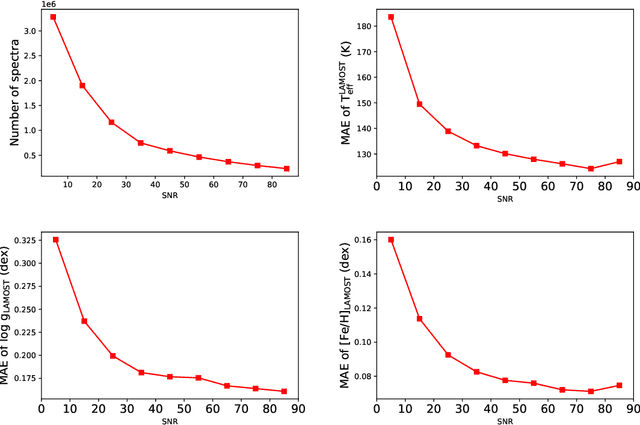
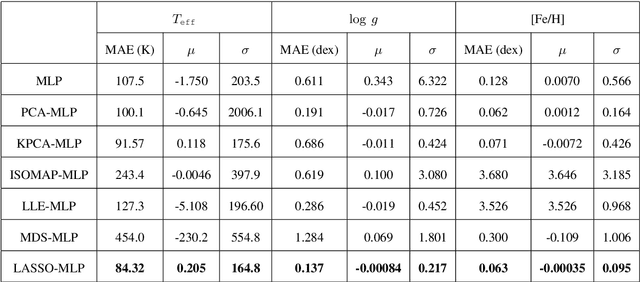

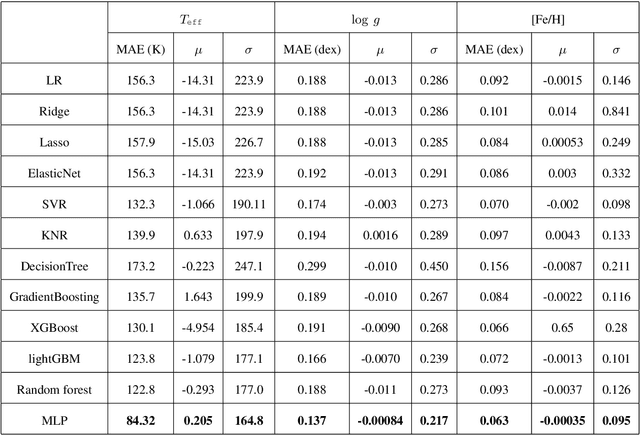
The accuracy of the estimated stellar atmospheric parameter decreases evidently with the decreasing of spectral signal-to-noise ratio (SNR) and there are a huge amount of this kind observations, especially in case of SNR$<$30. Therefore, it is helpful to improve the parameter estimation performance for these spectra and this work studied the ($T_\texttt{eff}, \log~g$, [Fe/H]) estimation problem for LAMOST DR8 low-resolution spectra with 20$\leq$SNR$<$30. We proposed a data-driven method based on machine learning techniques. Firstly, this scheme detected stellar atmospheric parameter-sensitive features from spectra by the Least Absolute Shrinkage and Selection Operator (LASSO), rejected ineffective data components and irrelevant data. Secondly, a Multi-layer Perceptron (MLP) method was used to estimate stellar atmospheric parameters from the LASSO features. Finally, the performance of the LASSO-MLP was evaluated by computing and analyzing the consistency between its estimation and the reference from the APOGEE (Apache Point Observatory Galactic Evolution Experiment) high-resolution spectra. Experiments show that the Mean Absolute Errors (MAE) of $T_\texttt{eff}, \log~g$, [Fe/H] are reduced from the LASP (137.6 K, 0.195 dex, 0.091 dex) to LASSO-MLP (84.32 K, 0.137 dex, 0.063 dex), which indicate evident improvements on stellar atmospheric parameter estimation. In addition, this work estimated the stellar atmospheric parameters for 1,162,760 low-resolution spectra with 20$\leq$SNR$<$30 from LAMOST DR8 using LASSO-MLP, and released the estimation catalog, learned model, experimental code, trained model, training data and test data for scientific exploration and algorithm study.
* 16 pages, 6 figures, 4 tables