 Add to Chrome
 Add to Firefox
 Add to Edge
Fully Trainable Deep Differentiable Logic Gate Networks and Lookup Table Networks
Jul 10, 2026
We introduce a novel method for both partial and full optimization of the connections in deep differentiable logic gate networks (LGNs) and lookup table networks (LUTNs). Our training method utilizes a probability distribution over a set of connections per gate/lookup table (LUT) input pin, selecting the connection with highest merit, all whilst the optimal gate types or LUT-entries are learned in parallel. We show that the connection-optimized LGNs outperform standard fixed-connection LGNs on the Yin-Yang, MNIST Handwritten Digits and Fashion-MNIST benchmarks, while requiring only a fraction of the number of logic gates. We achieve 98.92% on the MNIST dataset with two layers of 8000 gates. With only one layer of 8000 gates, we obtain 98.45%, showing that our method requires almost 50 times fewer gates compared to fixed-connection LGNs. Training stability up to ten layers has been ensured by employing a high learning rate, straight-through estimators and trimming constant-output gate types. Additionally, we present a LUT neuron description that enables stable training with backpropagation, tested up to 6-layer deep networks. The model requires four times fewer trainable parameters and still achieves a higher accuracy compared to the fixed-connection LGN training algorithm. Our connection-training algorithm also works well for the LUTNs, achieving an accuracy of 98.88% for two layers of 2000 6-input LUTs.

Inter-patient ECG Arrhythmia Classification with LGNs and LUTNs
Jan 16, 2026Deep Differentiable Logic Gate Networks (LGNs) and Lookup Table Networks (LUTNs) are demonstrated to be suitable for the automatic classification of electrocardiograms (ECGs) using the inter-patient paradigm. The methods are benchmarked using the MIT-BIH arrhythmia data set, achieving up to 94.28% accuracy and a $jκ$ index of 0.683 on a four-class classification problem. Our models use between 2.89k and 6.17k FLOPs, including preprocessing and readout, which is three to six orders of magnitude less compared to SOTA methods. A novel preprocessing method is utilized that attains superior performance compared to existing methods for both the mixed-patient and inter-patient paradigms. In addition, a novel method for training the Lookup Tables (LUTs) in LUTNs is devised that uses the Boolean equation of a multiplexer (MUX). Additionally, rate coding was utilized for the first time in these LGNs and LUTNs, enhancing the performance of LGNs. Furthermore, it is the first time that LGNs and LUTNs have been benchmarked on the MIT-BIH arrhythmia dataset using the inter-patient paradigm. Using an Artix 7 FPGA, between 2000 and 2990 LUTs were needed, and between 5 to 7 mW (i.e. 50 pJ to 70 pJ per inference) was estimated for running these models. The performance in terms of both accuracy and $jκ$-index is significantly higher compared to previous LGN results. These positive results suggest that one can utilize LGNs and LUTNs for the detection of arrhythmias at extremely low power and high speeds in heart implants or wearable devices, even for patients not included in the training set.
A Method for Optimizing Connections in Differentiable Logic Gate Networks
Jul 08, 2025We introduce a novel method for partial optimization of the connections in Deep Differentiable Logic Gate Networks (LGNs). Our training method utilizes a probability distribution over a subset of connections per gate input, selecting the connection with highest merit, after which the gate-types are selected. We show that the connection-optimized LGNs outperform standard fixed-connection LGNs on the Yin-Yang, MNIST and Fashion-MNIST benchmarks, while requiring only a fraction of the number of logic gates. When training all connections, we demonstrate that 8000 simple logic gates are sufficient to achieve over 98% on the MNIST data set. Additionally, we show that our network has 24 times fewer gates, while performing better on the MNIST data set compared to standard fully connected LGNs. As such, our work shows a pathway towards fully trainable Boolean logic.
Resource-Efficient Gesture Recognition using Low-Resolution Thermal Camera via Spiking Neural Networks and Sparse Segmentation
Jan 12, 2024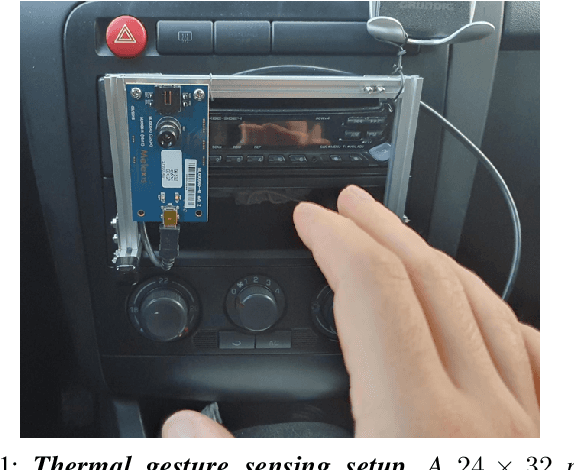
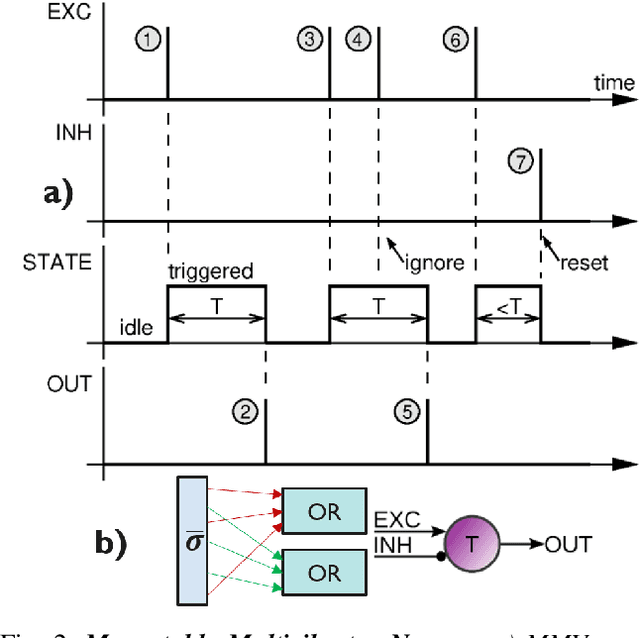
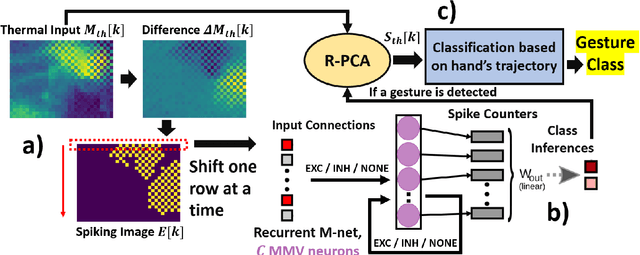
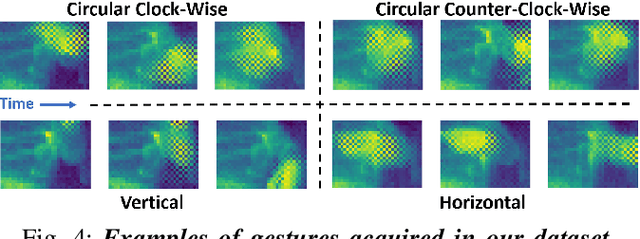
This work proposes a novel approach for hand gesture recognition using an inexpensive, low-resolution (24 x 32) thermal sensor processed by a Spiking Neural Network (SNN) followed by Sparse Segmentation and feature-based gesture classification via Robust Principal Component Analysis (R-PCA). Compared to the use of standard RGB cameras, the proposed system is insensitive to lighting variations while being significantly less expensive compared to high-frequency radars, time-of-flight cameras and high-resolution thermal sensors previously used in literature. Crucially, this paper shows that the innovative use of the recently proposed Monostable Multivibrator (MMV) neural networks as a new class of SNN achieves more than one order of magnitude smaller memory and compute complexity compared to deep learning approaches, while reaching a top gesture recognition accuracy of 93.9% using a 5-class thermal camera dataset acquired in a car cabin, within an automotive context. Our dataset is released for helping future research.