 Add to Chrome
 Add to Firefox
 Add to Edge
Barrier-enforced multi-objective optimization for direct point and sharp interval forecasting
Apr 20, 2026
This paper proposes a multi-step probabilistic forecasting framework using a single neural-network based model to generate simultaneous point and interval forecasts. Our approach ensures non-crossing prediction intervals (PIs) through a model structure design that strictly satisfy a target coverage probability (PICP) while maximizing sharpness. Unlike existing methods that rely on manual weight tuning for scalarized loss functions, we treat point and PI forecasting as a multi-objective optimization problem, utilizing multi-gradient descent to adaptively select optimal weights. Key innovations include a new PI loss function based on an extended log-barrier with an adaptive hyperparameter to guarantee the coverage, a hybrid architecture featuring a shared temporal model with horizon-specific submodels, and a training strategy. The proposed loss is scale-independent and universally applicable; combined with our training algorithm, the framework eliminates trial-and-error hyperparameter tuning for balancing multiple objectives. Validated by an intra-day solar irradiance forecasting application, results demonstrate that our proposed loss consistently outperforms those in current literature by achieving target coverage with the narrowest PI widths. Furthermore, when compared against LSTM encoder-decoder and Transformer architectures--including those augmented with Chronos foundation models--our method remains highly competitive and can be seamlessly adapted to any deep learning structure.

Large width penalization for neural network-based prediction interval estimation
Nov 28, 2024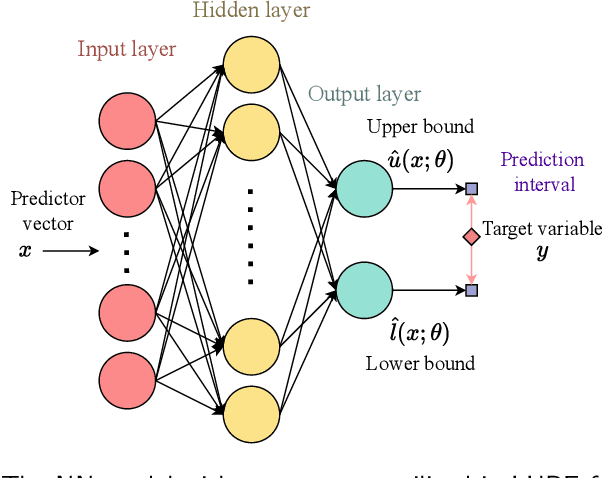
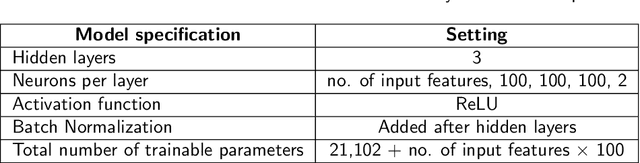
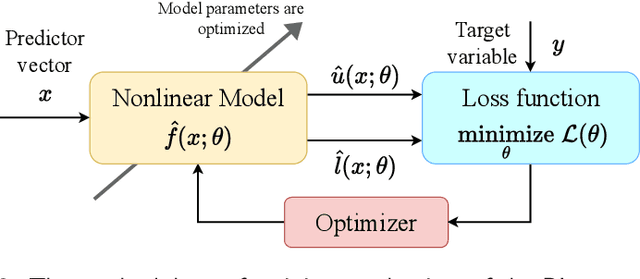
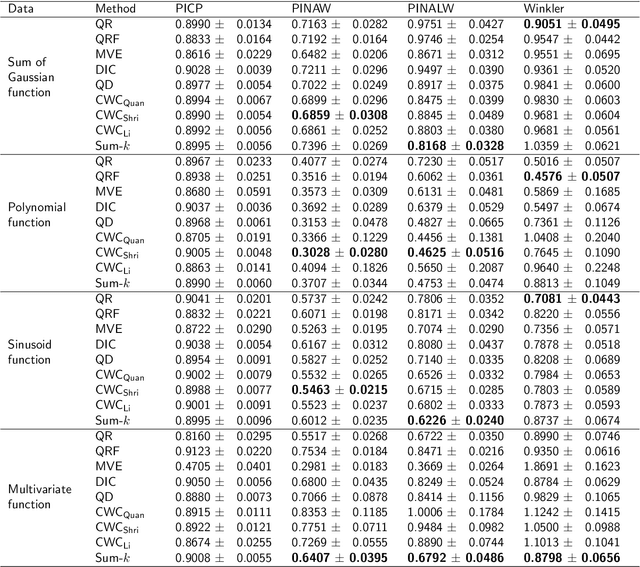
Forecasting accuracy in highly uncertain environments is challenging due to the stochastic nature of systems. Deterministic forecasting provides only point estimates and cannot capture potential outcomes. Therefore, probabilistic forecasting has gained significant attention due to its ability to quantify uncertainty, where one of the approaches is to express it as a prediction interval (PI), that explicitly shows upper and lower bounds of predictions associated with a confidence level. High-quality PI is characterized by a high PI coverage probability (PICP) and a narrow PI width. In many real-world applications, the PI width is generally used in risk management to prepare resources that improve reliability and effectively manage uncertainty. A wider PI width results in higher costs for backup resources as decision-making processes often focus on the worst-case scenarios arising with large PI widths under extreme conditions. This study aims to reduce the large PI width from the PI estimation method by proposing a new PI loss function that penalizes the average of the large PI widths more heavily. The proposed formulation is compatible with gradient-based algorithms, the standard approach to training neural networks (NNs), and integrating state-of-the-art NNs and existing deep learning techniques. Experiments with the synthetic dataset reveal that our formulation significantly reduces the large PI width while effectively maintaining the PICP to achieve the desired probability. The practical implementation of our proposed loss function is demonstrated in solar irradiance forecasting, highlighting its effectiveness in minimizing the large PI width in data with high uncertainty and showcasing its compatibility with more complex neural network models. Therefore, reducing large PI widths from our method can lead to significant cost savings by over-allocation of reserve resources.