 Add to Chrome
 Add to Firefox
 Add to Edge
Segment-driven Structural Induction and Semantic Alignment for Heterogeneous Tabular Representation
Jun 01, 2026
Real-world domains often contain heterogeneous tables whose headers vary while their underlying attribute semantics are shared, making it difficult to induce domain-specialized semantics from table-local evidence alone. Existing encoders model parts of this problem, but often underuse column-level value distributions and apply uniform objectives across attributes with different semantic roles. We propose NAVI, a segment-centric pretraining framework that treats each header-value pair as the unit for aggregating schema-level structural evidence and column-level distributional evidence. We realize this design through Masked Segment Modeling and Entropy-driven Segment Alignment, which jointly enforce structured header-value coupling and semantic alignment across stable and instance-specific attributes. Experiments on heterogeneous in-domain tables show improved reconstruction, semantic consistency, and downstream utility across evaluation settings overall.

QEVA: A Reference-Free Evaluation Metric for Narrative Video Summarization with Multimodal Question Answering
Apr 27, 2026Video-to-text summarization remains underexplored in terms of comprehensive evaluation methods. Traditional n-gram overlap-based metrics and recent large language model (LLM)-based approaches depend heavily on human-written reference summaries, limiting their practicality and sensitivity to nuanced semantic aspects. In this paper, we propose QEVA, a reference-free metric evaluating candidate summaries directly against source videos through multimodal question answering. QEVA assesses summaries along three clear dimensions: Coverage, Factuality, and Chronology. We also introduce MLVU(VS)-Eval, a new annotated benchmark derived from the MLVU dataset, comprising 800 summaries generated from 200 videos using state-of-the-art video-language multimodal models. This dataset establishes a transparent and consistent framework for evaluation. Experimental results demonstrate that QEVA shows higher correlation with human judgments compared to existing approaches, as measured by Kendall's $τ_b$, $τ_c$, and Spearman's $ρ$. We hope that our benchmark and metric will facilitate meaningful progress in video-to-text summarization research and provide valuable insights for the development of future evaluation methods.
Visual Funnel: Resolving Contextual Blindness in Multimodal Large Language Models
Dec 11, 2025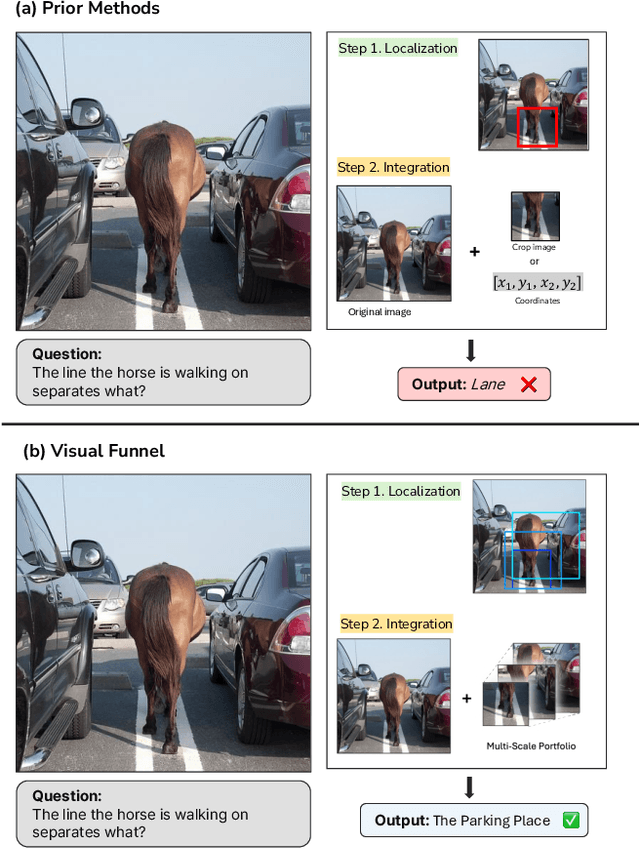
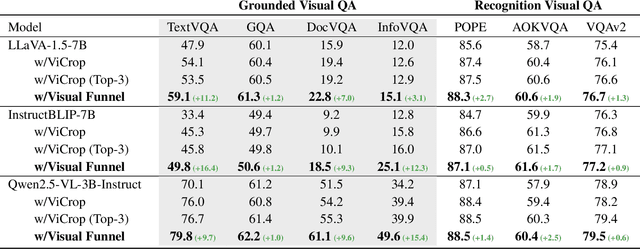
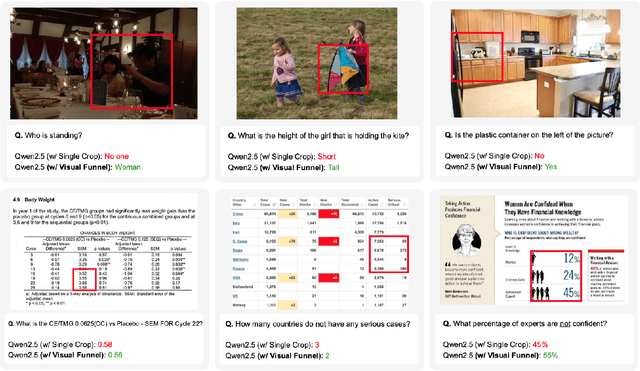
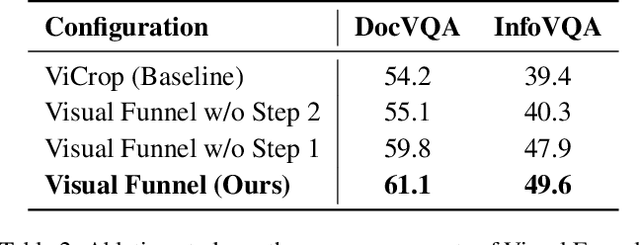
Multimodal Large Language Models (MLLMs) demonstrate impressive reasoning capabilities, but often fail to perceive fine-grained visual details, limiting their applicability in precision-demanding tasks. While methods that crop salient regions of an image offer a partial solution, we identify a critical limitation they introduce: "Contextual Blindness". This failure occurs due to structural disconnect between high-fidelity details (from the crop) and the broader global context (from the original image), even when all necessary visual information is present. We argue that this limitation stems not from a lack of information 'Quantity', but from a lack of 'Structural Diversity' in the model's input. To resolve this, we propose Visual Funnel, a training-free, two-step approach. Visual Funnel first performs Contextual Anchoring to identify the region of interest in a single forward pass. It then constructs an Entropy-Scaled Portfolio that preserves the hierarchical context - ranging from focal detail to broader surroundings - by dynamically determining crop sizes based on attention entropy and refining crop centers. Through extensive experiments, we demonstrate that Visual Funnel significantly outperforms naive single-crop and unstructured multi-crop baselines. Our results further validate that simply adding more unstructured crops provides limited or even detrimental benefits, confirming that the hierarchical structure of our portfolio is key to resolving Contextual Blindness.