 Add to Chrome
 Add to Firefox
 Add to Edge
SemanticDialect: Semantic-Aware Mixed-Format Quantization for Video Diffusion Transformers
Mar 03, 2026
Diffusion Transformers (DiT) achieve strong video generation quality, but their memory and compute costs hinder edge deployment. Quantization can reduce these costs, yet existing methods often degrade video quality under high activation variation and the need to preserve semantic/temporal coherence. We propose SemanticDialect, which advances recent block-wise mixed-format quantization-selecting a per-block optimal format (a dialect) from multiple candidates (a formatbook)-by scaling the formatbook with lookup tables for quantization error and quantized values, enabling efficient per-block format selection and quantization at low online cost. We also introduce activation decomposition that reduces quantization error by re-quantizing and adding back residual errors, with attention-guided salient token selection. We further propose semantic-aware dialect assignment (SeDA) to improve quantized value consistency by sharing a sub-formatbook among semantically correlated tokens. Experiments on video DiT (VDiT) models show that SemanticDialect outperforms prior VDiT quantization methods and fine-grained block-wise format baselines, while approaching FP16 quality on Open-Sora 2.0.

BlockDialect: Block-wise Fine-grained Mixed Format for Energy-Efficient LLM Inference
Jan 03, 2025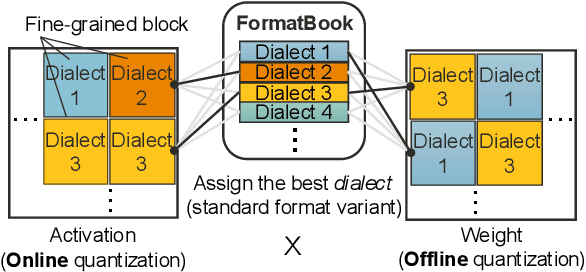
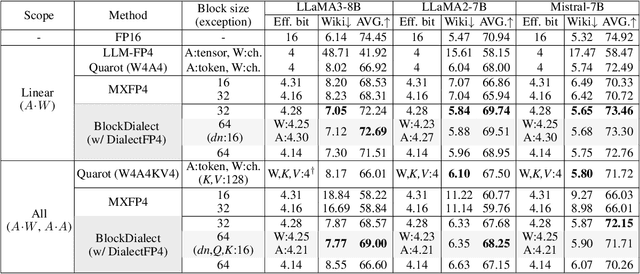
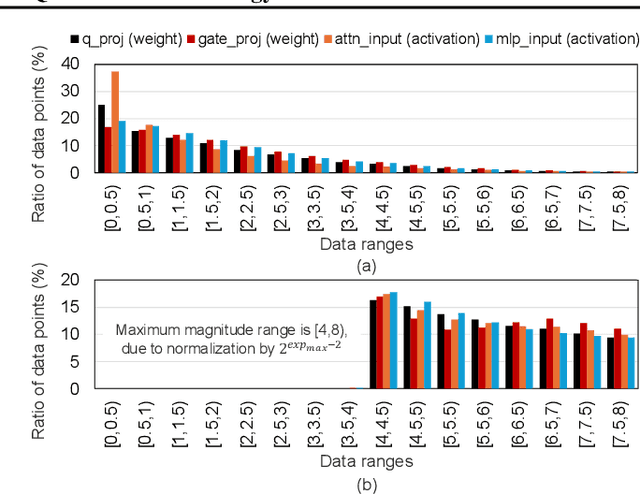
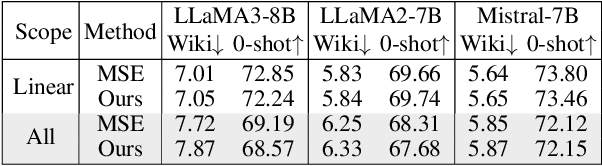
Large Language Models (LLMs) have achieved remarkable success, but their increasing size poses significant challenges in memory usage and computational costs. Quantizing both weights and activations can address these issues, with fine-grained block-wise quantization emerging as a promising hardware-supported solution to mitigate outliers. However, existing methods struggle to capture nuanced block data distributions. To address this, we propose BlockDialect, a block-wise fine-grained mixed format technique that assigns a per-block optimal number format from formatbook for better data representation. Additionally, we introduce DialectFP4, a formatbook of FP4 variants (akin to dialects) that adapt to diverse data distributions. To leverage this efficiently, we propose a two-stage approach for online DialectFP4 activation quantization. Importantly, DialectFP4 ensures hardware efficiency by selecting representable values as scaled integers compatible with low-precision integer arithmetic. BlockDialect achieves 11.83% (7.56%) accuracy gain on the LLaMA3-8B (LLaMA2-7B) model compared to MXFP4 format with lower bit usage per data, while being only 5.46% (2.65%) below full precision even when quantizing full-path matrix multiplication. Focusing on how to represent over how to scale, our work presents a promising path for energy-efficient LLM inference.