 Add to Chrome
 Add to Firefox
 Add to Edge
Appraisal of a Random Bit Generator Utilizing Smartphone Sensors as Entropy Source
Aug 24, 2022
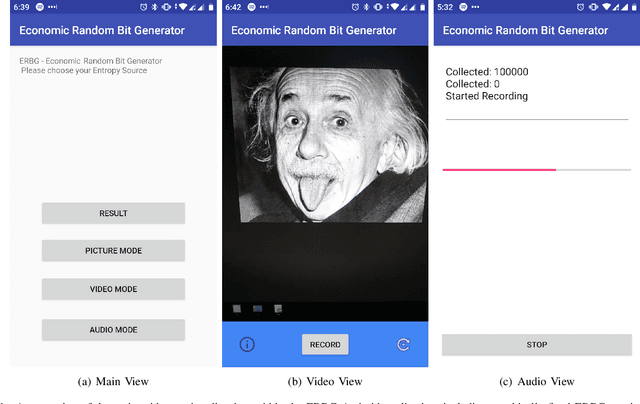
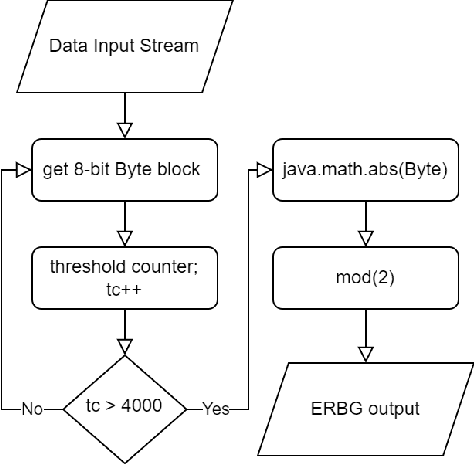
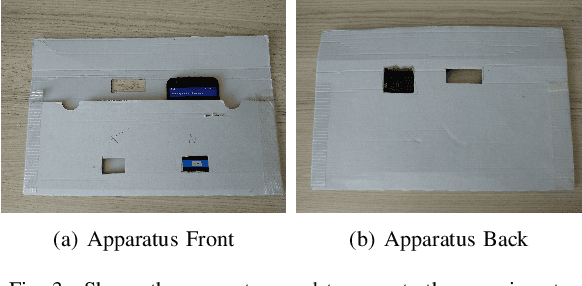
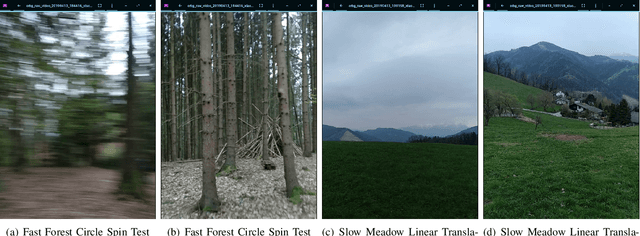
We aim to access entropy sources available within smartphones in order to construct and evaluate a random number generator which is competitive in comparison with existing and proven random number generators. A prototype utilizing the herein proposed algorithm shall generate data that can be tested against the Statistical Test Suit provided by NIST. Although our initial intention of using cosmic radiation failed, we were able to extract randomness from incoming video and audio sources. We found that it is possible to access these sources of entropy utilizing sensors from smartphones resulting in 15 out of 15 successful passed tests within the Statistical Test Suit. We also found that wrong methods of sensor data collection using our prototype eventually generates weak random numbers and fails NIST's Statistical Test Suit. Finally, we suggest that in order to reach the initial goal of providing a smartphone-based true nondeterministic random number generator the detection of muons shall be researched.

Catroid: A Mobile Visual Programming System for Children
Apr 28, 2012


Catroid is a free and open source visual programming language, programming environment, image manipulation program, and website. Catroid allows casual and first-time users starting from age eight to develop their own animations and games solely using their Android phones or tablets. Catroid also allows to wirelessly control external hardware such as Lego Mindstorms robots via Bluetooth, Bluetooth Arduino boards, as well as Parrot's popular and inexpensive AR.Drone quadcopters via WiFi.
A reusable iterative optimization software library to solve combinatorial problems with approximate reasoning
Dec 15, 1998


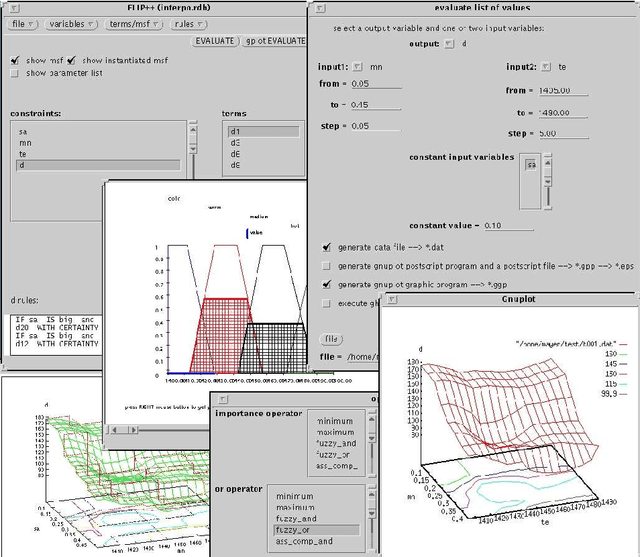
Real world combinatorial optimization problems such as scheduling are typically too complex to solve with exact methods. Additionally, the problems often have to observe vaguely specified constraints of different importance, the available data may be uncertain, and compromises between antagonistic criteria may be necessary. We present a combination of approximate reasoning based constraints and iterative optimization based heuristics that help to model and solve such problems in a framework of C++ software libraries called StarFLIP++. While initially developed to schedule continuous caster units in steel plants, we present in this paper results from reusing the library components in a shift scheduling system for the workforce of an industrial production plant.
* 33 pages, 9 figures; for a project overview see http://www.dbai.tuwien.ac.at/proj/StarFLIP/