 Add to Chrome
 Add to Firefox
 Add to Edge
Joint Sequence Learning and Cross-Modality Convolution for 3D Biomedical Segmentation
Apr 25, 2017
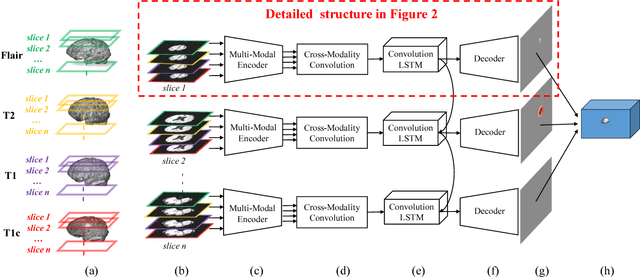

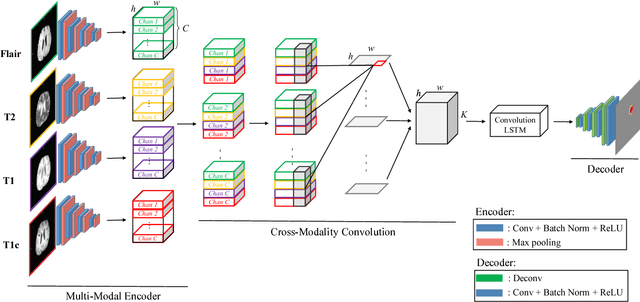
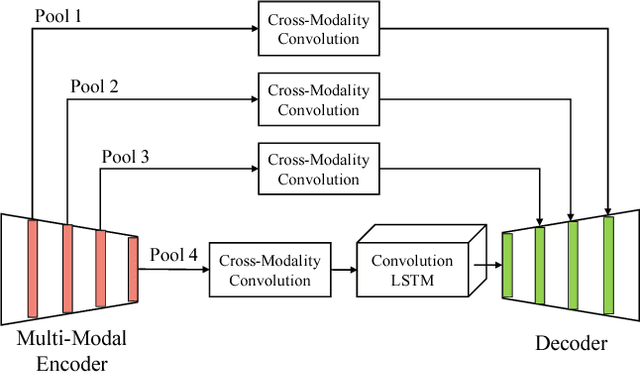
Deep learning models such as convolutional neural net- work have been widely used in 3D biomedical segmentation and achieve state-of-the-art performance. However, most of them often adapt a single modality or stack multiple modalities as different input channels. To better leverage the multi- modalities, we propose a deep encoder-decoder structure with cross-modality convolution layers to incorporate different modalities of MRI data. In addition, we exploit convolutional LSTM to model a sequence of 2D slices, and jointly learn the multi-modalities and convolutional LSTM in an end-to-end manner. To avoid converging to the certain labels, we adopt a re-weighting scheme and two-phase training to handle the label imbalance. Experimental results on BRATS-2015 show that our method outperforms state-of-the-art biomedical segmentation approaches.

We Can "See" You via Wi-Fi - WiFi Action Recognition via Vision-based Methods
Apr 03, 2017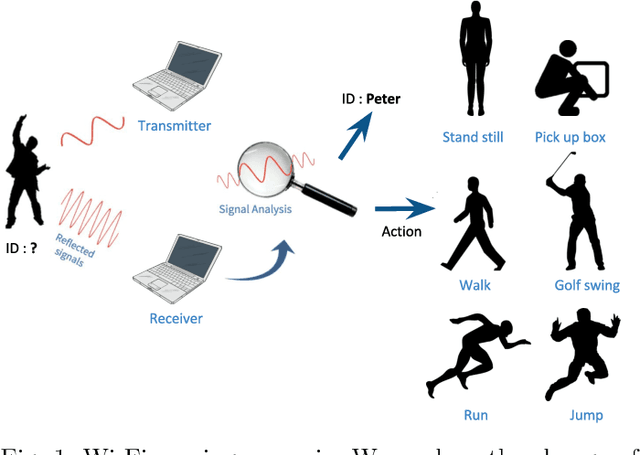
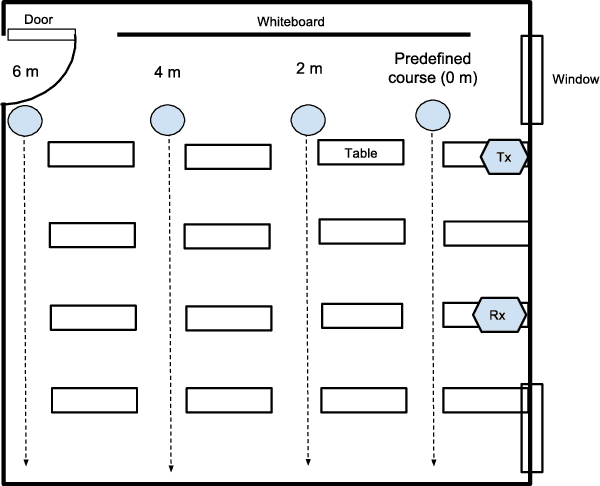

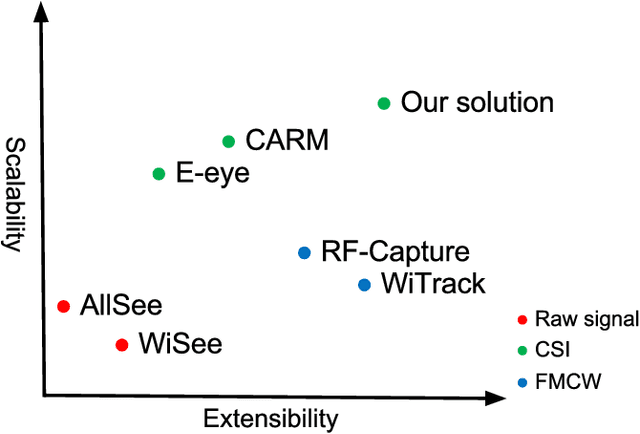
Recently, Wi-Fi has caught tremendous attention for its ubiquity, and, motivated by Wi-Fi's low cost and privacy preservation, researchers have been putting lots of investigation into its potential on action recognition and even person identification. In this paper, we offer an comprehensive overview on these two topics in Wi-Fi. Also, through looking at these two topics from an unprecedented perspective, we could achieve generality instead of designing specific ad-hoc features for each scenario. Observing the great resemblance of Channel State Information (CSI, a fine-grained information captured from the received Wi-Fi signal) to texture, we proposed a brand-new framework based on computer vision methods. To minimize the effect of location dependency embedded in CSI, we propose a novel de-noising method based on Singular Value Decomposition (SVD) to eliminate the background energy and effectively extract the channel information of signals reflected by human bodies. From the experiments conducted, we demonstrate the feasibility and efficacy of the proposed methods. Also, we conclude factors that would affect the performance and highlight a few promising issues that require further deliberation.
Semi-supervised Learning for Convolutional Neural Networks via Online Graph Construction
Jan 19, 2016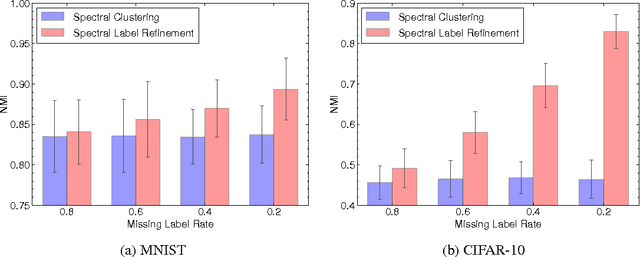
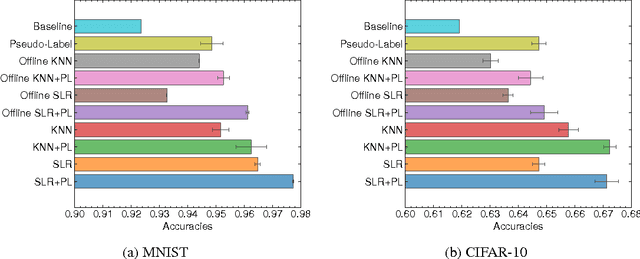
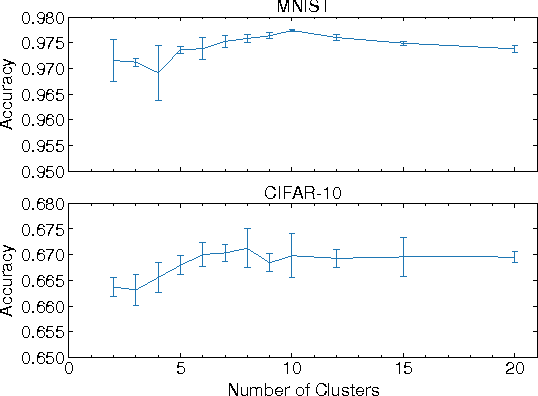
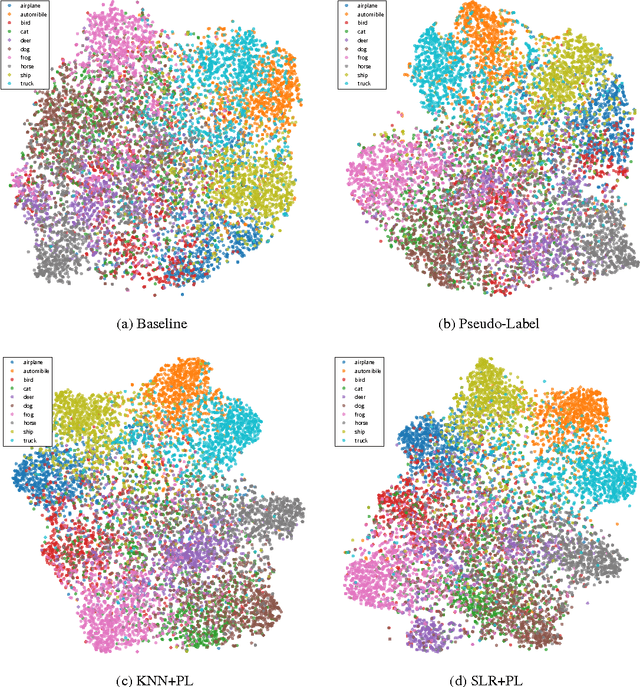
The recent promising achievements of deep learning rely on the large amount of labeled data. Considering the abundance of data on the web, most of them do not have labels at all. Therefore, it is important to improve generalization performance using unlabeled data on supervised tasks with few labeled instances. In this work, we revisit graph-based semi-supervised learning algorithms and propose an online graph construction technique which suits deep convolutional neural network better. We consider an EM-like algorithm for semi-supervised learning on deep neural networks: In forward pass, the graph is constructed based on the network output, and the graph is then used for loss calculation to help update the network by back propagation in the backward pass. We demonstrate the strength of our online approach compared to the conventional ones whose graph is constructed on static but not robust enough feature representations beforehand.