 Add to Chrome
 Add to Firefox
 Add to Edge
PROCESS-2: A Benchmark Speech Corpus for Early Cognitive Impairment Detection
May 14, 2026
Speech-based analysis offers a scalable and non-invasive approach for detecting cognitive decline, yet progress has been constrained by the limited availability of clinically validated datasets collected under realistic conditions. We introduce PROCESS-2, a large-scale speech dataset designed to support research on automatic assessment of cognitive impairment from spontaneous and task-oriented speech. The dataset comprises recordings from 200 healthy controls, 150 mild cognitive impairment, and 50 dementia diagnoses collected using the CognoMemory digital assessment platform. Each participant completed a single assessment session, including picture description and verbal fluency tasks, accompanied by manually verified transcripts and participant-level metadata. PROCESS-2 contains approximately 21 hours of speech audio with predefined train/test partitions. Comprehensive technical validation evaluated demographic balance, clinical consistency, recording stability, embedding-space structure, and reproducible baseline modelling performance, demonstrating clinically meaningful group separation and stable performance across modelling approaches while preserving real-world conversational variability. PROCESS-2 is released under controlled access via Hugging Face to enable responsible reuse while protecting participant privacy, providing a reproducible benchmark resource for speech-based cognitive assessment research.

Training Data Augmentation for Dysarthric Automatic Speech Recognition by Text-to-Dysarthric-Speech Synthesis
Jun 12, 2024
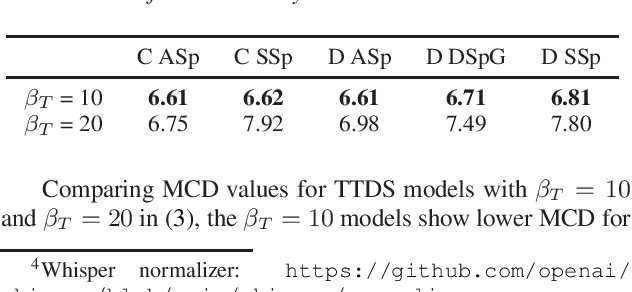


Automatic speech recognition (ASR) research has achieved impressive performance in recent years and has significant potential for enabling access for people with dysarthria (PwD) in augmentative and alternative communication (AAC) and home environment systems. However, progress in dysarthric ASR (DASR) has been limited by high variability in dysarthric speech and limited public availability of dysarthric training data. This paper demonstrates that data augmentation using text-to-dysarthic-speech (TTDS) synthesis for finetuning large ASR models is effective for DASR. Specifically, diffusion-based text-to-speech (TTS) models can produce speech samples similar to dysarthric speech that can be used as additional training data for fine-tuning ASR foundation models, in this case Whisper. Results show improved synthesis metrics and ASR performance for the proposed multi-speaker diffusion-based TTDS data augmentation for ASR fine-tuning compared to current DASR baselines.