 Add to Chrome
 Add to Firefox
 Add to Edge
Fair Cognitive Impairment Detection Through Unlearning
Jun 17, 2026
Mild Cognitive Impairment (MCI) is a medical condition characterized by a noticeable decline in memory, language, or thinking abilities. MCI detection from spontaneous speech is promising for scalable screening. However, learned models often exploit demographic cues correlated with labels, resulting in a large performance gap across subgroups. We present a multimodal framework that combines (i) cross-model fusion between modalities (speech, text, and image), and (ii) unlearning using gradient reversal that discourages the shared embedding from encoding task-irrelevant demographic attributes. Evaluated on the multilingual benchmarks TAUKADIAL and PREPARE, our method outperforms the state-of-the-art multilingual and multimodal baseline in MCI classification while substantially reducing the performance gap across patient subgroups (sex and language). We further analyze transfer across datasets, showing that demographic unlearning helps learn more robust representations for MCI detection.

SemiKong: Curating, Training, and Evaluating A Semiconductor Industry-Specific Large Language Model
Nov 22, 2024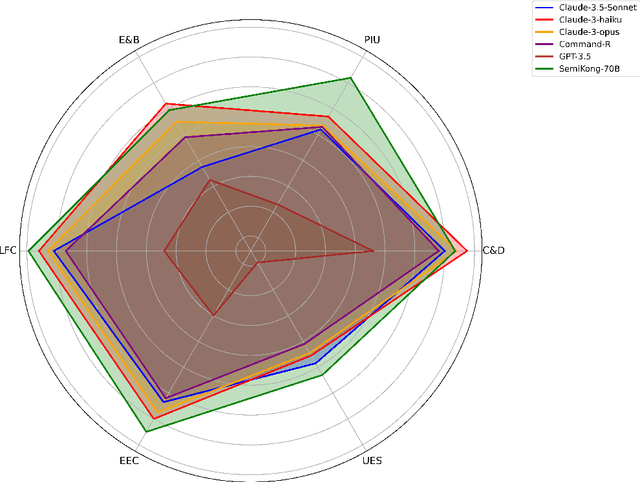
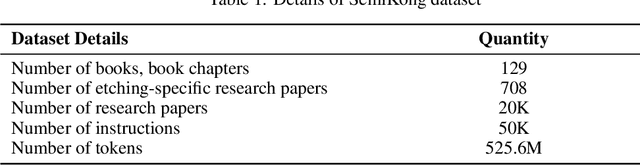

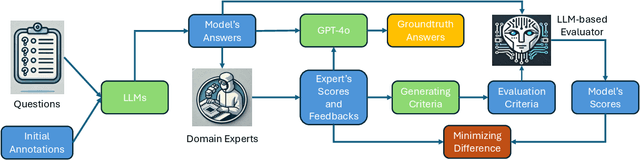
Large Language Models (LLMs) have demonstrated the potential to address some issues within the semiconductor industry. However, they are often general-purpose models that lack the specialized knowledge needed to tackle the unique challenges of this sector, such as the intricate physics and chemistry of semiconductor devices and processes. SemiKong, the first industry-specific LLM for the semiconductor domain, provides a foundation that can be used to develop tailored proprietary models. With SemiKong 1.0, we aim to develop a foundational model capable of understanding etching problems at an expert level. Our key contributions include (a) curating a comprehensive corpus of semiconductor-related texts, (b) creating a foundational model with in-depth semiconductor knowledge, and (c) introducing a framework for integrating expert knowledge, thereby advancing the evaluation process of domain-specific AI models. Through fine-tuning a pre-trained LLM using our curated dataset, we have shown that SemiKong outperforms larger, general-purpose LLMs in various semiconductor manufacturing and design tasks. Our extensive experiments underscore the importance of developing domain-specific LLMs as a foundation for company- or tool-specific proprietary models, paving the way for further research and applications in the semiconductor domain. Code and dataset will be available at https://github.com/aitomatic/semikong