 Add to Chrome
 Add to Firefox
 Add to Edge
Privacy-Preserving Iris Recognition: Performance Challenges and Outlook
Mar 27, 2026
Iris-based biometric identification is increasingly recognized for its significant accuracy and long-term stability compared to other biometric modalities such as fingerprints or facial features. However, all biometric modalities are highly sensitive data that raise serious privacy and security concerns, particularly in decentralized and untrusted environments. While Fully Homomorphic Encryption (FHE) has emerged as a promising solution for protecting sensitive data during computation, existing privacy-preserving iris recognition systems face significant performance limitations that hinder their practical deployment. This paper investigates the performance challenges of the current landscape of privacy-preserving iris recognition systems using FHE. Based on these insights, we outline a scalable privacy-preserving framework that aligns with all the requirements specified in the ISO/IEC 24745 standard. Leveraging the Open Iris library, our approach starts with robust iris segmentation, followed by normalization and feature extraction using Gabor filters to generate iris codes. We then apply binary masking to filter out unreliable regions and perform matching using Hamming distance on encrypted iris codes. The accuracy and performance of our proposed privacy-preserving framework is evaluated on the CASIA-Iris-Thousand dataset. Results show that our privacy-preserving framework yields very similar accuracy to the cleartext equivalent, but a much higher computational overhead with respect to pairwise iris template comparisons, of $\sim 120\,000 \times$. This points towards the need for the deployment of two-level schemes in the context of scalable $1-N$ template comparisons.

A Diagrammatic Approach to Improve Computational Efficiency in Group Equivariant Neural Networks
Dec 14, 2024Group equivariant neural networks are growing in importance owing to their ability to generalise well in applications where the data has known underlying symmetries. Recent characterisations of a class of these networks that use high-order tensor power spaces as their layers suggest that they have significant potential; however, their implementation remains challenging owing to the prohibitively expensive nature of the computations that are involved. In this work, we present a fast matrix multiplication algorithm for any equivariant weight matrix that maps between tensor power layer spaces in these networks for four groups: the symmetric, orthogonal, special orthogonal, and symplectic groups. We obtain this algorithm by developing a diagrammatic framework based on category theory that enables us to not only express each weight matrix as a linear combination of diagrams but also makes it possible for us to use these diagrams to factor the original computation into a series of steps that are optimal. We show that this algorithm improves the Big-$O$ time complexity exponentially in comparison to a na\"{i}ve matrix multiplication.
Time-series Transformer Generative Adversarial Networks
May 23, 2022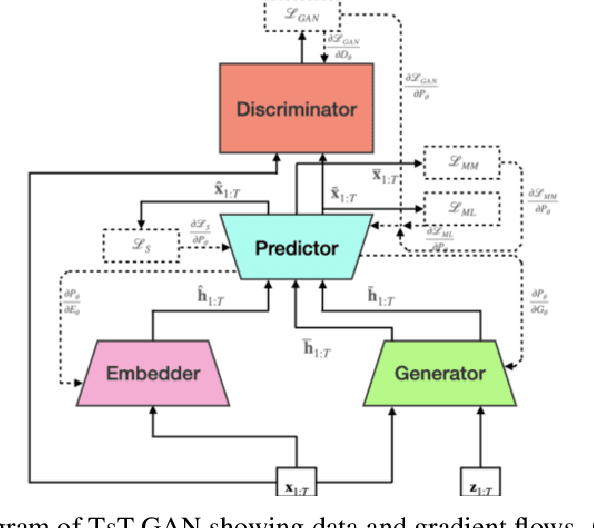
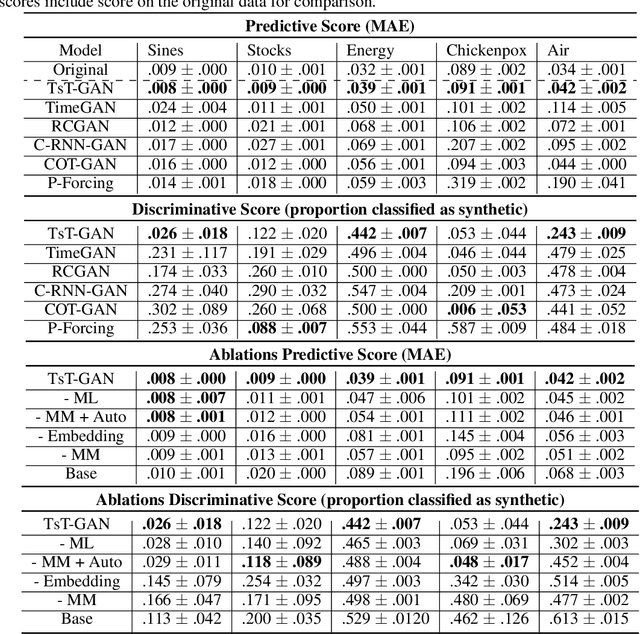
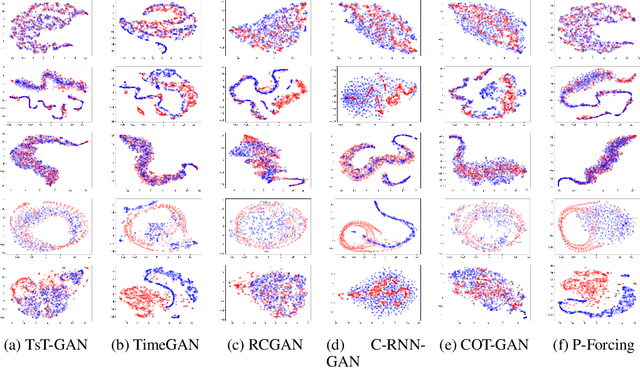
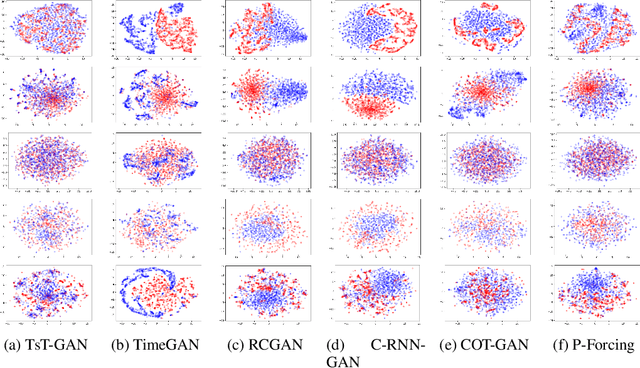
Many real-world tasks are plagued by limitations on data: in some instances very little data is available and in others, data is protected by privacy enforcing regulations (e.g. GDPR). We consider limitations posed specifically on time-series data and present a model that can generate synthetic time-series which can be used in place of real data. A model that generates synthetic time-series data has two objectives: 1) to capture the stepwise conditional distribution of real sequences, and 2) to faithfully model the joint distribution of entire real sequences. Autoregressive models trained via maximum likelihood estimation can be used in a system where previous predictions are fed back in and used to predict future ones; in such models, errors can accrue over time. Furthermore, a plausible initial value is required making MLE based models not really generative. Many downstream tasks learn to model conditional distributions of the time-series, hence, synthetic data drawn from a generative model must satisfy 1) in addition to performing 2). We present TsT-GAN, a framework that capitalises on the Transformer architecture to satisfy the desiderata and compare its performance against five state-of-the-art models on five datasets and show that TsT-GAN achieves higher predictive performance on all datasets.