 Add to Chrome
 Add to Firefox
 Add to Edge
A signal discovery step in interstellar communication
Dec 09, 2024
Prior work using synchronized, geographically spaced radio telescopes, and a radio interferometer, suggests that narrow-bandwidth polarized pulse pair measurements repeatedly falsify a noise-cause hypothesis, given a prior celestial direction of interest. A four-step method was proposed, tested, and reported, using interferometer phase measurements, to seek common celestial directions among pulse pair components, during 92 days of observation. In the work reported here, the proposed four-step signal discovery method is simplified to have a single step. A 123.8 day interferometer experiment provides measurement evidence supporting a hypothesis that the prior direction of interest, and a second direction of interest, are associated with celestial coordinates. Each pointing direction measures statistical power at greater than six standard deviations, with some indications of associated interferometer-induced Right Ascension aliasing. Explanations are proposed and discussed.

A proposed signal discovery method in interstellar communication
Nov 04, 2024Experiments conducted since 2018, using three geographically spaced synchronized radio telescopes, and a radio interferometer, indicate the presence of anomalous narrow bandwidth pulse pairs, conjectured to be sourced from a celestial direction near the star Rigel. Many explanatory hypotheses are possible. In the current work, a measurement method is proposed and implemented to attempt to provide high levels of statistical power of narrowband pulse pair observations, while minimizing interferometer instrument adjustments that might bias the experiment. Using the proposed method, twenty pulse pairs having statistical power at 5 to 10 standard deviations, and one pulse pair at 22 standard deviations of mean shift of pulse pair count, were observed in the prior celestial direction range, while using other celestial directions as an experimental comparison group. High levels of standard deviations of pulse pair count mean shift, observed in this 92 day experiment, imply the falsification of a Gaussian noise hypothesis. Alternate and auxiliary hypotheses, and further experiments, are sought to try to explain the narrow bandwidth pulsed signals.
Replication of filtered interferometer measurements in interstellar communications
Jun 29, 2024Interstellar communication signals have been conjectured to be present, albeit difficult to identify. Experiments conducted since 2018 indicate an anomalous presence of a type of speculated interstellar signal, delta-t delta-f polarized pulse pairs, thought to be possibly sourced from a celestial direction near 5.25 hr Right Ascension and -7.6 deg. Declination. A recent experiment utilizing a radio interferometer identified anomalous pulse pairs associated with these celestial coordinates. The experiment is described in arXiv:2404.08994. Other experiments produced anomalous results, reported in arXiv:2105.03727, arXiv:2106.10168, arXiv:2202.12791 and arXiv:2203.10065. After the recent experiment was concluded, the interferometer antenna elements were modified to have increased aperture and reduction in radio interference-caused false positives. An experiment was conducted to attempt replication of the previously reported interferometer measurements. Observations are reported here. Apparent replicated falsification of an expected random white noise explanatory hypothesis compels the development and testing of alternate and auxiliary hypotheses.
Symbol quantization in interstellar communications: methods and observations
Mar 18, 2022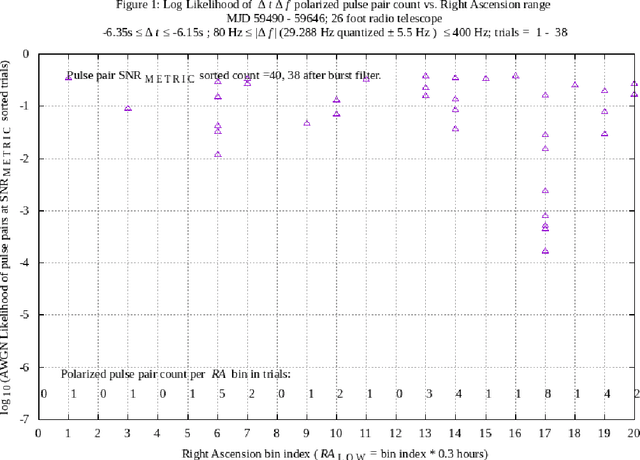
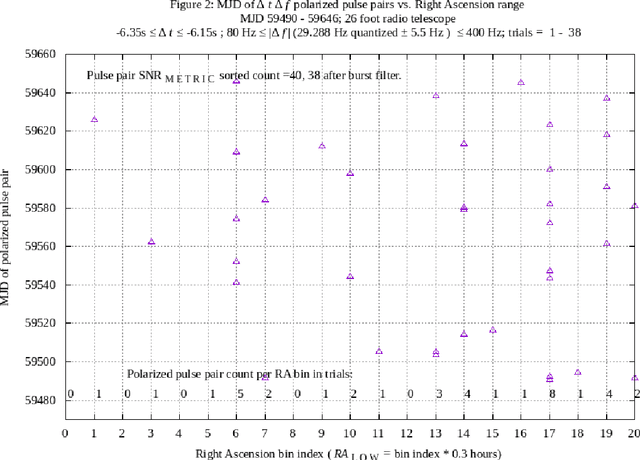
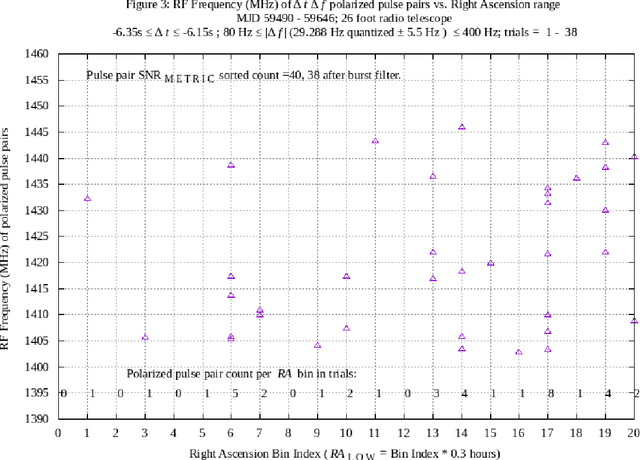
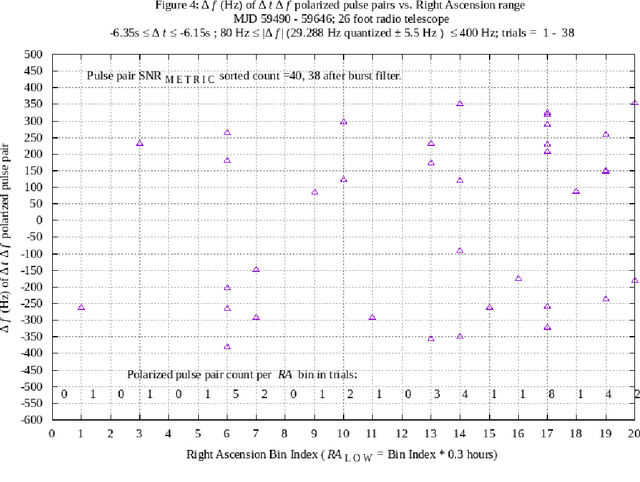
Interstellar communication transmitters, intended to be discovered and decoded to information bits, are expected to transmit signals that contain message symbols quantized in at least one of the degrees of freedom of the transmitted signal. A hypothesis is proposed that signal quantization, in the form of multiplicative values of one or more signal measurements, may be observable during the reception of hypothetical discoverable interstellar communication signals. In previous work, using single and multiple synchronized radio telescopes, candidate hypothetical interstellar communication signals comprising delta-t delta-f opposite circular polarized pulse pairs have been reported and analyzed (ref. arXiv:2105.03727, arXiv:2106.10168, arXiv:2202.12791). In the latter report, an apparent quantization of delta-f at multiples of 58.575 Hz was observed. In the current work, a machine process has been implemented to further examine anomalous delta-f and delta-t quantization, with results reported in this paper. As in some past work, a 26 foot diameter radio telescope with fixed azimuth and elevation pointing is used to enable a Right Ascension filter to measure signals associated with a celestial direction of interest, relative to other directions, over a 6.3 hour range of Right Ascension. The 5.25 plus or minus 0.15 hour Right Ascension, -7.6 degrees plus or minus 1 degree Declination celestial direction presents repetition and quantization anomalies, during an experiment lasting 157 days, with the first 143 days overlapping the previous experiment.
Symbol repetition in interstellar communications: methods and observations
Feb 25, 2022
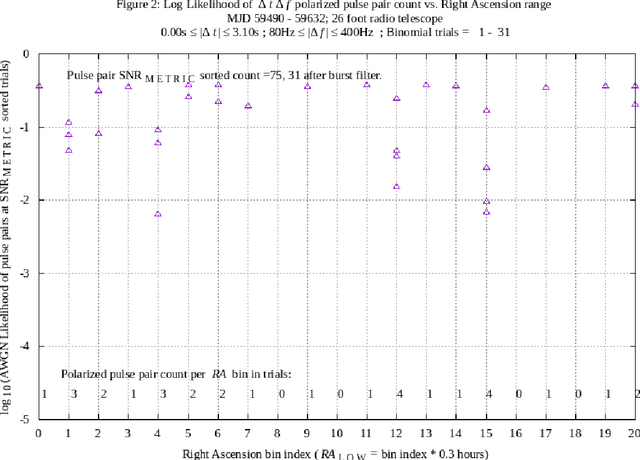
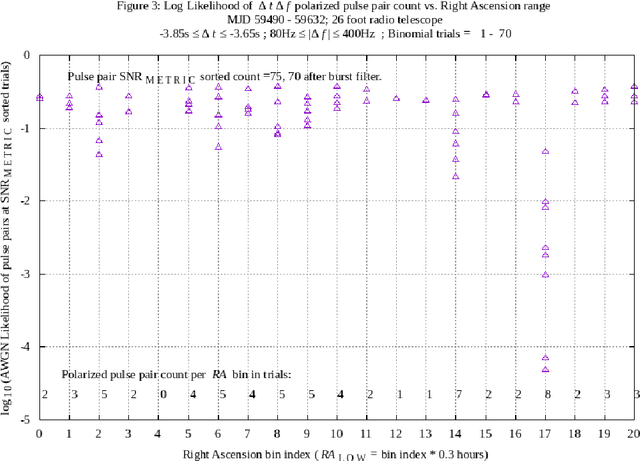
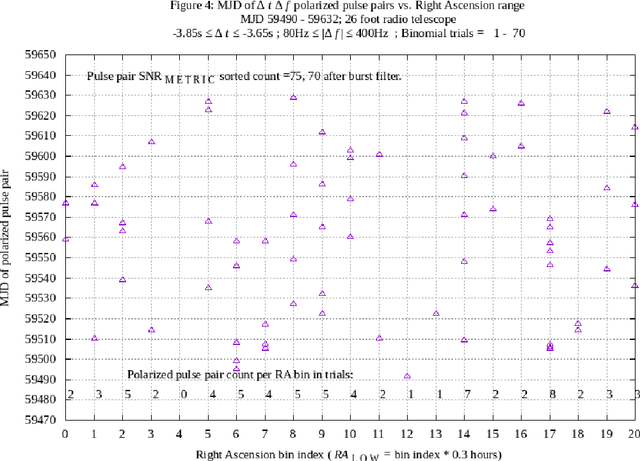
Discoverable interstellar communication signals are expected to exhibit al least one signal characteristic clearly distinct from random noise. A hypothesis is proposed that radio telescope received signals may contain transmitted delta-t delta-f opposite circular polarized pulse pairs, conveying a combination of information content and discovery methods, including symbol repetition. Hypothetical signals are experimentally measured using a 26 foot diameter radio telescope, a chosen matched filter receiver, and machine post processing system. Measurements are expected to present likelihoods explained by an Additive White Gaussian Noise model, augmented to reduce radio frequency interference. In addition, measurements are expected to present no significant differences across a population of Right Ascension ranges, during long duration experiments. The hypothesis and experimental methods described in this paper are based on multiple radio telescope delta-t delta-f polarized pulse pair experiments previously reported. (ref. arXiv:2105.03727, arXiv:2106.10168). In the current work, a Right Ascension filter spans twenty-one 0.3 hour Right Ascension bins over a 0 to 6.3 hr range, during a 143 day experiment. Apparent symbol repetition is measured and analyzed. The 5.25 plus or minus 0.15 hr Right Ascension, -7.6 degree plus or minus 1 degree Declination celestial direction has been associated with anomalous observations in previous work, and continues to present anomalies, having unknown cause.
Radio interference reduction in interstellar communications: methods and observations
Jun 18, 2021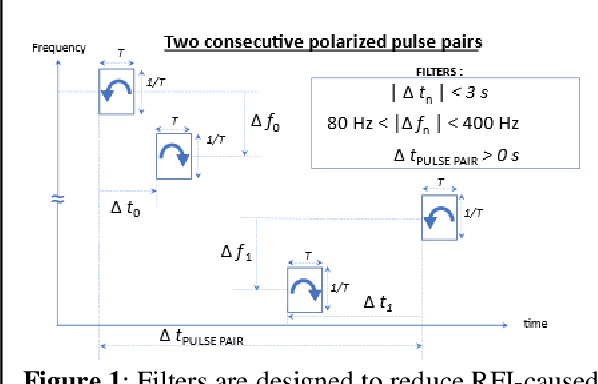
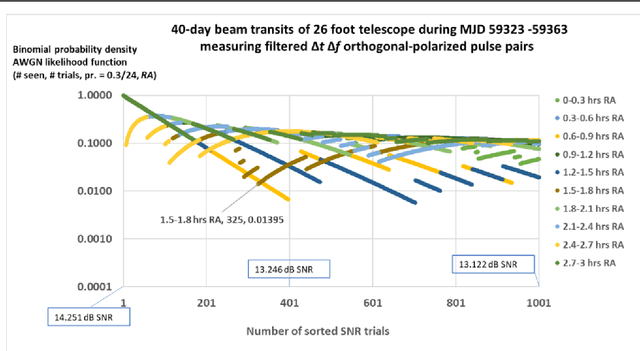
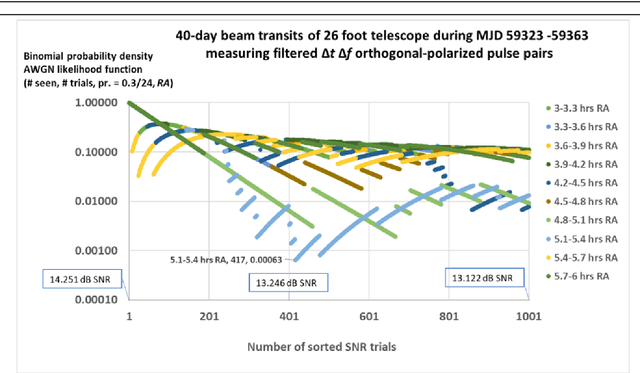
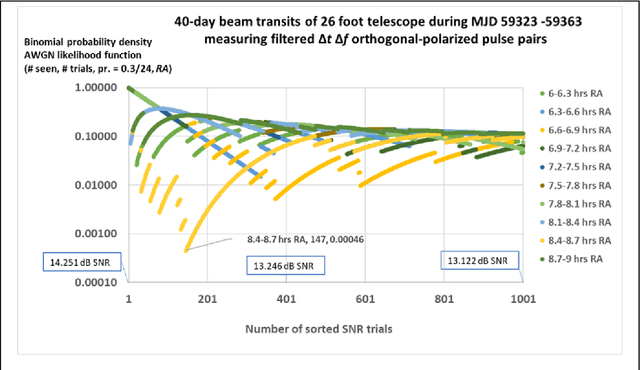
The discovery of interstellar communication signals is complicated by the presence of radio interference. Consequently, interstellar communication signals are hypothesized to have properties that favor discovery in high levels of local planetary radio interference. A hypothesized type of interstellar signal, delta-t delta-f polarized pulse pairs, has properties that are similar to infrequent elements of random noise, while dissimilar from many types of known radio interference. Discovery of delta-t delta-f polarized pulse pairs is aided by the use of interference-filtered receiver systems that are designed to indicate anomalous presence of delta-t delta-f polarized pulse pairs, when pointing a radio telescope to celestial coordinates of a hypothetical transmitter. Observations reported in previous work (ref. arXiv:2105.03727) indicate an anomalous celestial pointing direction having coordinates 5.25 +- 0.15 hours Right Ascension and -7.6 +- 1 degrees Declination. Augmented interference reduction mechanisms used in the current work are described, together with reports of follow-up radio telescope beam transit measurements during 40 days. Conclusions and further work are proposed.
An interstellar communication method: system design and observations
May 08, 2021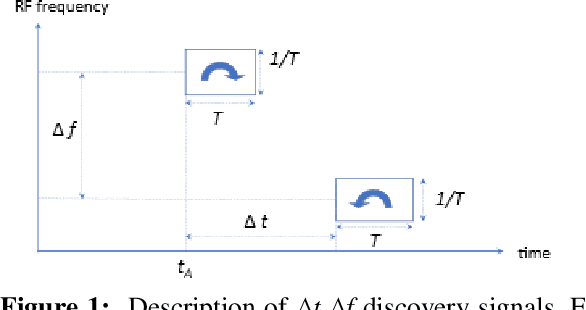

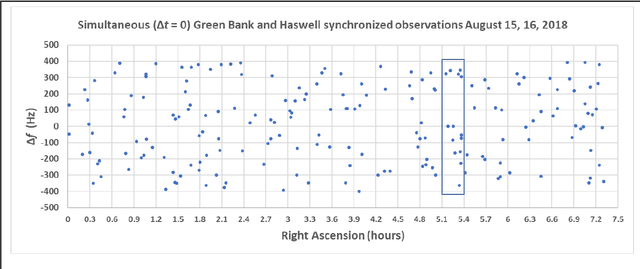
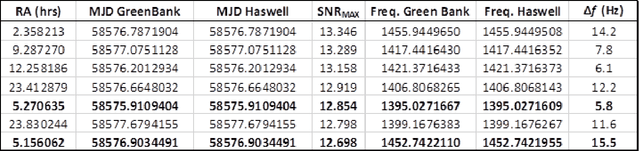
A system of synchronized radio telescopes is utilized to search for hypothetical wide bandwidth interstellar communication signals. Transmitted signals are hypothesized to have characteristics that enable high channel capacity and minimally low energy per information bit, while containing energy-efficient signal elements that are readily discoverable, distinct from random noise. A hypothesized transmitter signal is described. Signal reception and discovery processes are detailed. Observations using individual and multiple synchronized radio telescopes, during 2017 - 2021, are described. Conclusions and further work are suggested.