 Add to Chrome
 Add to Firefox
 Add to Edge
Operator Learning for Families of Finite-State Mean-Field Games
Feb 13, 2026
Finite-state mean-field games (MFGs) arise as limits of large interacting particle systems and are governed by an MFG system, a coupled forward-backward differential equation consisting of a forward Kolmogorov-Fokker-Planck (KFP) equation describing the population distribution and a backward Hamilton-Jacobi-Bellman (HJB) equation defining the value function. Solving MFG systems efficiently is challenging, with the structure of each system depending on an initial distribution of players and the terminal cost of the game. We propose an operator learning framework that solves parametric families of MFGs, enabling generalization without retraining for new initial distributions and terminal costs. We provide theoretical guarantees on the approximation error, parametric complexity, and generalization performance of our method, based on a novel regularity result for an appropriately defined flow map corresponding to an MFG system. We demonstrate empirically that our framework achieves accurate approximation for two representative instances of MFGs: a cybersecurity example and a high-dimensional quadratic model commonly used as a benchmark for numerical methods for MFGs.

Convergence Guarantees for Neural Network-Based Hamilton-Jacobi Reachability
Oct 03, 2024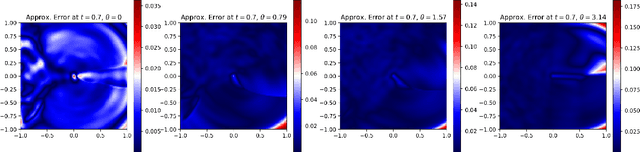
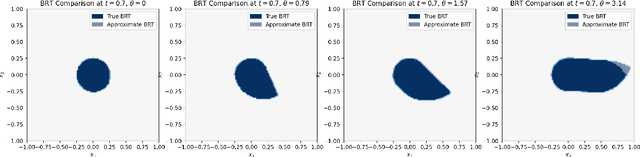
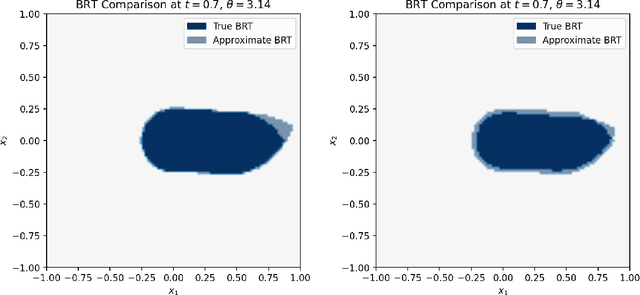
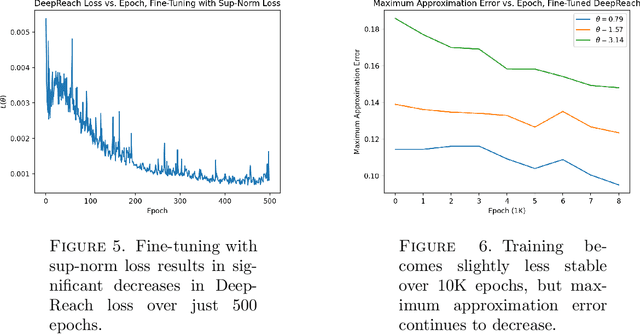
We provide a novel uniform convergence guarantee for DeepReach, a deep learning-based method for solving Hamilton-Jacobi-Isaacs (HJI) equations associated with reachability analysis. Specifically, we show that the DeepReach algorithm, as introduced by Bansal et al. in their eponymous paper from 2020, is stable in the sense that if the loss functional for the algorithm converges to zero, then the resulting neural network approximation converges uniformly to the classical solution of the HJI equation, assuming that a classical solution exists. We also provide numerical tests of the algorithm, replicating the experiments provided in the original DeepReach paper and empirically examining the impact that training with a supremum norm loss metric has on approximation error.
Convergence of the Deep Galerkin Method for Mean Field Control Problems
May 22, 2024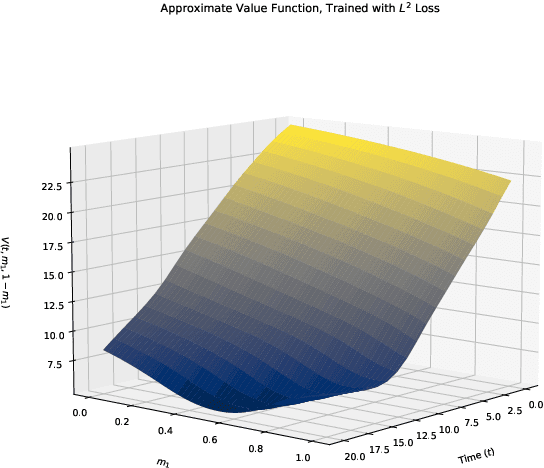
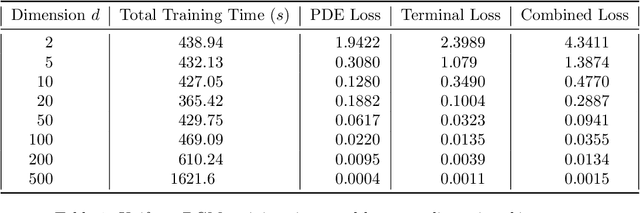


We establish the convergence of the deep Galerkin method (DGM), a deep learning-based scheme for solving high-dimensional nonlinear PDEs, for Hamilton-Jacobi-Bellman (HJB) equations that arise from the study of mean field control problems (MFCPs). Based on a recent characterization of the value function of the MFCP as the unique viscosity solution of an HJB equation on the simplex, we establish both an existence and convergence result for the DGM. First, we show that the loss functional of the DGM can be made arbitrarily small given that the value function of the MFCP possesses sufficient regularity. Then, we show that if the loss functional of the DGM converges to zero, the corresponding neural network approximators must converge uniformly to the true value function on the simplex. We also provide numerical experiments demonstrating the DGM's ability to generalize to high-dimensional HJB equations.