 Add to Chrome
 Add to Firefox
 Add to Edge
ABSTRAL: Automatic Design of Multi-Agent Systems Through Iterative Refinement and Topology Optimization
Mar 24, 2026
How should multi-agent systems be designed, and can that design knowledge be captured in a form that is inspectable, revisable, and transferable? We introduce ABSTRAL, a framework that treats MAS architecture as an evolving natural-language document, an artifact refined through contrastive trace analysis. Three findings emerge. First, we provide a precise measurement of the multi-agent coordination tax: under fixed turn budgets, ensembles achieve only 26% turn efficiency, with 66% of tasks exhausting the limit, yet still improve over single-agent baselines by discovering parallelizable task decompositions. Second, design knowledge encoded in documents transfers: topology reasoning and role templates learned on one domain provide a head start on new domains, with transferred seeds matching coldstart iteration 3 performance in a single iteration. Third, contrastive trace analysis discovers specialist roles absent from any initial design, a capability no prior system demonstrates. On SOPBench (134 bank tasks, deterministic oracle), ABSTRAL reaches 70% validation / 65.96% test pass rate with a GPT-4o backbone. We release the converged documents as inspectable design rationale.

Compass: A Decentralized Scheduler for Latency-Sensitive ML Workflows
Feb 28, 2024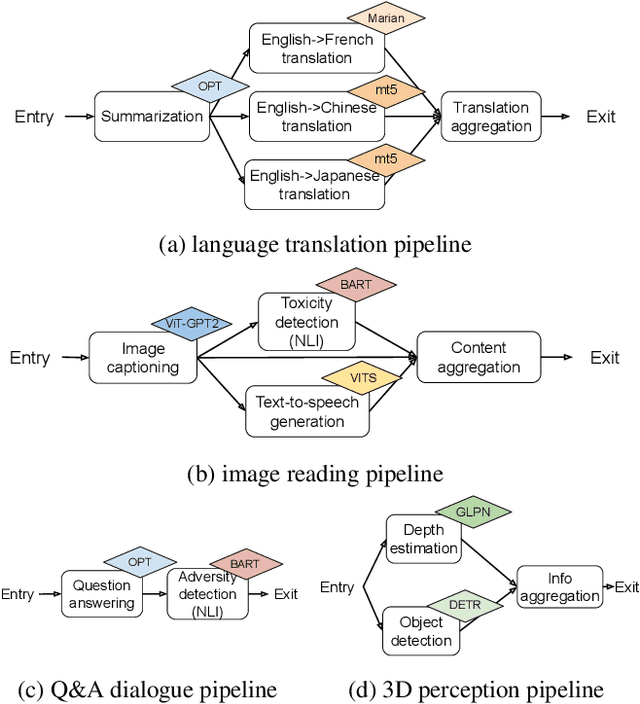
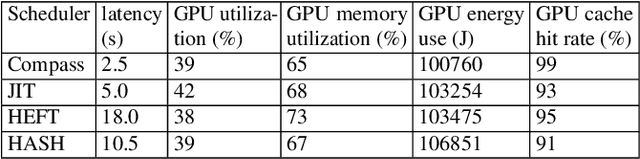
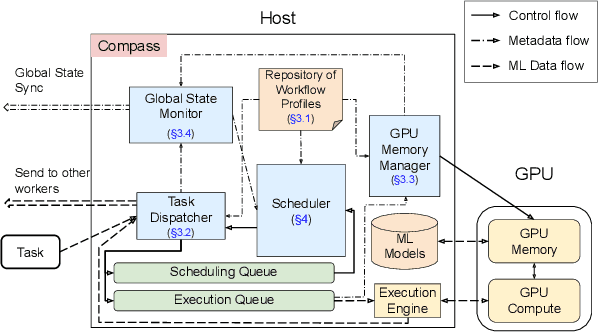
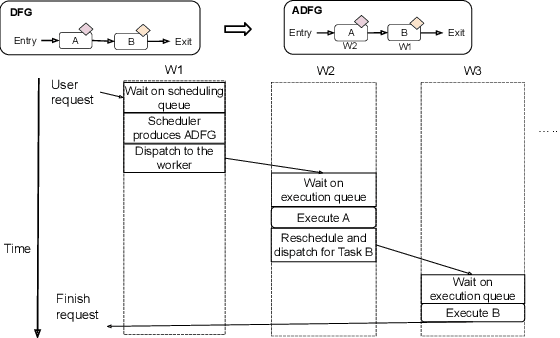
We consider ML query processing in distributed systems where GPU-enabled workers coordinate to execute complex queries: a computing style often seen in applications that interact with users in support of image processing and natural language processing. In such systems, coscheduling of GPU memory management and task placement represents a promising opportunity. We propose Compass, a novel framework that unifies these functions to reduce job latency while using resources efficiently, placing tasks where data dependencies will be satisfied, collocating tasks from the same job (when this will not overload the host or its GPU), and efficiently managing GPU memory. Comparison with other state of the art schedulers shows a significant reduction in completion times while requiring the same amount or even fewer resources. In one case, just half the servers were needed for processing the same workload.
Cascade: A Platform for Delay-Sensitive Edge Intelligence
Nov 29, 2023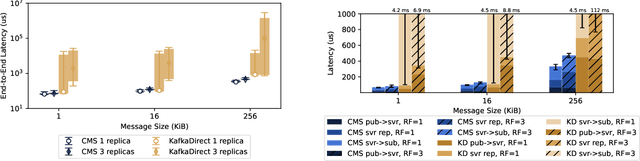

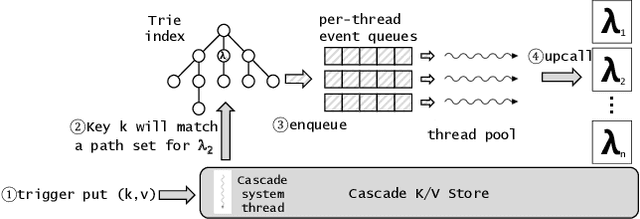
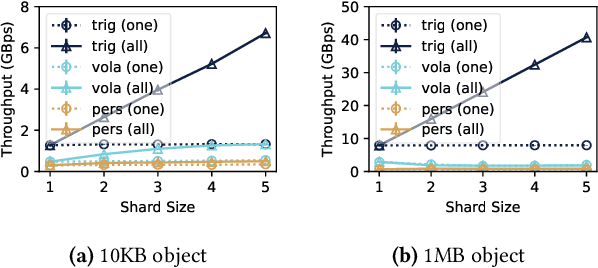
Interactive intelligent computing applications are increasingly prevalent, creating a need for AI/ML platforms optimized to reduce per-event latency while maintaining high throughput and efficient resource management. Yet many intelligent applications run on AI/ML platforms that optimize for high throughput even at the cost of high tail-latency. Cascade is a new AI/ML hosting platform intended to untangle this puzzle. Innovations include a legacy-friendly storage layer that moves data with minimal copying and a "fast path" that collocates data and computation to maximize responsiveness. Our evaluation shows that Cascade reduces latency by orders of magnitude with no loss of throughput.