 Add to Chrome
 Add to Firefox
 Add to Edge
The Geometric Price of Discrete Logic: Context-driven Manifold Dynamics of Number Representations
Mar 24, 2026
Large language models (LLMs) generalize smoothly across continuous semantic spaces, yet strict logical reasoning demands the formation of discrete decision boundaries. Prevailing theories relying on linear isometric projections fail to resolve this fundamental tension. In this work, we argue that task context operates as a non-isometric dynamical operator that enforces a necessary "topological distortion." By applying Gram-Schmidt decomposition to residual-stream activations , we reveal a dual-modulation mechanism driving this process: a class-agnostic topological preservation that anchors global structure to prevent semantic collapse, and a specific algebraic divergence that directionally tears apart cross-class concepts to forge logical boundaries. We validate this geometric evolution across a gradient of tasks, from simple mapping to complex primality testing. Crucially, targeted specific vector ablation establishes a strict causal binding between this topology and model function: algebraically erasing the divergence component collapses parity classification accuracy from 100% to chance levels (38.57%). Furthermore, we uncover a three-phase layer-wise geometric dynamic and demonstrate that under social pressure prompts, models fail to generate sufficient divergence. This results in a "manifold entanglement" that geometrically explains sycophancy and hallucination. Ultimately, our findings revise the linear-isometric presumption, demonstrating that the emergence of discrete logic in LLMs is purchased at an irreducible cost of topological deformation.

When Crowdsensing Meets Federated Learning: Privacy-Preserving Mobile Crowdsensing System
Feb 20, 2021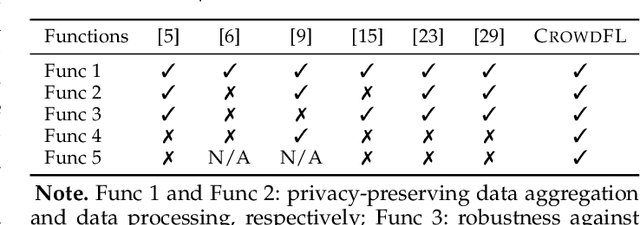


Mobile crowdsensing (MCS) is an emerging sensing data collection pattern with scalability, low deployment cost, and distributed characteristics. Traditional MCS systems suffer from privacy concerns and fair reward distribution. Moreover, existing privacy-preserving MCS solutions usually focus on the privacy protection of data collection rather than that of data processing. To tackle faced problems of MCS, in this paper, we integrate federated learning (FL) into MCS and propose a privacy-preserving MCS system, called \textsc{CrowdFL}. Specifically, in order to protect privacy, participants locally process sensing data via federated learning and only upload encrypted training models. Particularly, a privacy-preserving federated averaging algorithm is proposed to average encrypted training models. To reduce computation and communication overhead of restraining dropped participants, discard and retransmission strategies are designed. Besides, a privacy-preserving posted pricing incentive mechanism is designed, which tries to break the dilemma of privacy protection and data evaluation. Theoretical analysis and experimental evaluation on a practical MCS application demonstrate the proposed \textsc{CrowdFL} can effectively protect participants privacy and is feasible and efficient.