 Add to Chrome
 Add to Firefox
 Add to Edge
Robustness without Wrinkles: Parallel Simulation and Robust MPC for Certified Deformable Manipulation
Jun 12, 2026
We present CORD-SLS, a real-time control method for safe deformable object manipulation, with a focus on ropes and cloth. At its core is a GPU-parallel differentiable simulator with contact smoothing which enables efficient gradient-based planning through intermittent contact. To robustly satisfy constraints under model and sensing uncertainty, we develop a real-time, GPU-parallel output-feedback robust model predictive control (MPC) algorithm that plans with this simulator. We further show that the simulator accelerates model-based RL for training neural manipulation policies. To improve real-world robustness, we use conformal prediction to calibrate visual-feedback and perception-error bounds for MPC, producing reachable tubes that enable high-probability safe control. We evaluate CORD-SLS on high-dimensional, contact-rich rope and cloth manipulation tasks in simulation and hardware, including obstacle avoidance, routing, folding, and smoothing. Across settings, CORD-SLS achieves millisecond-speed planning, exceeding baselines in safety, speed, and task success.

Certified Gradient-Based Contact-Rich Manipulation via Smoothing-Error Reachable Tubes
Feb 10, 2026Gradient-based methods can efficiently optimize controllers using physical priors and differentiable simulators, but contact-rich manipulation remains challenging due to discontinuous or vanishing gradients from hybrid contact dynamics. Smoothing the dynamics yields continuous gradients, but the resulting model mismatch can cause controller failures when executed on real systems. We address this trade-off by planning with smoothed dynamics while explicitly quantifying and compensating for the induced errors, providing formal guarantees of constraint satisfaction and goal reachability on the true hybrid dynamics. Our method smooths both contact dynamics and geometry via a novel differentiable simulator based on convex optimization, which enables us to characterize the discrepancy from the true dynamics as a set-valued deviation. This deviation constrains the optimization of time-varying affine feedback policies through analytical bounds on the system's reachable set, enabling robust constraint satisfaction guarantees for the true closed-loop hybrid dynamics, while relying solely on informative gradients from the smoothed dynamics. We evaluate our method on several contact-rich tasks, including planar pushing, object rotation, and in-hand dexterous manipulation, achieving guaranteed constraint satisfaction with lower safety violation and goal error than baselines. By bridging differentiable physics with set-valued robust control, our method is the first certifiable gradient-based policy synthesis method for contact-rich manipulation.
Extension of compressive sampling to binary vector recovery for model-based defect imaging
Dec 02, 2024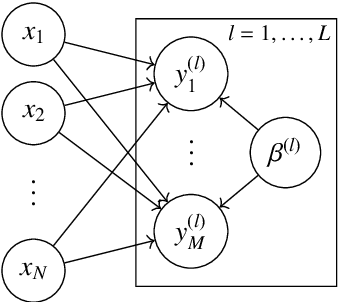
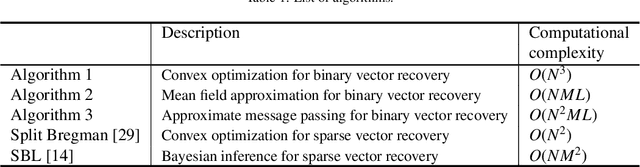
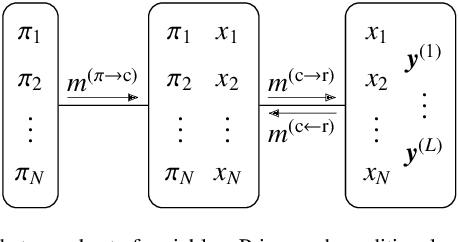
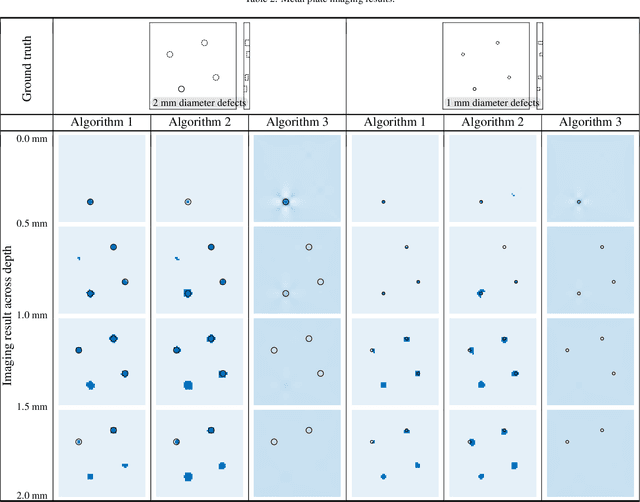
Common imaging techniques for detecting structural defects typically require sampling at more than twice the spatial frequency to achieve a target resolution. This study introduces a novel framework for imaging structural defects using significantly fewer samples. In this framework, defects are modeled as regions where physical properties shift from their nominal values to resemble those of air, and a linear approximation is formulated to relate these binary shifts in physical properties with corresponding changes in measurements. Recovering a binary vector from linear measurements is generally an NP-hard problem. To address this challenge, this study proposes two algorithmic approaches. The first approach relaxes the binary constraint, using convex optimization to find a solution. The second approach incorporates a binary-inducing prior and employs approximate Bayesian inference to estimate the posterior probability of the binary vector given the measurements. Both algorithmic approaches demonstrate better performance compared to existing compressive sampling methods for binary vector recovery. The framework's effectiveness is illustrated through examples of eddy current sensing to image defects in metal structures.