 Add to Chrome
 Add to Firefox
 Add to Edge
Filtering Memorization from Parameter-Space in Diffusion Models
May 11, 2026
Low-Rank Adaptation (LoRA) has become a widely used mechanism for customizing diffusion models, enabling users to inject new visual concepts or styles through lightweight parameter updates. However, LoRAs can memorize training images, causing generated outputs to reproduce copyrighted or sensitive content. This risk is particularly concerning in LoRA-sharing ecosystems, where users distribute trained LoRAs without releasing the underlying training data. Existing approaches for mitigating memorization rely on access to the training pipeline, training data, or control over the inference process, making them difficult to apply when only the released LoRA weights are available. We propose \textbf{Base-Anchored Filtering (BAF)}, a training-free and data-free framework for post-hoc memorization mitigation in diffusion LoRAs. BAF decomposes LoRA updates into spectral channels and measures their alignment with the principal subspace of the pretrained backbone. Channels strongly aligned with this subspace are retained as generalizable adaptations, while weakly aligned channels are suppressed as potential carriers of memorized content. Experiments on multiple datasets and diffusion backbones demonstrate that BAF consistently reduces memorization while preserving or even improving generation quality. Our code is available in the supplementary material.

Disrupting Model Merging: A Parameter-Level Defense Without Sacrificing Accuracy
Mar 08, 2025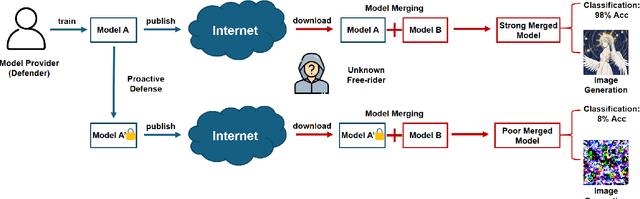
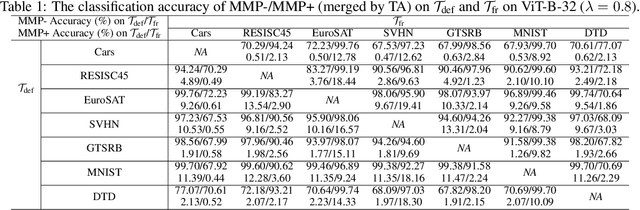
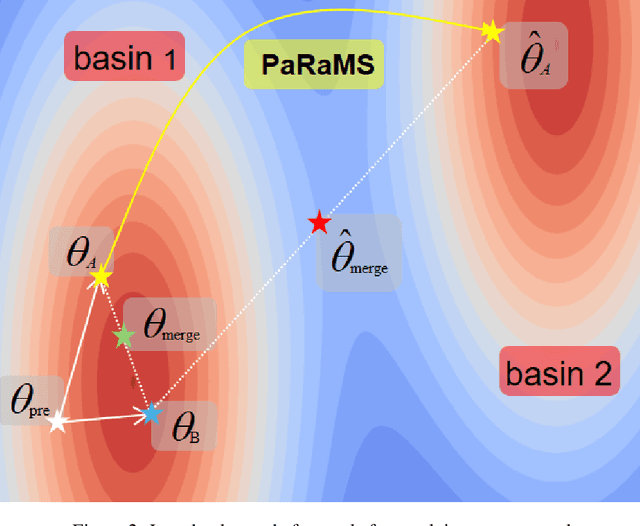

Model merging is a technique that combines multiple finetuned models into a single model without additional training, allowing a free-rider to cheaply inherit specialized capabilities. This study investigates methodologies to suppress unwanted model merging by free-riders. Existing methods such as model watermarking or fingerprinting can only detect merging in hindsight. In contrast, we propose a first proactive defense against model merging. Specifically, our defense method modifies the model parameters so that the model is disrupted if the model is merged with any other model, while its functionality is kept unchanged if not merged with others. Our approach consists of two modules, rearranging MLP parameters and scaling attention heads, which push the model out of the shared basin in parameter space, causing the merging performance with other models to degrade significantly. We conduct extensive experiments on image classification, image generation, and text classification to demonstrate that our defense severely disrupts merging while retaining the functionality of the post-protect model. Moreover, we analyze potential adaptive attacks and further propose a dropout-based pruning to improve our proposal's robustness.