 Add to Chrome
 Add to Firefox
 Add to Edge
Exploring Structures in Physics Problems: Can AI Agents Discover Statistical Mechanical Mappings?
Jul 29, 2026
An important skill in theoretical physics is to recognize when a new problem can be transformed into a known model. We study this skill as an AI-agent task: can LLM-based agents discover statistical mechanical mappings from a raw partition function to a tractable representation? To probe this question, we introduce StatMechBench-v0, a benchmark of six Ising-type problems covering transfer-matrix methods, gauge-removable disorder, and planar/Pfaffian structure. We evaluate a simple propose-verify-revise agent across multiple LLMs and problem phrasings. The results show that numerical feedback often helps agents repair code and recover correct partition functions. However, agents can also pass the numerical checks while misidentifying the underlying tractable class or understating computational complexity. This both reveals limitations in current LLM reasoning and calls for a verification stack that goes beyond numerical agreement, incorporating, for example, symbolic checks and structural invariants. Our study provides an early evaluation and design directions for AI agents aimed at structural discovery in theoretical physics.

A Light Weight Model for Active Speaker Detection
Mar 08, 2023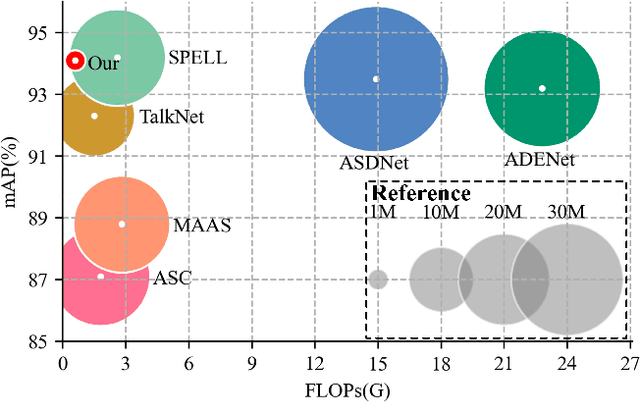
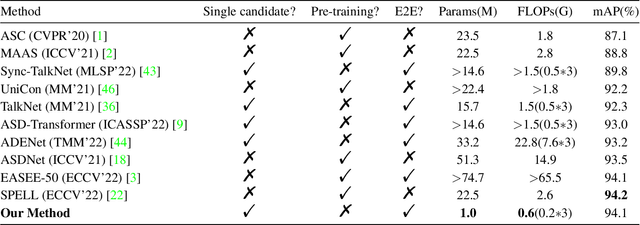
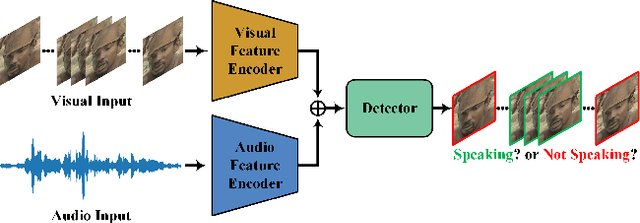
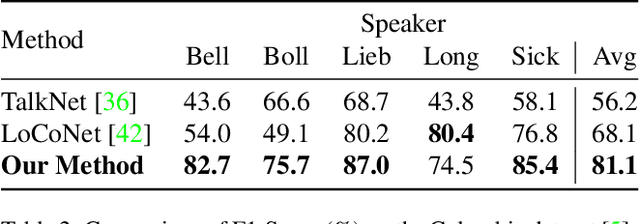
Active speaker detection is a challenging task in audio-visual scenario understanding, which aims to detect who is speaking in one or more speakers scenarios. This task has received extensive attention as it is crucial in applications such as speaker diarization, speaker tracking, and automatic video editing. The existing studies try to improve performance by inputting multiple candidate information and designing complex models. Although these methods achieved outstanding performance, their high consumption of memory and computational power make them difficult to be applied in resource-limited scenarios. Therefore, we construct a lightweight active speaker detection architecture by reducing input candidates, splitting 2D and 3D convolutions for audio-visual feature extraction, and applying gated recurrent unit (GRU) with low computational complexity for cross-modal modeling. Experimental results on the AVA-ActiveSpeaker dataset show that our framework achieves competitive mAP performance (94.1% vs. 94.2%), while the resource costs are significantly lower than the state-of-the-art method, especially in model parameters (1.0M vs. 22.5M, about 23x) and FLOPs (0.6G vs. 2.6G, about 4x). In addition, our framework also performs well on the Columbia dataset showing good robustness. The code and model weights are available at https://github.com/Junhua-Liao/Light-ASD.