 Add to Chrome
 Add to Firefox
 Add to Edge
Efficient Audio Enhancement with a Differentiable Psychoacoustic Loss
Aug 03, 2026
Audio enhancement consists of improving the perceived quality of audio signals. Initially, with the aim of addressing bandwidth extension, this work proposes \(AEROMamba_{P}\), an efficient variant of the AERO super-resolution architecture where attention and LSTM layers are replaced by the Mamba state-space model, and which incorporates a newly developed differentiable perceptual loss derived from the Perceptual Audio Quality Measure (PAQM). During training, the architecture requires approximately 2-4x less GPU memory than the baseline; during inference, it achieves a 14x speedup while using only one-fifth of the GPU memory. When upsampling both a piano dataset and MUSDB18 from 11.025 kHz to 44.1 kHz, subjective listening tests show that \(AEROMamba_{P}\) outperforms AERO by 15% in perceived quality scores. Next, to handle the enhancement of audio signals that have been highly compressed by lossy coding, it is further proposed \(AEROMamba_{PS}\), which applies the same framework but replaces STFT reconstruction losses with the PAQM loss, specifically to enhance MP3 encoded audio at 32 kbps. In listening evaluations, \(AEROMamba_{PS}\) achieves 52% higher quality rating than \(AEROMamba_{P}\) when restoring compressed audio. These results demonstrate that PAQM-driven training coupled with lightweight state-space modeling yields high perceptual quality and computational efficiency in both band-limited and compressed audio scenarios.
* Author's Accepted Manuscript (AAM). Accepted for publication in the Journal of the Audio Engineering Society (JAES) in June/2026

FiPA-SR -- FiLM-Conditioned Perceptually Informed Audio Super-Resolution
May 28, 2026Audio bandwidth extension aims to reconstruct missing high-frequency content from bandlimited signals. This paper proposes FiPA-SR, a GAN-based perceptual architecture capable of handling different input bandwidths within a single model. Building upon the previous $\textrm{AEROMamba}_\textrm{P}$ framework, the proposed model incorporates FiLM layers to adapt the reconstruction process according to the respective bandwidth. Experiments on the MUSDB dataset show that FiPA-SR outperforms the state-of-the-art AudioSR model across 8, 20, and 32 kHz input sampling rates. Moreover, the proposed architecture uses approximately 3$\times$ less GPU memory and performs inference more than 60$\times$ faster than the diffusion-based baseline.
Guitar-TECHS: An Electric Guitar Dataset Covering Techniques, Musical Excerpts, Chords and Scales Using a Diverse Array of Hardware
Jan 07, 2025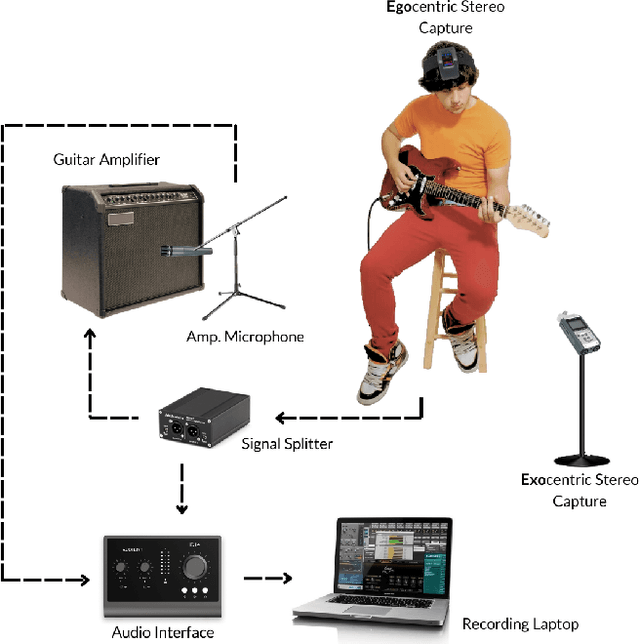
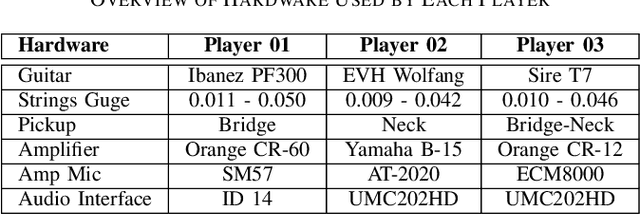
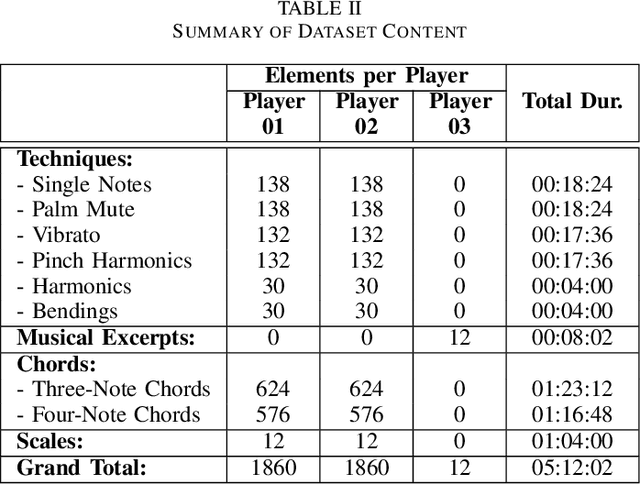

Guitar-related machine listening research involves tasks like timbre transfer, performance generation, and automatic transcription. However, small datasets often limit model robustness due to insufficient acoustic diversity and musical content. To address these issues, we introduce Guitar-TECHS, a comprehensive dataset featuring a variety of guitar techniques, musical excerpts, chords, and scales. These elements are performed by diverse musicians across various recording settings. Guitar-TECHS incorporates recordings from two stereo microphones: an egocentric microphone positioned on the performer's head and an exocentric microphone placed in front of the performer. It also includes direct input recordings and microphoned amplifier outputs, offering a wide spectrum of audio inputs and recording qualities. All signals and MIDI labels are properly synchronized. Its multi-perspective and multi-modal content makes Guitar-TECHS a valuable resource for advancing data-driven guitar research, and to develop robust guitar listening algorithms. We provide empirical data to demonstrate the dataset's effectiveness in training robust models for Guitar Tablature Transcription.
AEROMamba: An efficient architecture for audio super-resolution using generative adversarial networks and state space models
Nov 11, 2024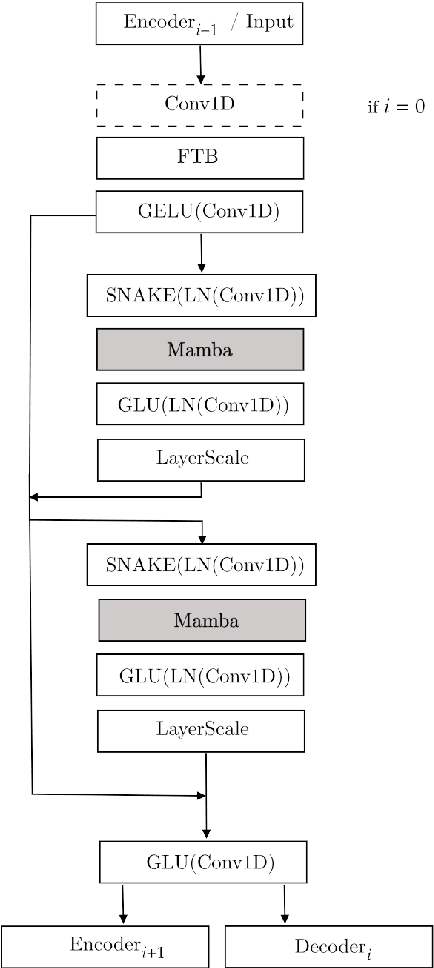
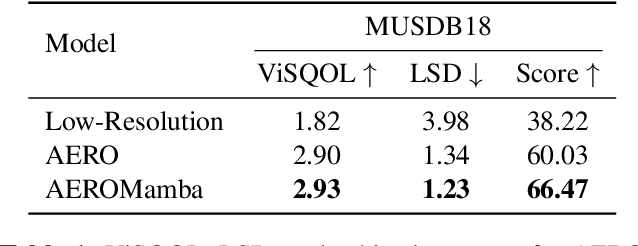
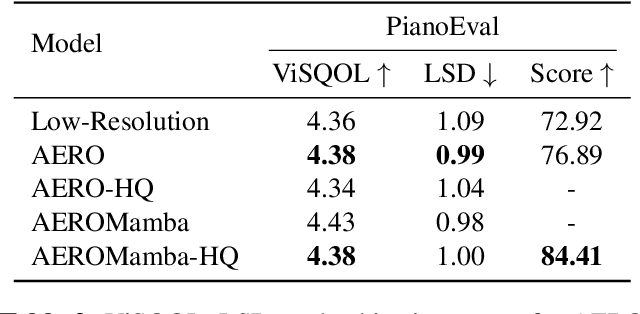
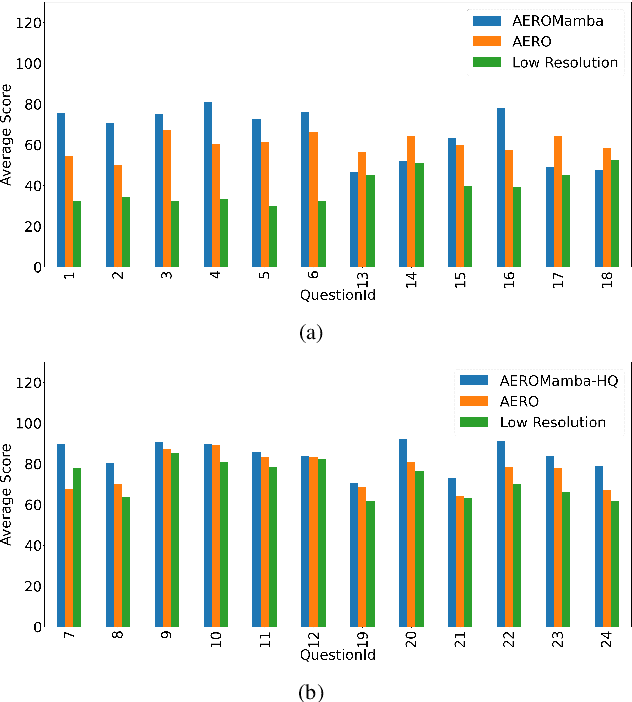
Audio super-resolution aims to enhance low-resolution signals by creating high-frequency content. In this work, we modify the architecture of AERO (a state-of-the-art system for this task) for music super-resolution. SPecifically, we replace its original Attention and LSTM layers with Mamba, a State Space Model (SSM), across all network layers. Mamba is capable of effectively substituting the mentioned modules, as it offers a mechanism similar to that of Attention while also functioning as a recurrent network. With the proposed AEROMamba, training requires 2-4x less GPU memory, since Mamba exploits the convolutional formulation and leverages GPU memory hierarchy. Additionally, during inference, Mamba operates in constant memory due to recurrence, avoiding memory growth associated with Attention. This results in a 14x speed improvement using 5x less GPU. Subjective listening tests (0 to 100 scale) show that the proposed model surpasses the AERO model. In the MUSDB dataset, degraded signals scored 38.22, while AERO and AEROMamba scored 60.03 and 66.74, respectively. For the PianoEval dataset, scores were 72.92 for degraded signals, 76.89 for AERO, and 84.41 for AEROMamba.