 Add to Chrome
 Add to Firefox
 Add to Edge
Novel Semantic Prompting for Zero-Shot Action Recognition
Mar 09, 2026
Zero-shot action recognition relies on transferring knowledge from vision-language models to unseen actions using semantic descriptions. While recent methods focus on temporal modeling or architectural adaptations to handle video data, we argue that semantic prompting alone provides a strong and underexplored signal for zero-shot action understanding. We introduce SP-CLIP, a lightweight framework that augments frozen vision-language models with structured semantic prompts describing actions at multiple levels of abstraction, such as intent, motion, and object interaction. Without modifying the visual encoder or learning additional parameters, SP-CLIP aligns video representations with enriched textual semantics through prompt aggregation and consistency scoring. Experiments across standard benchmarks show that semantic prompting substantially improves zero-shot action recognition, particularly for fine-grained and compositional actions, while preserving the efficiency and generalization of pretrained models.

A Novel Approach to Image Steganography Using Generative Adversarial Networks
Nov 27, 2024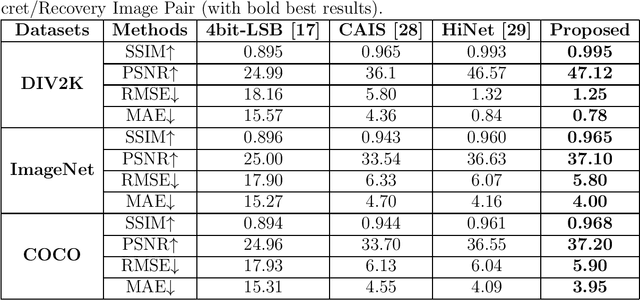
The field of steganography has long been focused on developing methods to securely embed information within various digital media while ensuring imperceptibility and robustness. However, the growing sophistication of detection tools and the demand for increased data hiding capacity have revealed limitations in traditional techniques. In this paper, we propose a novel approach to image steganography that leverages the power of generative adversarial networks (GANs) to address these challenges. By employing a carefully designed GAN architecture, our method ensures the creation of stego-images that are visually indistinguishable from their original counterparts, effectively thwarting detection by advanced steganalysis tools. Additionally, the adversarial training paradigm optimizes the balance between embedding capacity, imperceptibility, and robustness, enabling more efficient and secure data hiding. We evaluate our proposed method through a series of experiments on benchmark datasets and compare its performance against baseline techniques, including least significant bit (LSB) substitution and discrete cosine transform (DCT)-based methods. Our results demonstrate significant improvements in metrics such as Peak Signal-to-Noise Ratio (PSNR), Structural Similarity Index Measure (SSIM), and robustness against detection. This work not only contributes to the advancement of image steganography but also provides a foundation for exploring GAN-based approaches for secure digital communication.