 Add to Chrome
 Add to Firefox
 Add to Edge
Fractional Doppler Effects on OTFS-NOMA HetNets with Mixed-Mobility Users
Jul 30, 2026
Heterogeneous networks (HetNets) are considered a promising approach to meet the increasing throughput requirements of 6G vehicular networks. The integration of orthogonal time frequency space (OTFS) modulation and non-orthogonal multiple access (NOMA) has demonstrated significant improvements in the reliability of wireless networks under mixed-mobility. Applying this combination in HetNets helps accommodate high-mobility (HM) and low-mobility (LM) users while effectively addressing high Doppler shifts. However, in practical scenarios, fractional Doppler arises from the mismatch between the actual Doppler frequency and its discrete representation on the DD grid. This effect leads to inter-Doppler interference (IDI) that can significantly degrade detection performance. In our work, we investigate the effect of fractional Doppler on OTFS-NOMA systems under mixed-mobility conditions and analyze how NOMA power allocation can be optimized to mitigate the resulting performance degradation. OTFS modulation is used for the HM user, while the LM users' symbols are embedded in the time-frequency (TF) domain. Minimum mean square error (MMSE) detection is utilized under multiple assumptions regarding the knowledge of the IDI parameters. We investigate the impact of optimizing NOMA power allocation on the overall system performance. The purpose of this work is to analyze the impact of fractional Doppler in OTFS-NOMA systems in HetNets rather than proposing new detection algorithms for OTFS modulation. The results validate the significant performance impact of fractional Doppler on the system and demonstrate the role of power allocation in mitigating IDI effects in terms of spectral efficiency and number of users served.

Adaptive Wavelet Division Multiplexing for Heterogeneous Mobility Users
Jul 09, 2026This paper proposes an adaptive wavelet division multiplexing scheme for wireless systems serving users with heterogeneous mobility profiles over frequency-selective Rayleigh fading channels. By exploiting the multiresolution structure of the discrete wavelet transform (DWT), users are adaptively assigned to different decomposition levels according to their channel dynamics and Doppler conditions. A single-tap minimum mean square error (MMSE) equalizer is applied in the frequency domain, and the system performance is evaluated under realistic time-varying multipath fading environments. Simulation results demonstrate that the proposed adaptive allocation achieves balanced bit error rate (BER) across all user mobility classes while delivering substantial peak-to-average power ratio (PAPR) reductions relative to both conventional orthogonal frequency division multiplexing (OFDM) and orthogonal time-frequency space (OTFS) modulation. The proposed framework is further validated in a four-user heterogeneous-mobility scenario, confirming its scalability and effectiveness to mixed-mobility multi-user scenarios.
RSMA-Assisted OFDM-OTFS Hybrid Framework for Mixed-Mobility Multiuser Systems
Jul 09, 2026In future 6G vehicular networks, users employing orthogonal frequency division multiplexing (OFDM) and orthogonal time frequency space (OTFS) waveforms may coexist under diverse mobility conditions, where both can experience high-mobility and low-mobility profiles. Since OFDM users can suffer severe inter-carrier interference (ICI) and OTFS users occupy larger spectrum resources, rate-splitting multiple access (RSMA) is a flexible framework that can efficiently handle these heterogeneous aspects. In this work, we propose a novel RSMA-assisted system to provide downlink communication to multiple OFDM and OTFS users. A common stream comprising the common messages of OFDM users spans the whole bandwidth to help OFDM users manage the ICI induced by potential high Doppler effects. OTFS users do not participate in the common stream. The private streams of OFDM users and the streams of OTFS users are transmitted over disjoint frequency bands. During the SIC process implemented at all receivers, channel estimation errors are taken into account. The simulation results highlight the impact of the power allocation factors and channel estimation errors on the system performance, and demonstrate the superiority of the proposed framework over orthogonal multiplexing in terms of outage probability and rate performance.
Performance Analysis of OTFS-NOMA System with Fractional Doppler
Oct 14, 2024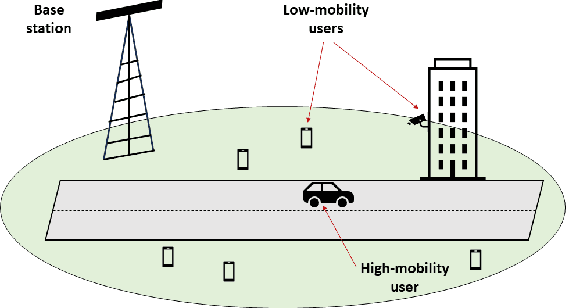
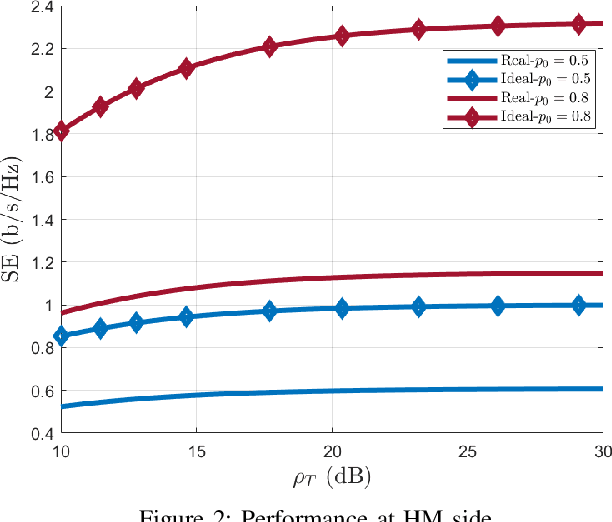
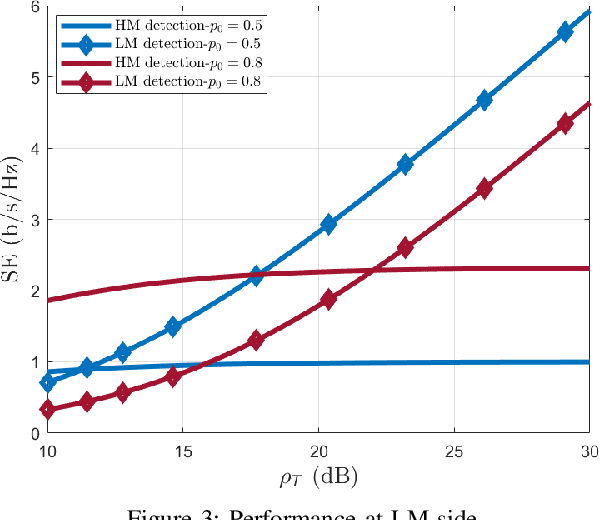
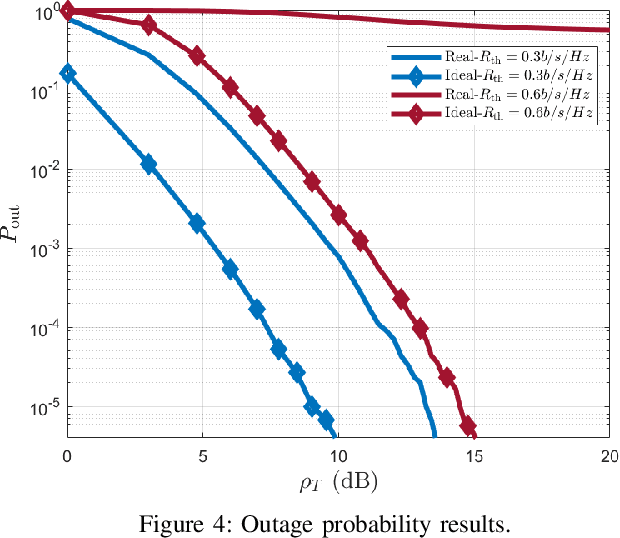
In this work, we investigate the effect of fractional Doppler on the performance of a system using orthogonal time frequency space (OTFS) modulation and non-orthogonal multiple access (NOMA) where users have different mobility profiles. Fractional Doppler results in inter-Doppler interference (IDI) and degrades the quality of OTFS-modulated signals. We consider a downlink (DL) communication scenario where multiple users are distinguished based on their mobility profiles into a single high-mobility (HM) user and multiple low-mobility (LM) users. OTFS modulation is implemented for the HM user by embedding its information symbols in the delay-Doppler domain, while LM users' symbols are represented in the time-frequency (TF) domain. The LM users' signals are kept orthogonal to each other in the frequency domain by accessing disjoint subcarriers. Further, NOMA spectrum sharing is implemented between the HM user and the KM users to achieve higher spectral efficiency. Performance analysis in terms of DL spectral efficiency and outage probability is conducted for different system parameters. The numerical results show that IDI has a noticeable performance impact on the HM user, depending on the NOMA parameters.
OTFS-NOMA System for MIMO Communication Networks with Spatial Diversity
Jun 27, 2024
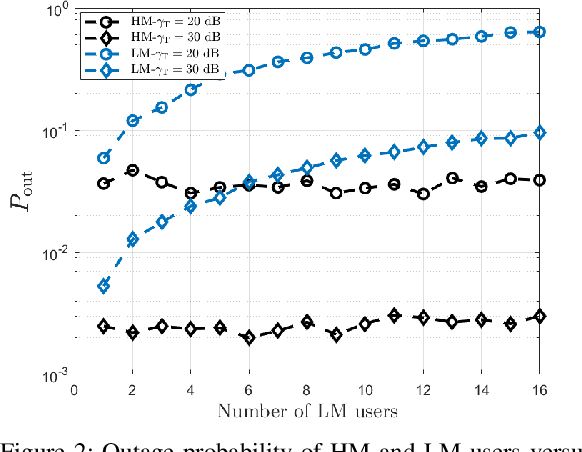


In this work, we study the use of non-orthogonal multiple access (NOMA) and orthogonal time frequency space (OTFS) modulation in a multiple-input multiple-output (MIMO) communication network where mobile users (MUs) with different mobility profiles are grouped into clusters. We consider a downlink scenario where a base station (BS) communicates with multiple users that have diverse mobility profiles. High-mobility (HM) users' signals are placed in the delay-Doppler (DD) domain using OTFS modulation in order to transform their time-varying channel into a sparse static channel, while low-mobility (LM) users signals are placed in the time-frequency (TF) domain. Precoding is adopted at the BS to direct focused beams towards each cluster of users. Moreover, NOMA spectrum sharing is used in each cluster to allow the coexistence of a single HM user and multiple LM users within the same resource block. LM users access disjoint subchannels to ensure their orthogonality. All users within the same cluster first detect the HM user's signal. Afterward, LM users suppress the interference from the HM user and detect their own signals. Closed-form expressions of the detection signal-to-noise ratios (SNRs) are derived. The numerical results showed that the performance of the proposed system highly depends on the number of LM users, the number of clusters and the power allocation factors between HM and LM users.