 Add to Chrome
 Add to Firefox
 Add to Edge
Predicting the Outcome of rTMS Depression Therapy using EEG Signals and CNN
Jul 24, 2026
Repetitive transcranial magnetic stimulation (rTMS) is a non invasive therapy for Major Depressive Disorder (MDD). In this study, we generate images using two time frequency methods to represent EEG signals: Fourier-Bessel Series Expansion with Euclidean Distance (FBSE-ED) and Discrete Wavelet Transform (DWT). We propose an efficient deep learning classifier to predict the outcome of rTMS depression therapy. In this study, we use a private rTMS databases to train a lightweight custom Convolutional Neural Network (CNN) using 10-fold cross validation strategy in order to avoid any bias in our results. The results show that the FBSE-ED representation achieves the highest classification accuracy of 93.60\%, outperforming traditional time-frequency technique (DWT). In addition, the proposed architecture with FBSE-ED image representation technique outperforms more complex EEG-Specific deep learning models (EEGNet, DeepConvNet, SleepEEGNet) by 3.62-10.72% and pretrained models (Xception, DenseNet201, and MobileNetV2) by 23.03-27.35%. For more experiments, we utilize another private rTMS database as test database to show the robustness of the proposed model. Our results suggest that integrating advanced signal decomposition with deep learning can facilitate early prediction of rTMS treatment response and support more targeted clinical decision-making. The proposed framework is interpretable, computationally efficient, and well-suited for deployment in real-world local psychiatric clinics.

Optimizing Neural Network Weights using Nature-Inspired Algorithms
May 20, 2021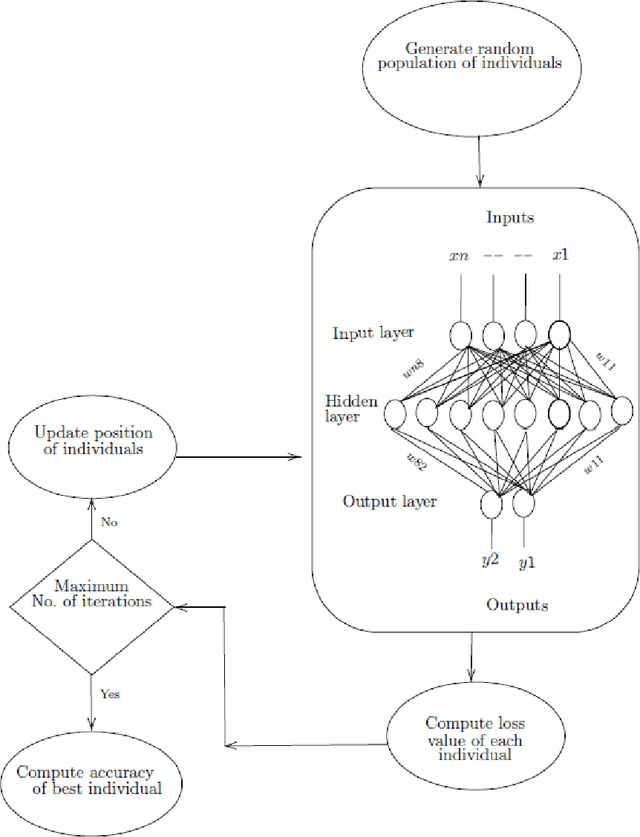
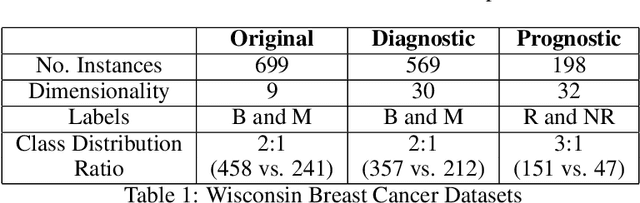
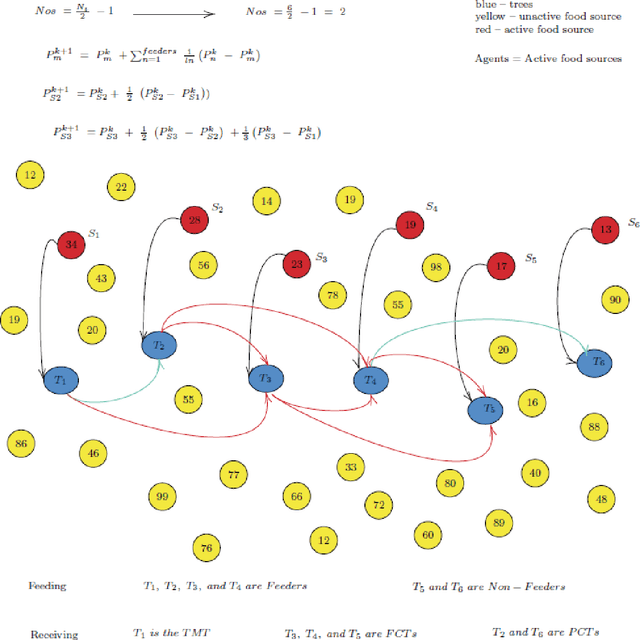
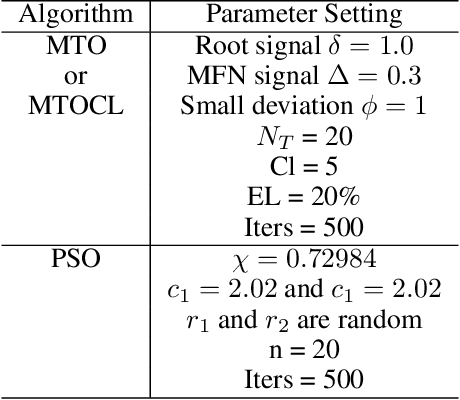
This study aims to optimize Deep Feedforward Neural Networks (DFNNs) training using nature-inspired optimization algorithms, such as PSO, MTO, and its variant called MTOCL. We show how these algorithms efficiently update the weights of DFNNs when learning from data. We evaluate the performance of DFNN fused with optimization algorithms using three Wisconsin breast cancer datasets, Original, Diagnostic, and Prognosis, under different experimental scenarios. The empirical analysis demonstrates that MTOCL is the most performing in most scenarios across the three datasets. Also, MTOCL is comparable to past weight optimization algorithms for the original dataset, and superior for the other datasets, especially for the challenging Prognostic dataset.