 Add to Chrome
 Add to Firefox
 Add to Edge
Lung nodule classification on CT scan patches using 3D convolutional neural networks
Feb 13, 2026
Lung cancer remains one of the most common and deadliest forms of cancer worldwide. The likelihood of successful treatment depends strongly on the stage at which the disease is diagnosed. Therefore, early detection of lung cancer represents a critical medical challenge. However, this task poses significant difficulties for thoracic radiologists due to the large number of studies to review, the presence of multiple nodules within the lungs, and the small size of many nodules, which complicates visual assessment. Consequently, the development of automated systems that incorporate highly accurate and computationally efficient lung nodule detection and classification modules is essential. This study introduces three methodological improvements for lung nodule classification: (1) an advanced CT scan cropping strategy that focuses the model on the target nodule while reducing computational cost; (2) target filtering techniques for removing noisy labels; (3) novel augmentation methods to improve model robustness. The integration of these techniques enables the development of a robust classification subsystem within a comprehensive Clinical Decision Support System for lung cancer detection, capable of operating across diverse acquisition protocols, scanner types, and upstream models (segmentation or detection). The multiclass model achieved a Macro ROC AUC of 0.9176 and a Macro F1-score of 0.7658, while the binary model reached a Binary ROC AUC of 0.9383 and a Binary F1-score of 0.8668 on the LIDC-IDRI dataset. These results outperform several previously reported approaches and demonstrate state-of-the-art performance for this task.

Multimodal system for skin cancer detection
Jan 21, 2026Melanoma detection is vital for early diagnosis and effective treatment. While deep learning models on dermoscopic images have shown promise, they require specialized equipment, limiting their use in broader clinical settings. This study introduces a multi-modal melanoma detection system using conventional photo images, making it more accessible and versatile. Our system integrates image data with tabular metadata, such as patient demographics and lesion characteristics, to improve detection accuracy. It employs a multi-modal neural network combining image and metadata processing and supports a two-step model for cases with or without metadata. A three-stage pipeline further refines predictions by boosting algorithms and enhancing performance. To address the challenges of a highly imbalanced dataset, specific techniques were implemented to ensure robust training. An ablation study evaluated recent vision architectures, boosting algorithms, and loss functions, achieving a peak Partial ROC AUC of 0.18068 (0.2 maximum) and top-15 retrieval sensitivity of 0.78371. Results demonstrate that integrating photo images with metadata in a structured, multi-stage pipeline yields significant performance improvements. This system advances melanoma detection by providing a scalable, equipment-independent solution suitable for diverse healthcare environments, bridging the gap between specialized and general clinical practices.
Interactive decision support system for lung cancer segmentation
Aug 26, 2024This paper studies Clinical Intelligent Decision Support Systems (CIDSSs) for lung cancer segmentation, which are based on deep neural nets. A new interactive CIDSS is proposed and compared with previous approaches. Addition-ally, the purpose uncertainty problem in building interactive systems is discussed, and criteria for measuring both quality and amount of user feedback are proposed. In order to automate system evaluation, a new algorithm was used to simulate expert feedback. The proposed interactive CIDSS outperforms previous approaches (both interactive and noninteractive) on the task of lung lesion segmentation. This ap-proach looks promising both in terms of quality and expert user experience. At the same time, this paper discusses a bunch of possible modifications that can be done to improve both evaluation criteria and proposed CIDSS in future works.
* 14 pages, 8 figures
Semi-Supervised Segmentation of Functional Tissue Units at the Cellular Level
May 03, 2023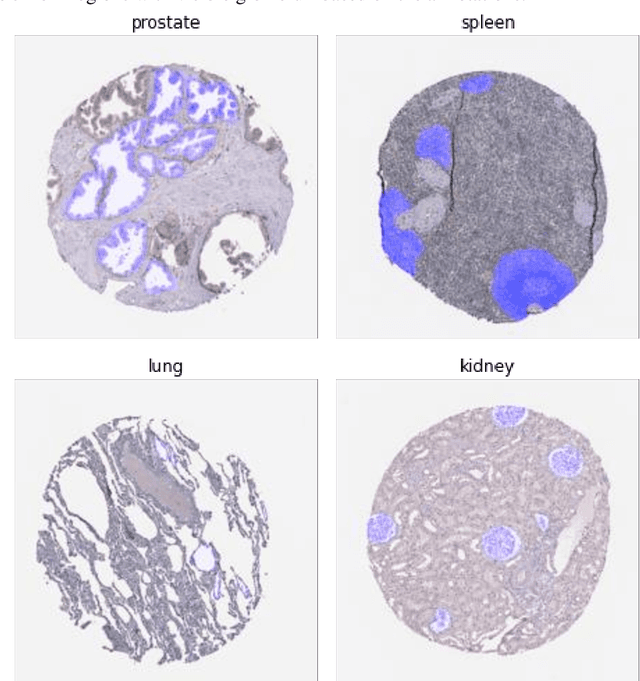
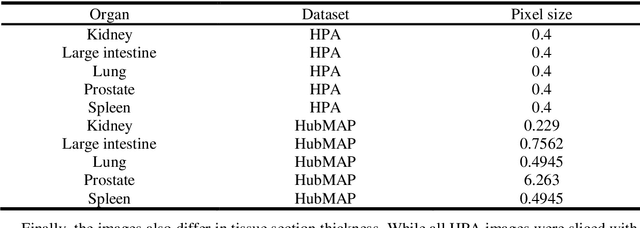
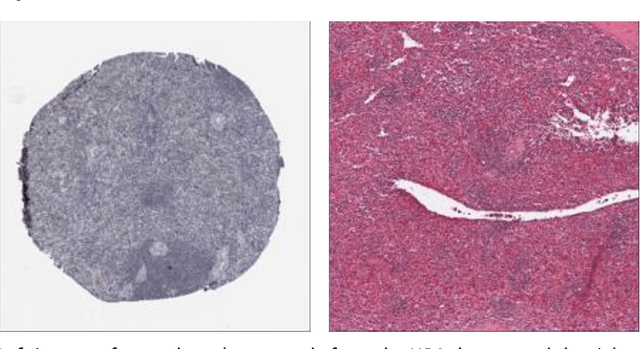
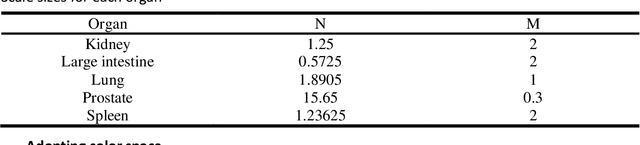
We present a new method for functional tissue unit segmentation at the cellular level, which utilizes the latest deep learning semantic segmentation approaches together with domain adaptation and semi-supervised learning techniques. This approach allows for minimizing the domain gap, class imbalance, and captures settings influence between HPA and HubMAP datasets. The presented approach achieves comparable with state-of-the-art-result in functional tissue unit segmentation at the cellular level. The source code is available at https://github.com/VSydorskyy/hubmap_2022_htt_solution