 Add to Chrome
 Add to Firefox
 Add to Edge
LLMic: Romanian Foundation Language Model
Jan 13, 2025
Recent advances in Large Language Models (LLMs) have demonstrated remarkable capabilities across various tasks with commercial models leading the way. While open models usually operate at a smaller scale, they maintain competitiveness through specialization and fine-tuning. However, a significant challenge persists: open models often underperform in low-resource languages due to limited representation in the training corpus. In this paper, we present LLMic, a bilingual foundation language model designed specifically for the Romanian Language. We document the complete process of pretraining a foundation model for a low-resource language, including corpus construction, architecture selection, and hyper-parameter optimization. Our evaluation demonstrates that LLMic can be specialized for tasks in the target language, achieving results comparable to other much larger open models. We show that fine-tuning LLMic for language translation after the initial pretraining phase outperforms existing solutions in English-to-Romanian translation tasks. This opens the path for efficient large-scale processing for the Romanian language community, using the much smaller LLMic model

FuLG: 150B Romanian Corpus for Language Model Pretraining
Jul 18, 2024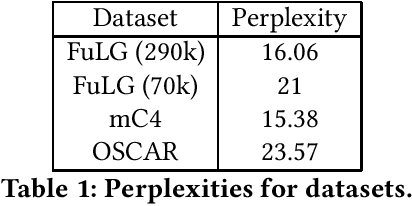
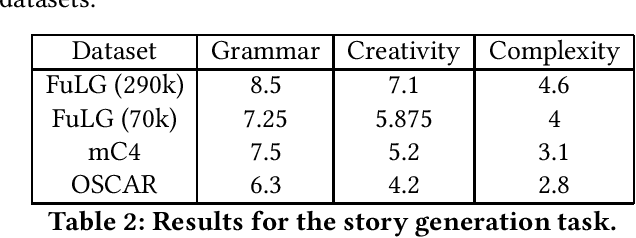
Research in the field of language models is rapidly evolving, with many open models being released to the public. Openly available pretraining corpora usually focus on only a handful of languages, with many others either missing completely or extremely underrepresented. In this report, we introduce FuLG, a hundred-fifty-billion-token Romanian corpus extracted from CommonCrawl. We present our methodology for filtering FuLG and compare it via ablation studies against existing Romanian corpora.
Prose-to-P4: Leveraging High Level Languages
Jun 19, 2024Languages such as P4 and NPL have enabled a wide and diverse range of networking applications that take advantage of programmable dataplanes. However, software development in these languages is difficult. To address this issue, high-level languages have been designed to offer programmers powerful abstractions that reduce the time, effort and domain-knowledge required for developing networking applications. These languages are then translated by a compiler into P4/NPL code. Inspired by the recent success of Large Language Models (LLMs) in the task of code generation, we propose to raise the level of abstraction even higher, employing LLMs to translate prose into high-level networking code. We analyze the problem, focusing on the motivation and opportunities, as well as the challenges involved and sketch out a roadmap for the development of a system that can generate high-level dataplane code from natural language instructions. We present some promising preliminary results on generating Lucid code from natural language.