 Add to Chrome
 Add to Firefox
 Add to Edge
Emulating Aggregate Human Choice Behavior and Biases with GPT Conversational Agents
Feb 05, 2026
Cognitive biases often shape human decisions. While large language models (LLMs) have been shown to reproduce well-known biases, a more critical question is whether LLMs can predict biases at the individual level and emulate the dynamics of biased human behavior when contextual factors, such as cognitive load, interact with these biases. We adapted three well-established decision scenarios into a conversational setting and conducted a human experiment (N=1100). Participants engaged with a chatbot that facilitates decision-making through simple or complex dialogues. Results revealed robust biases. To evaluate how LLMs emulate human decision-making under similar interactive conditions, we used participant demographics and dialogue transcripts to simulate these conditions with LLMs based on GPT-4 and GPT-5. The LLMs reproduced human biases with precision. We found notable differences between models in how they aligned human behavior. This has important implications for designing and evaluating adaptive, bias-aware LLM-based AI systems in interactive contexts.

Predicting Biased Human Decision-Making with Large Language Models in Conversational Settings
Jan 16, 2026We examine whether large language models (LLMs) can predict biased decision-making in conversational settings, and whether their predictions capture not only human cognitive biases but also how those effects change under cognitive load. In a pre-registered study (N = 1,648), participants completed six classic decision-making tasks via a chatbot with dialogues of varying complexity. Participants exhibited two well-documented cognitive biases: the Framing Effect and the Status Quo Bias. Increased dialogue complexity resulted in participants reporting higher mental demand. This increase in cognitive load selectively, but significantly, increased the effect of the biases, demonstrating the load-bias interaction. We then evaluated whether LLMs (GPT-4, GPT-5, and open-source models) could predict individual decisions given demographic information and prior dialogue. While results were mixed across choice problems, LLM predictions that incorporated dialogue context were significantly more accurate in several key scenarios. Importantly, their predictions reproduced the same bias patterns and load-bias interactions observed in humans. Across all models tested, the GPT-4 family consistently aligned with human behavior, outperforming GPT-5 and open-source models in both predictive accuracy and fidelity to human-like bias patterns. These findings advance our understanding of LLMs as tools for simulating human decision-making and inform the design of conversational agents that adapt to user biases.
Virtue Ethics For Ethically Tunable Robotic Assistants
Jul 23, 2024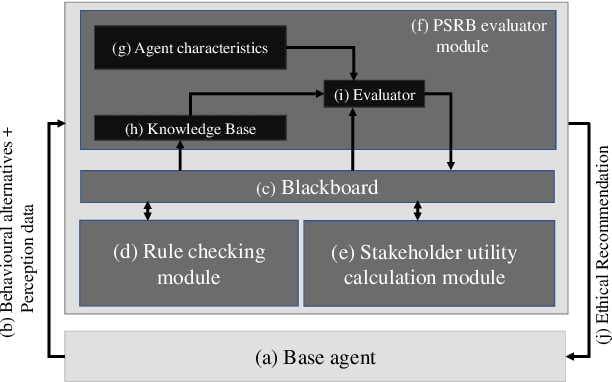
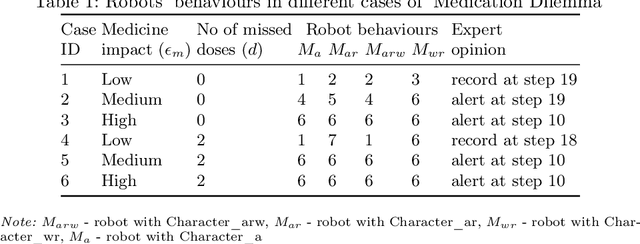
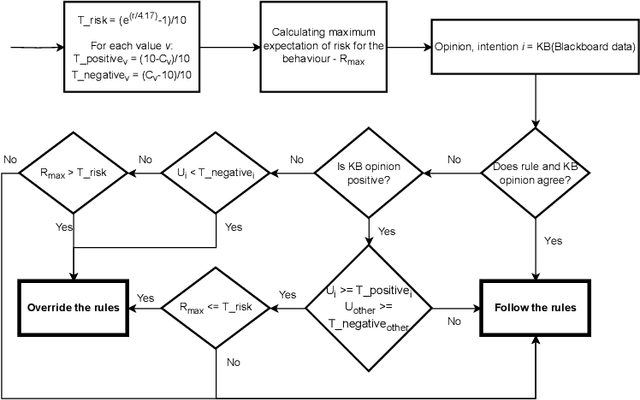
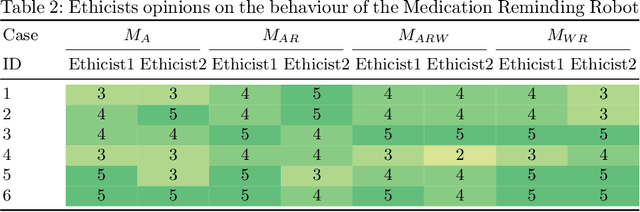
The common consensus is that robots designed to work alongside or serve humans must adhere to the ethical standards of their operational environment. To achieve this, several methods based on established ethical theories have been suggested. Nonetheless, numerous empirical studies show that the ethical requirements of the real world are very diverse and can change rapidly from region to region. This eliminates the idea of a universal robot that can fit into any ethical context. However, creating customised robots for each deployment, using existing techniques is challenging. This paper presents a way to overcome this challenge by introducing a virtue ethics inspired computational method that enables character-based tuning of robots to accommodate the specific ethical needs of an environment. Using a simulated elder-care environment, we illustrate how tuning can be used to change the behaviour of a robot that interacts with an elderly resident in an ambient-assisted environment. Further, we assess the robot's responses by consulting ethicists to identify potential shortcomings.
Towards An Ethics-Audit Bot
Mar 29, 2021In this paper we focus on artificial intelligence (AI) for governance, not governance for AI, and on just one aspect of governance, namely ethics audit. Different kinds of ethical audit bots are possible, but who makes the choices and what are the implications? In this paper, we do not provide ethical/philosophical solutions, but rather focus on the technical aspects of what an AI-based solution for validating the ethical soundness of a target system would be like. We propose a system that is able to conduct an ethical audit of a target system, given certain socio-technical conditions. To be more specific, we propose the creation of a bot that is able to support organisations in ensuring that their software development lifecycles contain processes that meet certain ethical standards.
Automation: An Essential Component Of Ethical AI?
Mar 29, 2021Ethics is sometimes considered to be too abstract to be meaningfully implemented in artificial intelligence (AI). In this paper, we reflect on other aspects of computing that were previously considered to be very abstract. Yet, these are now accepted as being done very well by computers. These tasks have ranged from multiple aspects of software engineering to mathematics to conversation in natural language with humans. This was done by automating the simplest possible step and then building on it to perform more complex tasks. We wonder if ethical AI might be similarly achieved and advocate the process of automation as key step in making AI take ethical decisions. The key contribution of this paper is to reflect on how automation was introduced into domains previously considered too abstract for computers.
Landscape of Machine Implemented Ethics
Sep 01, 2020

This paper surveys the state-of-the-art in machine ethics, that is, considerations of how to implement ethical behaviour in robots, unmanned autonomous vehicles, or software systems. The emphasis is on covering the breadth of ethical theories being considered by implementors, as well as the implementation techniques being used. There is no consensus on which ethical theory is best suited for any particular domain, nor is there any agreement on which technique is best placed to implement a particular theory. Another unresolved problem in these implementations of ethical theories is how to objectively validate the implementations. The paper discusses the dilemmas being used as validating 'whetstones' and whether any alternative validation mechanism exists. Finally, it speculates that an intermediate step of creating domain-specific ethics might be a possible stepping stone towards creating machines that exhibit ethical behaviour.
* 25 pages
"EHLO WORLD" -- Checking If Your Conversational AI Knows Right from Wrong
Jun 18, 2020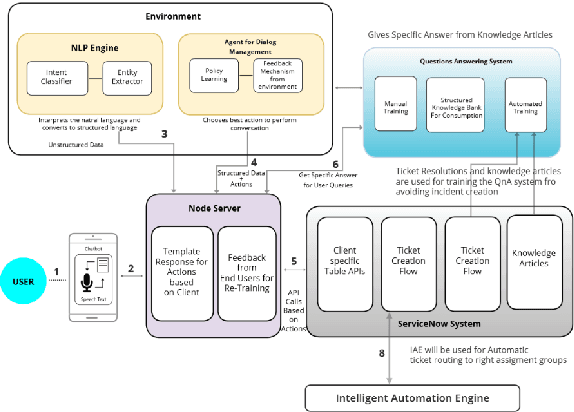
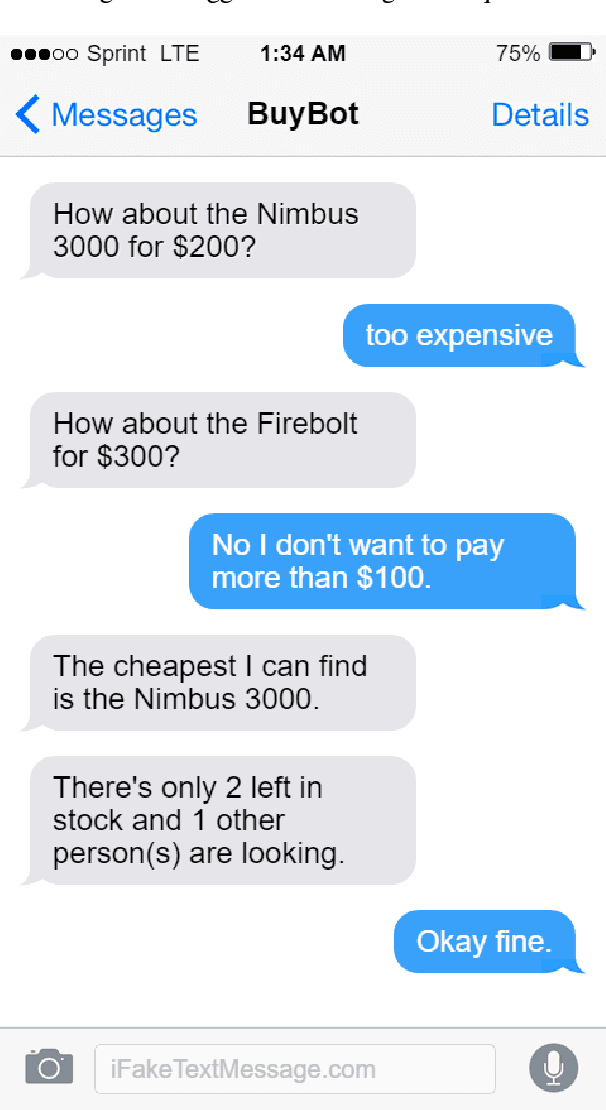
In this paper we discuss approaches to evaluating and validating the ethical claims of a Conversational AI system. We outline considerations around both a top-down regulatory approach and bottom-up processes. We describe the ethical basis for each approach and propose a hybrid which we demonstrate by taking the case of a customer service chatbot as an example. We speculate on the kinds of top-down and bottom-up processes that would need to exist for a hybrid framework to successfully function as both an enabler as well as a shepherd among multiple use-cases and multiple competing AI solutions.