 Add to Chrome
 Add to Firefox
 Add to Edge
Grouped Query Experts: Mixture-of-Experts on GQA Self-Attention
Jun 23, 2026
Self-attention is central to Transformer performance and is often the most expensive part of the Transformer at long context lengths because its pairwise token interactions scale quadratically with sequence length. Standard dense attention also applies the same set of attention heads to every token regardless of token difficulty or information content. This uniform activation can waste compute, especially as sequences grow longer and attention cost increases rapidly. We propose Grouped Query Experts (GQE), a mixture-of-experts layer on top of grouped-query attention (GQA). Within each GQA group, a router selects k query-head experts per token while all key-value (KV) heads remain dense and unchanged. Thus, GQE keeps the KV cache benefits of GQA and reduces only the active query-head computation. On a fixed 30B token budget at the 250M parameter scale, GQE matches the all-active GQA baseline in downstream accuracy while activating half the query heads per token.

The Instruction Gap: LLMs get lost in Following Instruction
Dec 19, 2025Large Language Models (LLMs) have shown remarkable capabilities in natural language understanding and generation, yet their deployment in enterprise environments reveals a critical limitation: inconsistent adherence to custom instructions. This study presents a comprehensive evaluation of 13 leading LLMs across instruction compliance, response accuracy, and performance metrics in realworld RAG (Retrieval-Augmented Generation) scenarios. Through systematic testing with samples and enterprise-grade evaluation protocols, we demonstrate that instruction following varies dramatically across models, with Claude-Sonnet-4 and GPT-5 achieving the highest results. Our findings reveal the "instruction gap" - a fundamental challenge where models excel at general tasks but struggle with precise instruction adherence required for enterprise deployment. This work provides practical insights for organizations deploying LLM-powered solutions and establishes benchmarks for instruction-following capabilities across major model families.
Bahasa Harmony: A Comprehensive Dataset for Bahasa Text-to-Speech Synthesis with Discrete Codec Modeling of EnGen-TTS
Oct 09, 2024This research introduces a comprehensive Bahasa text-to-speech (TTS) dataset and a novel TTS model, EnGen-TTS, designed to enhance the quality and versatility of synthetic speech in the Bahasa language. The dataset, spanning \textasciitilde55.0 hours and 52K audio recordings, integrates diverse textual sources, ensuring linguistic richness. A meticulous recording setup captures the nuances of Bahasa phonetics, employing professional equipment to ensure high-fidelity audio samples. Statistical analysis reveals the dataset's scale and diversity, laying the foundation for model training and evaluation. The proposed EnGen-TTS model performs better than established baselines, achieving a Mean Opinion Score (MOS) of 4.45 $\pm$ 0.13. Additionally, our investigation on real-time factor and model size highlights EnGen-TTS as a compelling choice, with efficient performance. This research marks a significant advancement in Bahasa TTS technology, with implications for diverse language applications. Link to Generated Samples: \url{https://bahasa-harmony-comp.vercel.app/}
Komodo: A Linguistic Expedition into Indonesia's Regional Languages
Mar 19, 2024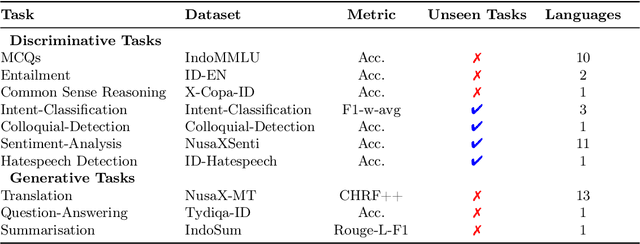


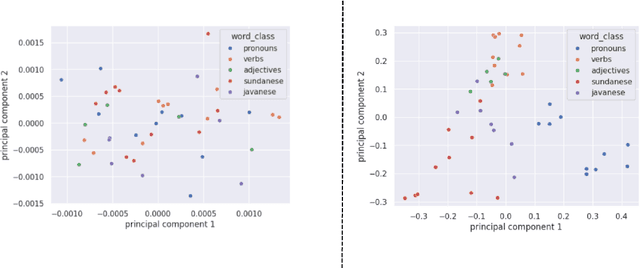
The recent breakthroughs in Large Language Models (LLMs) have mostly focused on languages with easily available and sufficient resources, such as English. However, there remains a significant gap for languages that lack sufficient linguistic resources in the public domain. Our work introduces Komodo-7B, 7-billion-parameter Large Language Models designed to address this gap by seamlessly operating across Indonesian, English, and 11 regional languages in Indonesia. Komodo-7B is a family of LLMs that consist of Komodo-7B-Base and Komodo-7B-Instruct. Komodo-7B-Instruct stands out by achieving state-of-the-art performance in various tasks and languages, outperforming the benchmarks set by OpenAI's GPT-3.5, Cohere's Aya-101, Llama-2-Chat-13B, Mixtral-8x7B-Instruct-v0.1, Gemma-7B-it , and many more. This model not only demonstrates superior performance in both language-specific and overall assessments but also highlights its capability to excel in linguistic diversity. Our commitment to advancing language models extends beyond well-resourced languages, aiming to bridge the gap for those with limited linguistic assets. Additionally, Komodo-7B-Instruct's better cross-language understanding contributes to addressing educational disparities in Indonesia, offering direct translations from English to 11 regional languages, a significant improvement compared to existing language translation services. Komodo-7B represents a crucial step towards inclusivity and effectiveness in language models, providing to the linguistic needs of diverse communities.
Beyond Extraction: Contextualising Tabular Data for Efficient Summarisation by Language Models
Jan 16, 2024The conventional use of the Retrieval-Augmented Generation (RAG) architecture has proven effective for retrieving information from diverse documents. However, challenges arise in handling complex table queries, especially within PDF documents containing intricate tabular structures.This research introduces an innovative approach to enhance the accuracy of complex table queries in RAG-based systems. Our methodology involves storing PDFs in the retrieval database and extracting tabular content separately. The extracted tables undergo a process of context enrichment, concatenating headers with corresponding values. To ensure a comprehensive understanding of the enriched data, we employ a fine-tuned version of the Llama-2-chat language model for summarisation within the RAG architecture. Furthermore, we augment the tabular data with contextual sense using the ChatGPT 3.5 API through a one-shot prompt. This enriched data is then fed into the retrieval database alongside other PDFs. Our approach aims to significantly improve the precision of complex table queries, offering a promising solution to a longstanding challenge in information retrieval.