 Add to Chrome
 Add to Firefox
 Add to Edge
Reinforcement Learning-Based Co-Design and Operation of Chiller and Thermal Energy Storage for Cost-Optimal HVAC Systems
Jan 30, 2026
We study the joint operation and sizing of cooling infrastructure for commercial HVAC systems using reinforcement learning, with the objective of minimizing life-cycle cost over a 30-year horizon. The cooling system consists of a fixed-capacity electric chiller and a thermal energy storage (TES) unit, jointly operated to meet stochastic hourly cooling demands under time-varying electricity prices. The life-cycle cost accounts for both capital expenditure and discounted operating cost, including electricity consumption and maintenance. A key challenge arises from the strong asymmetry in capital costs: increasing chiller capacity by one unit is far more expensive than an equivalent increase in TES capacity. As a result, identifying the right combination of chiller and TES sizes, while ensuring zero loss-of-cooling-load under optimal operation, is a non-trivial co-design problem. To address this, we formulate the chiller operation problem for a fixed infrastructure configuration as a finite-horizon Markov Decision Process (MDP), in which the control action is the chiller part-load ratio (PLR). The MDP is solved using a Deep Q Network (DQN) with a constrained action space. The learned DQN RL policy minimizes electricity cost over historical traces of cooling demand and electricity prices. For each candidate chiller-TES sizing configuration, the trained policy is evaluated. We then restrict attention to configurations that fully satisfy the cooling demand and perform a life-cycle cost minimization over this feasible set to identify the cost-optimal infrastructure design. Using this approach, we determine the optimal chiller and thermal energy storage capacities to be 700 and 1500, respectively.

A Deep Learning Technique using Low Sampling rate for residential Non Intrusive Load Monitoring
Nov 07, 2021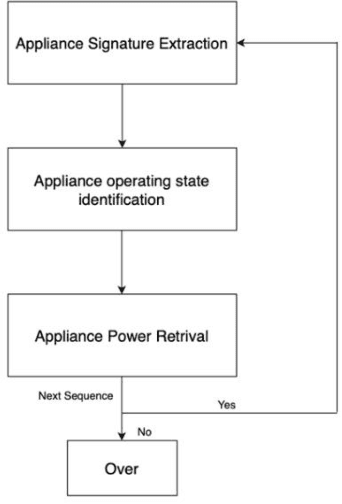
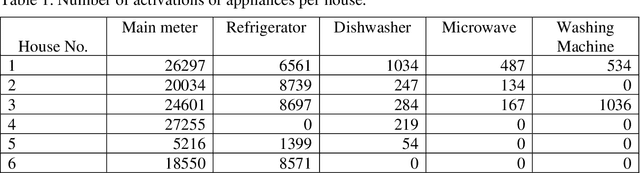


Individual device loads and energy consumption feedback is one of the important approaches for pursuing users to save energy in residences. This can help in identifying faulty devices and wasted energy by devices when left On unused. The main challenge is to identity and estimate the energy consumption of individual devices without intrusive sensors on each device. Non-intrusive load monitoring (NILM) or energy disaggregation, is a blind source separation problem which requires a system to estimate the electricity usage of individual appliances from the aggregated household energy consumption. In this paper, we propose a novel deep neural network-based approach for performing load disaggregation on low frequency power data obtained from residential households. We combine a series of one-dimensional Convolutional Neural Networks and Long Short Term Memory (1D CNN-LSTM) to extract features that can identify active appliances and retrieve their power consumption given the aggregated household power value. We used CNNs to extract features from main readings in a given time frame and then used those features to classify if a given appliance is active at that time period or not. Following that, the extracted features are used to model a generation problem using LSTM. We train the LSTM to generate the disaggregated energy consumption of a particular appliance. Our neural network is capable of generating detailed feedback of demand-side, providing vital insights to the end-user about their electricity consumption. The algorithm was designed for low power offline devices such as ESP32. Empirical calculations show that our model outperforms the state-of-the-art on the Reference Energy Disaggregation Dataset (REDD).