 Add to Chrome
 Add to Firefox
 Add to Edge
VAGNet: Vision-based Accident Anticipation with Global Features
Apr 13, 2026
Traffic accidents are a leading cause of fatalities and injuries across the globe. Therefore, the ability to anticipate hazardous situations in advance is essential. Automated accident anticipation enables timely intervention through driver alerts and collision avoidance maneuvers, forming a key component of advanced driver assistance systems. In autonomous driving, such predictive capabilities support proactive safety behaviors, such as initiating defensive driving and human takeover when required. Using dashcam video as input offers a cost-effective solution, but it is challenging due to the complexity of real-world driving scenes. Accident anticipation systems need to operate in real-time. However, current methods involve extracting features from each detected object, which is computationally intensive. We propose VAGNet, a deep neural network that learns to predict accidents from dash-cam video using global features of traffic scenes without requiring explicit object-level features. The network consists of transformer and graph modules, and we use the vision foundation model VideoMAE-V2 for global feature extraction. Experiments on four benchmark datasets (DAD, DoTA, DADA, and Nexar) show that our method anticipates accidents with higher average precision and mean time-to-accident while being computationally more efficient compared to existing methods.

STAGNet: A Spatio-Temporal Graph and LSTM Framework for Accident Anticipation
Aug 21, 2025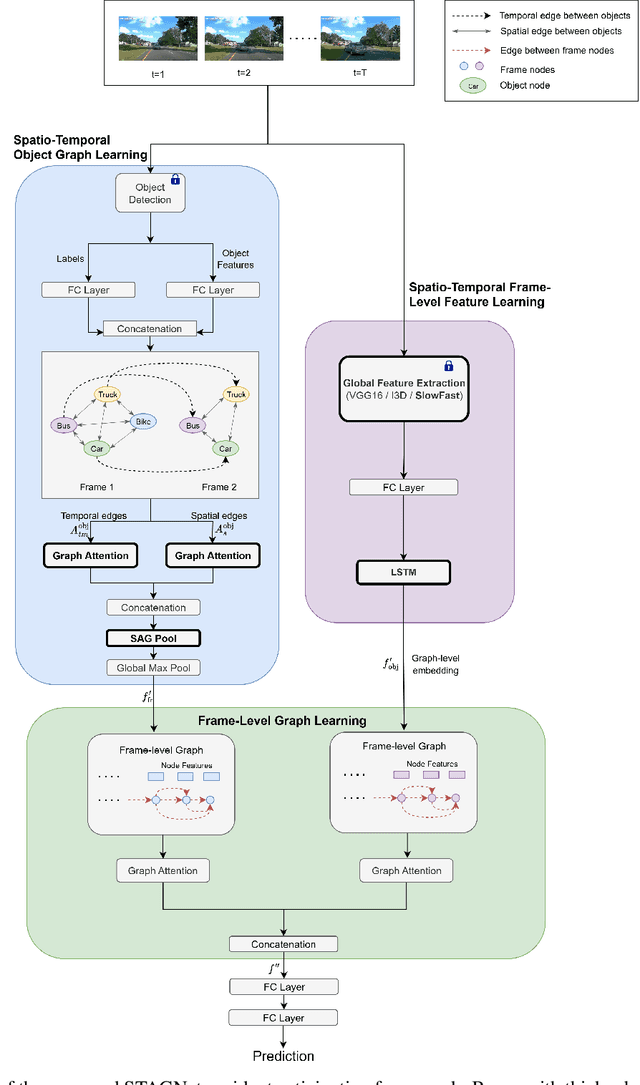
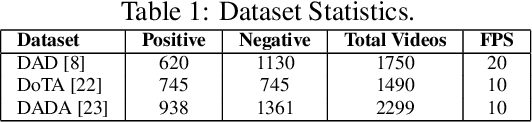
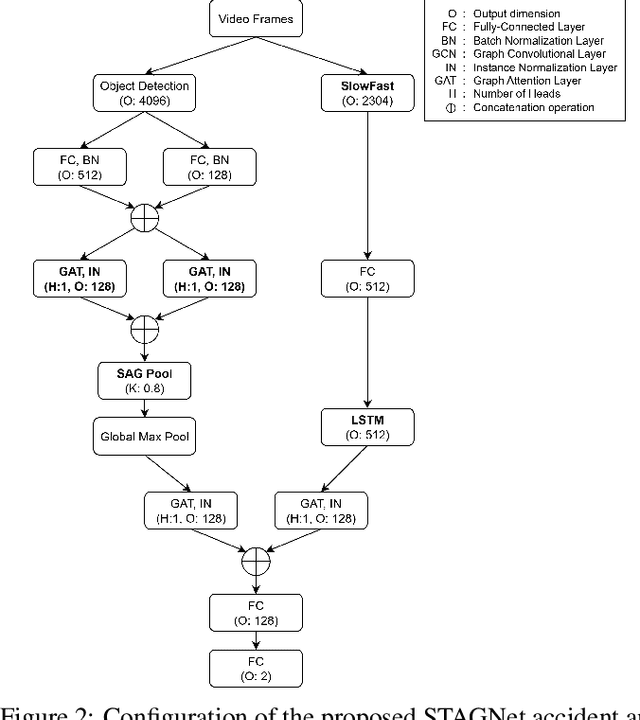
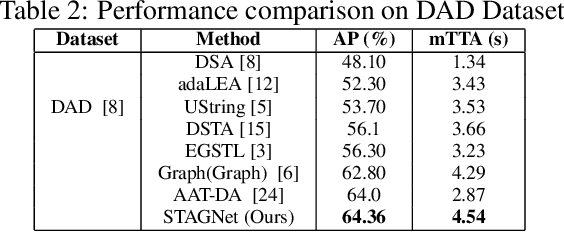
Accident prediction and timely warnings play a key role in improving road safety by reducing the risk of injury to road users and minimizing property damage. Advanced Driver Assistance Systems (ADAS) are designed to support human drivers and are especially useful when they can anticipate potential accidents before they happen. While many existing systems depend on a range of sensors such as LiDAR, radar, and GPS, relying solely on dash-cam video input presents a more challenging but a more cost-effective and easily deployable solution. In this work, we incorporate better spatio-temporal features and aggregate them through a recurrent network to improve upon state-of-the-art graph neural networks for predicting accidents from dash-cam videos. Experiments using three publicly available datasets show that our proposed STAGNet model achieves higher average precision and mean time-to-collision values than previous methods, both when cross-validated on a given dataset and when trained and tested on different datasets.