 Add to Chrome
 Add to Firefox
 Add to Edge
bacpipe: a Python package to make bioacoustic deep learning models accessible
Apr 13, 2026
1. Natural sounds have been recorded for millions of hours over the previous decades using passive acoustic monitoring. Improvements in deep learning models have vastly accelerated the analysis of large portions of this data. While new models advance the state-of-the-art, accessing them using tools to harness their full potential is not always straightforward. Here we present bacpipe, a collection of bioacoustic deep learning models and evaluation pipelines accessible through a graphical and programming interface, designed for both ecologists and computer scientists. Bacpipe is a modular software package intended as a point of convergence for bioacoustic models. 2. Bacpipe streamlines the usage of state-of-the-art models on custom audio datasets, generating acoustic feature vectors (embeddings) and classifier predictions. A modular design allows evaluation and benchmarking of models through interactive visualizations, clustering and probing. 3. We believe that access to new deep learning models is important. By designing bacpipe to target a wide audience, researchers will be enabled to answer new ecological and evolutionary questions in bioacoustics. 4. In conclusion, we believe accessibility to developments in deep learning to a wider audience benefits the ecological questions we are trying to answer.

Uncertainty Calibration of Multi-Label Bird Sound Classifiers
Nov 11, 2025Passive acoustic monitoring enables large-scale biodiversity assessment, but reliable classification of bioacoustic sounds requires not only high accuracy but also well-calibrated uncertainty estimates to ground decision-making. In bioacoustics, calibration is challenged by overlapping vocalisations, long-tailed species distributions, and distribution shifts between training and deployment data. The calibration of multi-label deep learning classifiers within the domain of bioacoustics has not yet been assessed. We systematically benchmark the calibration of four state-of-the-art multi-label bird sound classifiers on the BirdSet benchmark, evaluating both global, per-dataset and per-class calibration using threshold-free calibration metrics (ECE, MCS) alongside discrimination metrics (cmAP). Model calibration varies significantly across datasets and classes. While Perch v2 and ConvNeXt$_{BS}$ show better global calibration, results vary between datasets. Both models indicate consistent underconfidence, while AudioProtoPNet and BirdMAE are mostly overconfident. Surprisingly, calibration seems to be better for less frequent classes. Using simple post hoc calibration methods we demonstrate a straightforward way to improve calibration. A small labelled calibration set is sufficient to significantly improve calibration with Platt scaling, while global calibration parameters suffer from dataset variability. Our findings highlight the importance of evaluating and improving uncertainty calibration in bioacoustic classifiers.
Clustering and novel class recognition: evaluating bioacoustic deep learning feature extractors
Apr 09, 2025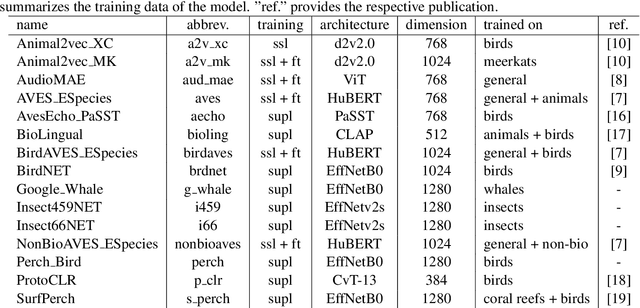
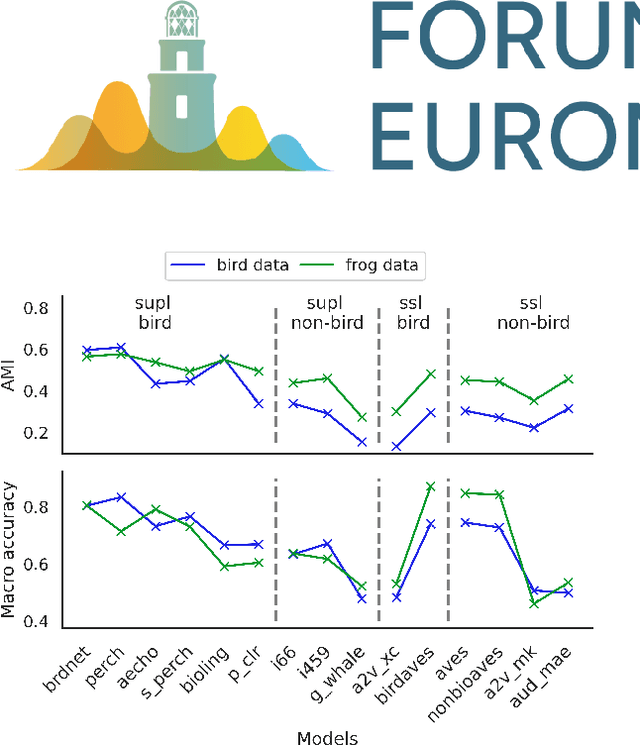
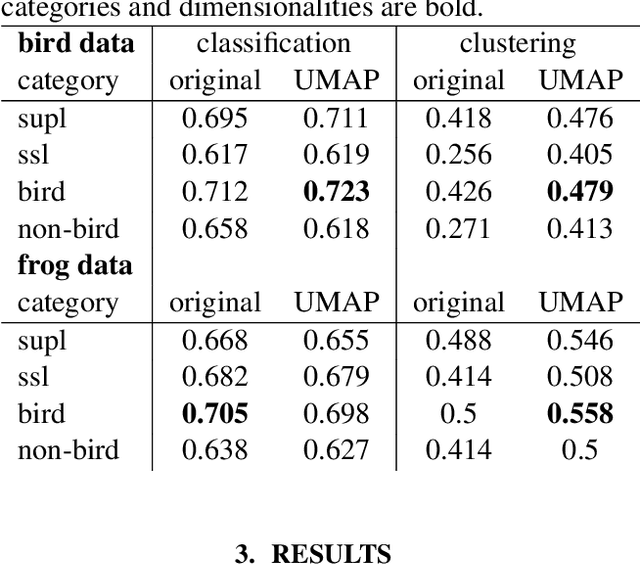
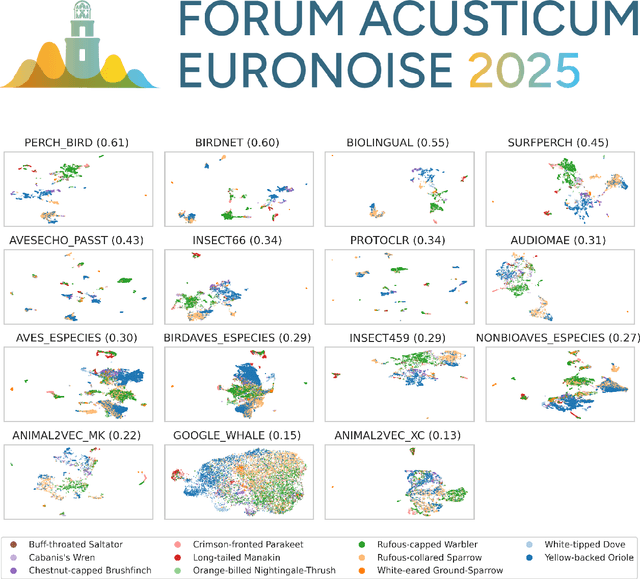
In computational bioacoustics, deep learning models are composed of feature extractors and classifiers. The feature extractors generate vector representations of the input sound segments, called embeddings, which can be input to a classifier. While benchmarking of classification scores provides insights into specific performance statistics, it is limited to species that are included in the models' training data. Furthermore, it makes it impossible to compare models trained on very different taxonomic groups. This paper aims to address this gap by analyzing the embeddings generated by the feature extractors of 15 bioacoustic models spanning a wide range of setups (model architectures, training data, training paradigms). We evaluated and compared different ways in which models structure embedding spaces through clustering and kNN classification, which allows us to focus our comparison on feature extractors independent of their classifiers. We believe that this approach lets us evaluate the adaptability and generalization potential of models going beyond the classes they were trained on.