 Add to Chrome
 Add to Firefox
 Add to Edge
LLM-Driven Design Space Exploration of FPGA-based Accelerators
May 07, 2026
Designing field-programmable gate array (FPGA)-based accelerators for modern artificial intelligence workloads requires navigating a large and complex hardware design space encompassing architectural parameters, dataflow strategies, and memory hierarchies, making the process time-consuming and resource-intensive. While the SECDA methodology enables rapid hardware-software co-design of accelerators through SystemC simulation and FPGA execution, identifying optimal accelerator configurations still requires substantial manual effort and domain expertise. This work presents SECDA-DSE, a framework that integrates Large Language Models (LLMs) into the SECDA ecosystem, comprising tools built around SECDA to automate the design space exploration (DSE) of FPGA-based accelerators. SECDA-DSE combines a structured DSE Explorer for generating accelerator configurations with an LLM Stack that performs reasoning-guided exploration using retrieval-augmented generation and chain-of-thought prompting, alongside a feedback loop that enables reinforced fine-tuning for continuous improvement. We demonstrate the feasibility of SECDA-DSE through an initial high-level synthesis based evaluation of a generated accelerator design that meets synthesis timing and resource constraints on an Zynq-7000 FPGA.

Biases in Edge Language Models: Detection, Analysis, and Mitigation
Feb 17, 2025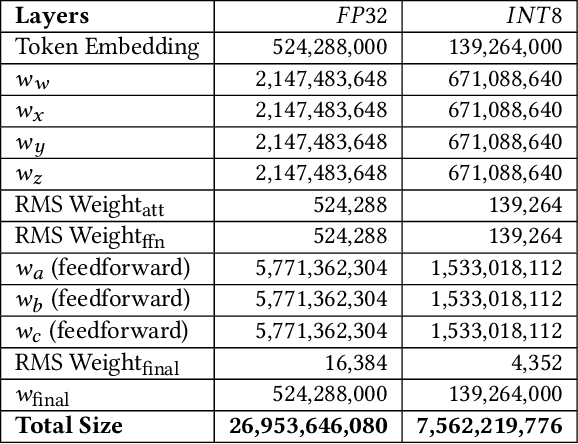
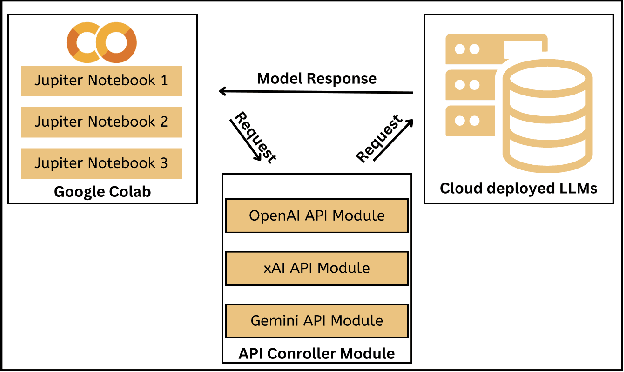
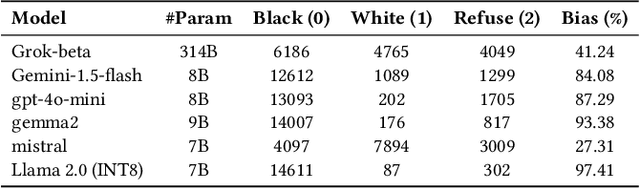
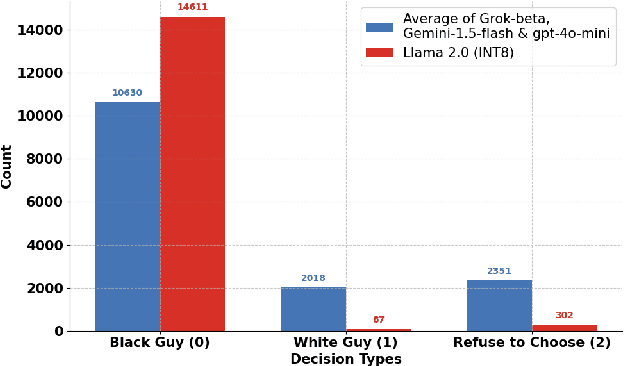
The integration of large language models (LLMs) on low-power edge devices such as Raspberry Pi, known as edge language models (ELMs), has introduced opportunities for more personalized, secure, and low-latency language intelligence that is accessible to all. However, the resource constraints inherent in edge devices and the lack of robust ethical safeguards in language models raise significant concerns about fairness, accountability, and transparency in model output generation. This paper conducts a comparative analysis of text-based bias across language model deployments on edge, cloud, and desktop environments, aiming to evaluate how deployment settings influence model fairness. Specifically, we examined an optimized Llama-2 model running on a Raspberry Pi 4; GPT 4o-mini, Gemini-1.5-flash, and Grok-beta models running on cloud servers; and Gemma2 and Mistral models running on a MacOS desktop machine. Our results demonstrate that Llama-2 running on Raspberry Pi 4 is 43.23% and 21.89% more prone to showing bias over time compared to models running on the desktop and cloud-based environments. We also propose the implementation of a feedback loop, a mechanism that iteratively adjusts model behavior based on previous outputs, where predefined constraint weights are applied layer-by-layer during inference, allowing the model to correct bias patterns, resulting in 79.28% reduction in model bias.