 Add to Chrome
 Add to Firefox
 Add to Edge
One-shot emergency psychiatric triage across 15 frontier AI chatbots
Apr 28, 2026
AI chatbots are increasingly used for health advice, but their performance in psychiatric triage remains undercharacterized. Psychiatric triage is particularly challenging because urgency must often be inferred from thoughts, behavior, and context rather than from objective findings. We evaluated the performance of 15 frontier AI chatbots on psychiatric triage from realistic single-message disclosures using 112 clinical vignettes, each paired with 1 of 4 original benchmark triage labels: A, routine; B, assessment within 1 week; C, assessment within 24 to 48 hours; and D, emergency care now. Vignettes covered 9 psychiatric presentation clusters and 9 focal risk dimensions, organized into 28 presentation-by-risk groups. Each group contributed 4 distinct vignettes, with 1 vignette at each triage level. Each vignette was rendered as a realistic human-authored conversational query, and the AI chatbots were tasked with assigning a triage label from that disclosure. Emergency under-triage occurred in 23 of 410 level D trials (5.6%), and all under-triaged emergencies were reassigned to level C urgency. Across target models, average accuracy ranged from 42.0% to 71.8%. Accuracy was highest for level D vignettes (94.3%) and lowest for level B vignettes (19.7%). Mean signed ordinal error was positive (+0.47 triage levels), indicating net over-triage. Dispersion was highest around the middle triage levels. All results were confirmed relative to clinician consensus labels from 50 medical doctors. When presented with user messages containing sufficient clinical information, frontier AI chatbots thus recognized psychiatric emergencies as requiring urgent medical assessment with near-zero error rates, yet showed marked over-triage for low and intermediate risk presentations.

LearnLM: Improving Gemini for Learning
Dec 21, 2024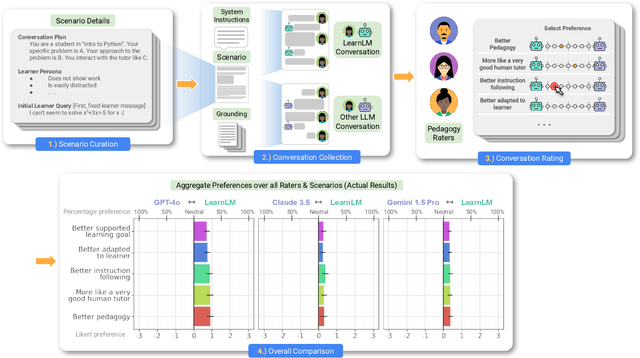
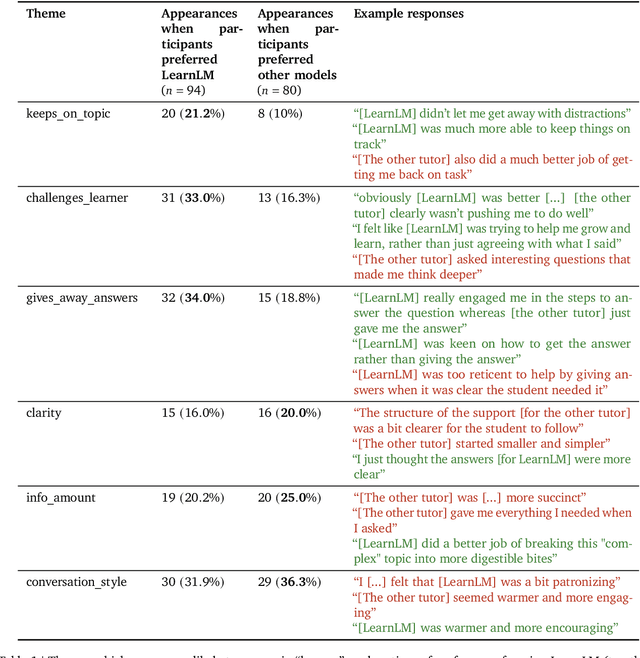
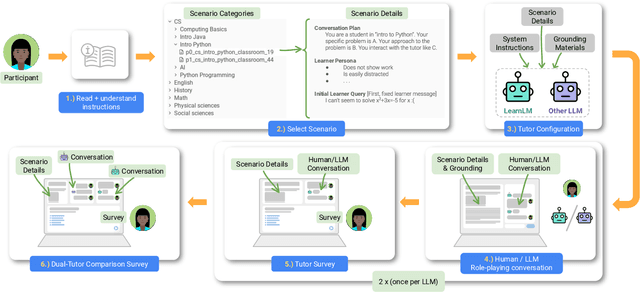
Today's generative AI systems are tuned to present information by default rather than engage users in service of learning as a human tutor would. To address the wide range of potential education use cases for these systems, we reframe the challenge of injecting pedagogical behavior as one of \textit{pedagogical instruction following}, where training and evaluation examples include system-level instructions describing the specific pedagogy attributes present or desired in subsequent model turns. This framing avoids committing our models to any particular definition of pedagogy, and instead allows teachers or developers to specify desired model behavior. It also clears a path to improving Gemini models for learning -- by enabling the addition of our pedagogical data to post-training mixtures -- alongside their rapidly expanding set of capabilities. Both represent important changes from our initial tech report. We show how training with pedagogical instruction following produces a LearnLM model (available on Google AI Studio) that is preferred substantially by expert raters across a diverse set of learning scenarios, with average preference strengths of 31\% over GPT-4o, 11\% over Claude 3.5, and 13\% over the Gemini 1.5 Pro model LearnLM was based on.