 Add to Chrome
 Add to Firefox
 Add to Edge
Stochastic Parroting in Temporal Attention -- Regulating the Diagonal Sink
Feb 11, 2026
Spatio-temporal models analyze spatial structures and temporal dynamics, which makes them prone to information degeneration among space and time. Prior literature has demonstrated that over-squashing in causal attention or temporal convolutions creates a bias on the first tokens. To analyze whether such a bias is present in temporal attention mechanisms, we derive sensitivity bounds on the expected value of the Jacobian of a temporal attention layer. We theoretically show how off-diagonal attention scores depend on the sequence length, and that temporal attention matrices suffer a diagonal attention sink. We suggest regularization methods, and experimentally demonstrate their effectiveness.

Tailored Architectures for Time Series Forecasting: Evaluating Deep Learning Models on Gaussian Process-Generated Data
Jun 10, 2025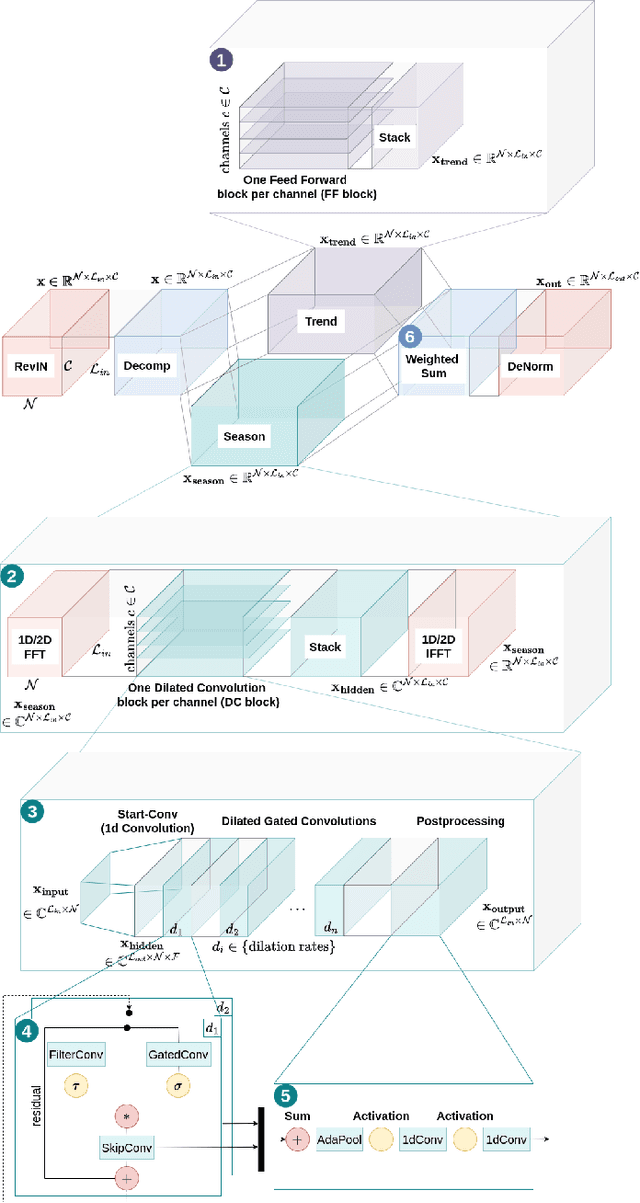
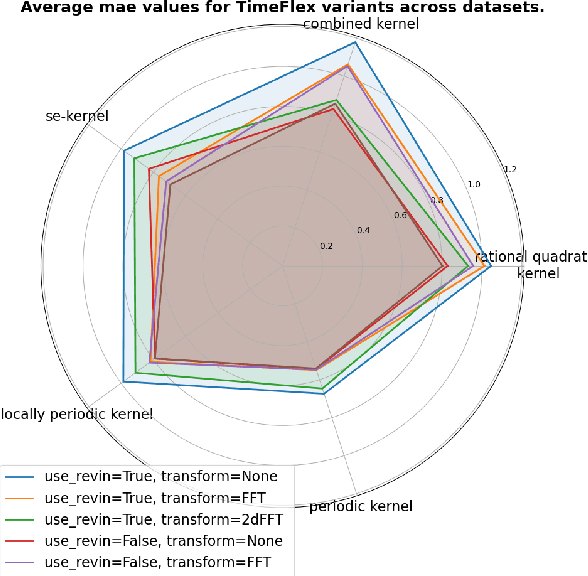
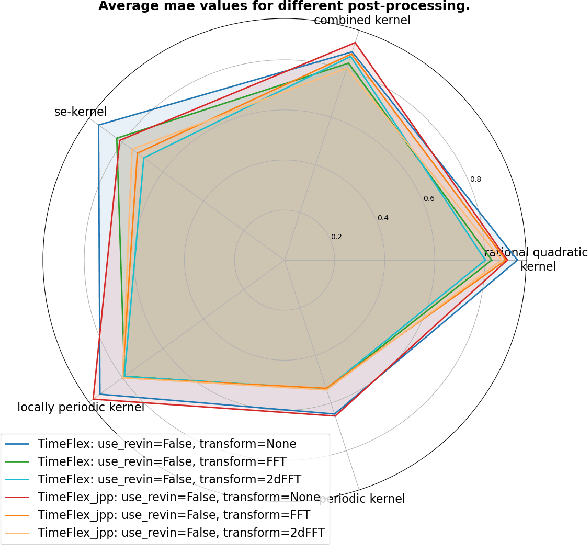
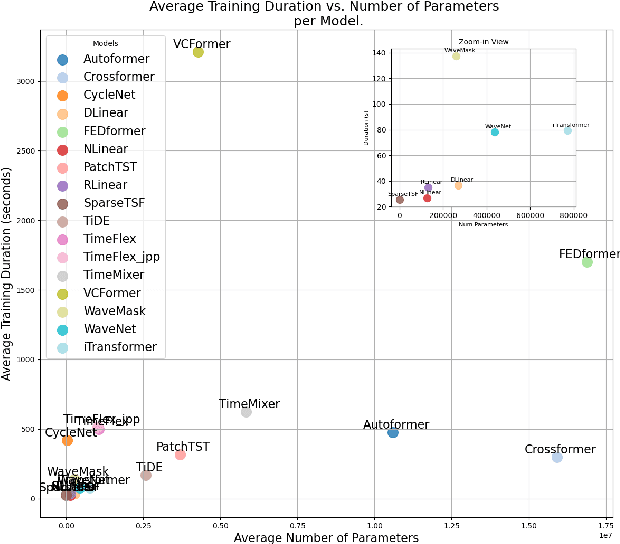
Developments in Deep Learning have significantly improved time series forecasting by enabling more accurate modeling of complex temporal dependencies inherent in sequential data. The effectiveness of such models is often demonstrated on limited sets of specific real-world data. Although this allows for comparative analysis, it still does not demonstrate how specific data characteristics align with the architectural strengths of individual models. Our research aims at uncovering clear connections between time series characteristics and particular models. We introduce a novel dataset generated using Gaussian Processes, specifically designed to display distinct, known characteristics for targeted evaluations of model adaptability to them. Furthermore, we present TimeFlex, a new model that incorporates a modular architecture tailored to handle diverse temporal dynamics, including trends and periodic patterns. This model is compared to current state-of-the-art models, offering a deeper understanding of how models perform under varied time series conditions.