 Add to Chrome
 Add to Firefox
 Add to Edge
Sub Specie Aeternitatis: Fourier Transforms from the Theory of Heat to Musical Signals
Feb 17, 2026
J. B. Fourier in his \emph{Théorie Analytique de la Chaleur} of 1822 introduced, amongst other things, two ideas that have made a fundamental impact in fields as diverse as Mathematical Physics, Electrical Engineering, Computer Science, and Music. The first one of these, a method to find the coefficients for a trigonometric series describing an arbitrary function, was very early on picked up by G. Ohm and H. Helmholtz as the foundation for a theory of \emph{musical tones}. The second one, which is described by Fourier's double integral, became the basis for treating certain kinds of infinity in discontinuous functions, as shown by A. De Morgan in his 1842 \emph{The Differential and Integral Calculus}. Both make up the fundamental basis for what is now commonly known as the \emph{Fourier theorem}. With the help of P. A. M. Dirac's insights into the nature of these infinities, we can have a compact description of the frequency spectrum of a function of time, or conversely of a waveform corresponding to a given function of frequency. This paper, using solely primary sources, takes us from the physics of heat propagation to the modern theory of musical signals. It concludes with some considerations on the inherent duality of time and frequency emerging from Fourier's theorem.

Higher-Order Frequency Modulation Synthesis
May 13, 2023Frequency modulation (FM) and phase modulation (PM) are well-known synthesis methods, which have been deployed widely in musical instruments. More recently, some synthesisers have implemented direct forms of FM (as opposed to PM), allowing, at least as part of their design, for higher-order modulation topologies. However, such implementations are affected by well-known difficulties that arise in the modulation of frequency, which are normally solved by the use of PM. In this article, we analyse these problems and using a direct comparison with PM, we put forward a solution for the direct application of FM in higher-order modulation arrangements. We begin by reviewing the theory of first-order FM, contrasting it to PM. We then proceed to develop a formulation of second-order FM which is equivalent to the issue-free PM synthesis, and present a closed-form expression for the evaluation of the second-order FM spectrum. We then extend the principle to higher-order topologies, by advancing the concept of an FM operator, analogous to the one used in PM instrument designs. From this we demonstrate that feedback FM is also a practical possibility. Finally, we complement the paper by giving a reference implementation in C++.
Improving the Chamberlin Digital State Variable Filter
Nov 10, 2021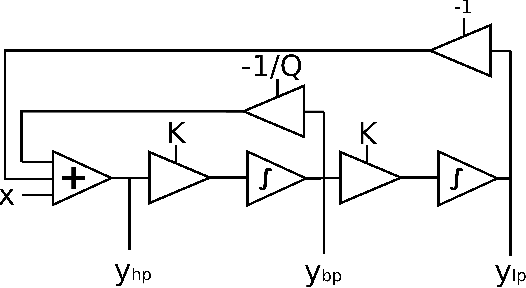
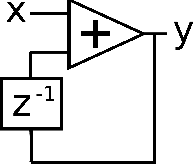
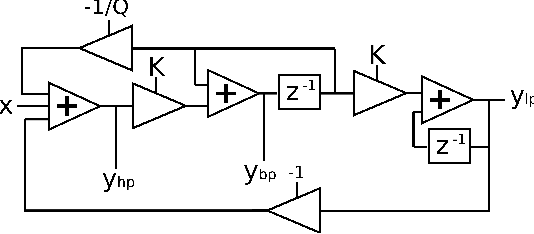
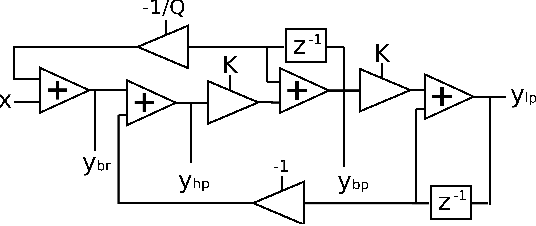
The state variable filter configuration is a classic analogue design which has been employed in many electronic music applications. A digital implementation of this filter was put forward by Chamberlin, which has been deployed in both software and hardware forms. While this has proven to be a straightforward and successful digital filter design, it suffers from some issues, which have already been identified in the literature. From a modified Chamberlin block diagram, we derive the transfer functions describing its three basic responses, highpass, bandpass, and lowpass. An analysis of these leads to the development of an improvement, which attempts to better shape the filter spectrum. From these new transfer functions, a set of filter equations is developed. Finally, the approach is compared to an alternative time-domain based re-organisation of update equations, which is shown to deliver a similar result.