 Add to Chrome
 Add to Firefox
 Add to Edge
Kwame 2.0: Human-in-the-Loop Generative AI Teaching Assistant for Large Scale Online Coding Education in Africa
Mar 31, 2026
Providing timely and accurate learning support in large-scale online coding courses is challenging, particularly in resource-constrained contexts. We present Kwame 2.0, a bilingual (English-French) generative AI teaching assistant built using retrieval-augmented generation and deployed in a human-in-the-loop forum within SuaCode, an introductory mobile-based coding course for learners across Africa. Kwame 2.0 retrieves relevant course materials and generates context-aware responses while encouraging human oversight and community participation. We deployed the system in a 15-month longitudinal study spanning 15 cohorts with 3,717 enrollments across 35 African countries. Evaluation using community feedback and expert ratings shows that Kwame 2.0 provided high-quality and timely support, achieving high accuracy on curriculum-related questions, while human facilitators and peers effectively mitigated errors, particularly for administrative queries. Our findings demonstrate that human-in-the-loop generative AI systems can combine the scalability and speed of AI with the reliability of human support, offering an effective approach to learning assistance for underrepresented populations in resource-constrained settings at scale.

Real-World Deployment and Evaluation of Kwame for Science, An AI Teaching Assistant for Science Education in West Africa
Feb 21, 2023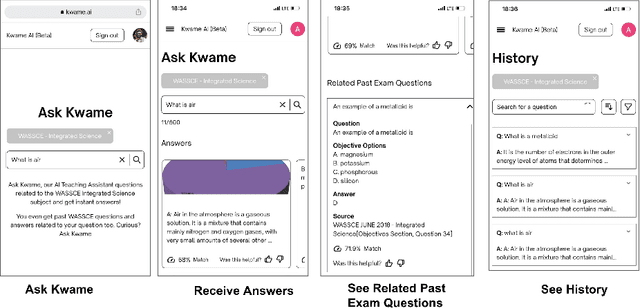
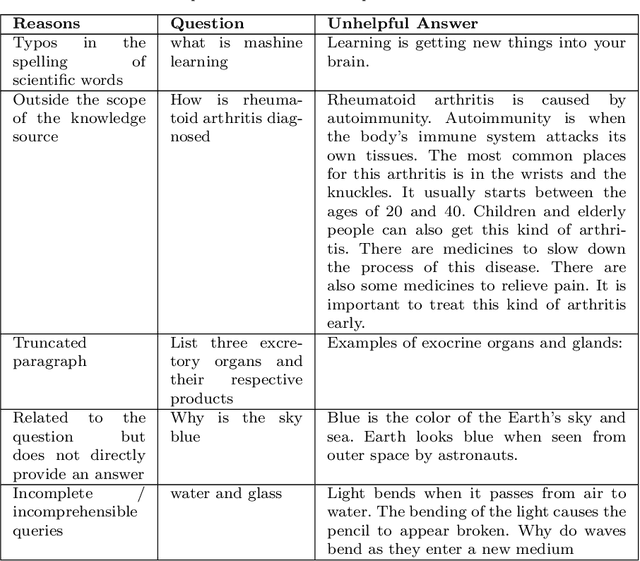
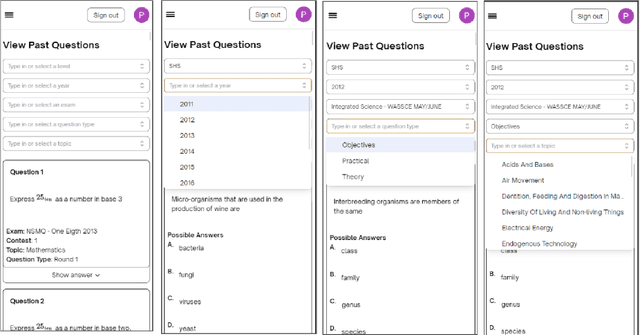
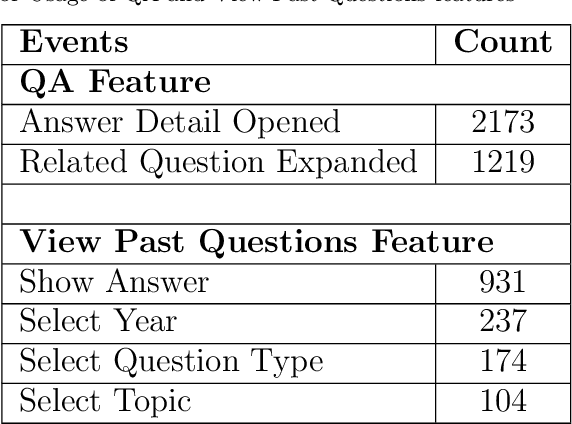
Africa has a high student-to-teacher ratio which limits students' access to teachers for learning support such as educational question answering. In this work, we extended Kwame, our previous AI teaching assistant for coding education, adapted it for science education, and deployed it as a web app. Kwame for Science provides passages from well-curated knowledge sources and related past national exam questions as answers to questions from students based on the Integrated Science subject of the West African Senior Secondary Certificate Examination (WASSCE). Furthermore, students can view past national exam questions along with their answers and filter by year, question type (objectives, theory, and practicals), and topics that were automatically categorized by a topic detection model which we developed (91% unweighted average recall). We deployed Kwame for Science in the real world over 8 months and had 750 users across 32 countries (15 in Africa) and 1.5K questions asked. Our evaluation showed an 87.2% top 3 accuracy (n=109 questions) implying that Kwame for Science has a high chance of giving at least one useful answer among the 3 displayed. We categorized the reasons the model incorrectly answered questions to provide insights for future improvements. We also share challenges and lessons with the development, deployment, and human-computer interaction component of such a tool to enable other researchers to deploy similar tools. With a first-of-its-kind tool within the African context, Kwame for Science has the potential to enable the delivery of scalable, cost-effective, and quality remote education to millions of people across Africa.
Can an AI Win Ghana's National Science and Maths Quiz? An AI Grand Challenge for Education
Jan 30, 2023There is a lack of enough qualified teachers across Africa which hampers efforts to provide adequate learning support such as educational question answering (EQA) to students. An AI system that can enable students to ask questions via text or voice and get instant answers will make high-quality education accessible. Despite advances in the field of AI, there exists no robust benchmark or challenge to enable building such an (EQA) AI within the African context. Ghana's National Science and Maths Quiz competition (NSMQ) is the perfect competition to evaluate the potential of such an AI due to its wide coverage of scientific fields, variety of question types, highly competitive nature, and live, real-world format. The NSMQ is a Jeopardy-style annual live quiz competition in which 3 teams of 2 students compete by answering questions across biology, chemistry, physics, and math in 5 rounds over 5 progressive stages until a winning team is crowned for that year. In this position paper, we propose the NSMQ AI Grand Challenge, an AI Grand Challenge for Education using Ghana's National Science and Maths Quiz competition (NSMQ) as a case study. Our proposed grand challenge is to "Build an AI to compete live in Ghana's National Science and Maths Quiz (NSMQ) competition and win - performing better than the best contestants in all rounds and stages of the competition." We describe the competition, and key technical challenges to address along with ideas from recent advances in machine learning that could be leveraged to solve this challenge. This position paper is a first step towards conquering such a challenge and importantly, making advances in AI for education in the African context towards democratizing high-quality education across Africa.
Kwame for Science: An AI Teaching Assistant for Science Education in West Africa
Jun 28, 2022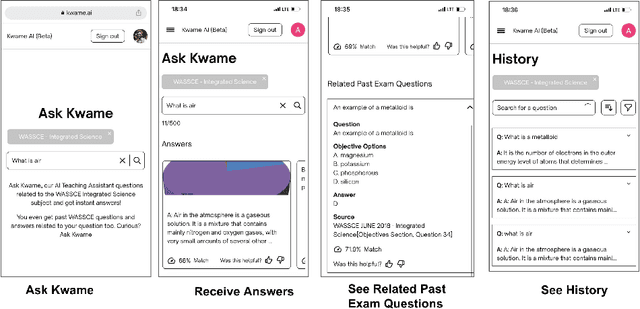
Africa has a high student-to-teacher ratio which limits students' access to teachers. Consequently, students struggle to get answers to their questions. In this work, we extended Kwame, our previous AI teaching assistant, adapted it for science education, and deployed it as a web app. Kwame for Science answers questions of students based on the Integrated Science subject of the West African Senior Secondary Certificate Examination (WASSCE). Kwame for Science is a Sentence-BERT-based question-answering web app that displays 3 paragraphs as answers along with a confidence score in response to science questions. Additionally, it displays the top 5 related past exam questions and their answers in addition to the 3 paragraphs. Our preliminary evaluation of the Kwame for Science with a 2.5-week real-world deployment showed a top 3 accuracy of 87.5% (n=56) with 190 users across 11 countries. Kwame for Science will enable the delivery of scalable, cost-effective, and quality remote education to millions of people across Africa.