 Add to Chrome
 Add to Firefox
 Add to Edge
Similarity-Aware Machine Unlearning
Jul 31, 2026
Machine unlearning removes the influence of user-specified training examples from a trained model, avoiding the need to retrain it from scratch. Localization-based methods improve unlearning efficiency by identifying a subset of influential model parameters. However, existing approaches select parameters based solely on forget-set importance, neglecting their role in retained dataset and often causing collateral damage to semantically similar retained examples. We address this limitation with a retain-aware localization method that considers parameter importance to both forgotten and retained data. We also introduce a retain-similar evaluation set, constructed using cosine similarity in the model embedding space, to directly measure collateral damage. Across eleven experimental settings on CIFAR-10 dataset and ResNet18 model, our method consistently reduces collateral damage while improving standard unlearning metrics, demonstrating the effectiveness of retain-aware localization for similarity-aware machine unlearning.

Adversarial generalization of unfolding (model-based) networks
Sep 18, 2025
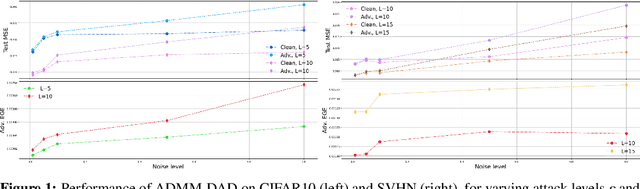
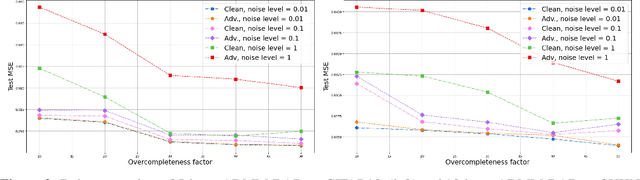
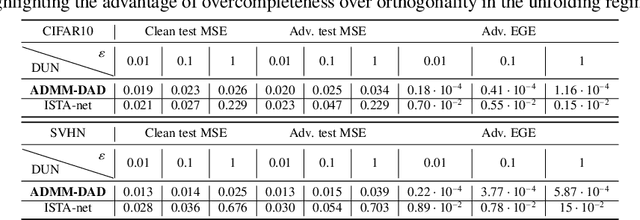
Unfolding networks are interpretable networks emerging from iterative algorithms, incorporate prior knowledge of data structure, and are designed to solve inverse problems like compressed sensing, which deals with recovering data from noisy, missing observations. Compressed sensing finds applications in critical domains, from medical imaging to cryptography, where adversarial robustness is crucial to prevent catastrophic failures. However, a solid theoretical understanding of the performance of unfolding networks in the presence of adversarial attacks is still in its infancy. In this paper, we study the adversarial generalization of unfolding networks when perturbed with $l_2$-norm constrained attacks, generated by the fast gradient sign method. Particularly, we choose a family of state-of-the-art overaparameterized unfolding networks and deploy a new framework to estimate their adversarial Rademacher complexity. Given this estimate, we provide adversarial generalization error bounds for the networks under study, which are tight with respect to the attack level. To our knowledge, this is the first theoretical analysis on the adversarial generalization of unfolding networks. We further present a series of experiments on real-world data, with results corroborating our derived theory, consistently for all data. Finally, we observe that the family's overparameterization can be exploited to promote adversarial robustness, shedding light on how to efficiently robustify neural networks.
How to warm-start your unfolding network
Feb 03, 2025


We present a new ensemble framework for boosting the performance of overparameterized unfolding networks solving the compressed sensing problem. We combine a state-of-the-art overparameterized unfolding network with a continuation technique, to warm-start a crucial quantity of the said network's architecture; we coin the resulting continued network C-DEC. Moreover, for training and evaluating C-DEC, we incorporate the log-cosh loss function, which enjoys both linear and quadratic behavior. Finally, we numerically assess C-DEC's performance on real-world images. Results showcase that the combination of continuation with the overparameterized unfolded architecture, trained and evaluated with the chosen loss function, yields smoother loss landscapes and improved reconstruction and generalization performance of C-DEC, consistently for all datasets.
Generalization analysis of an unfolding network for analysis-based Compressed Sensing
Mar 09, 2023


Unfolding networks have shown promising results in the Compressed Sensing (CS) field. Yet, the investigation of their generalization ability is still in its infancy. In this paper, we perform generalization analysis of a state-of-the-art ADMM-based unfolding network, which jointly learns a decoder for CS and a sparsifying redundant analysis operator. To this end, we first impose a structural constraint on the learnable sparsifier, which parametrizes the network's hypothesis class. For the latter, we estimate its Rademacher complexity. With this estimate in hand, we deliver generalization error bounds for the examined network. Finally, the validity of our theory is assessed and numerical comparisons to a state-of-the-art unfolding network are made, on synthetic and real-world datasets. Our experimental results demonstrate that our proposed framework complies with our theoretical findings and outperforms the baseline, consistently for all datasets.