 Add to Chrome
 Add to Firefox
 Add to Edge
Neural Networks as Local-to-Global Computations
Mar 16, 2026
We construct a cellular sheaf from any feedforward ReLU neural network by placing one vertex for each intermediate quantity in the forward pass and encoding each computational step - affine transformation, activation, output - as a restriction map on an edge. The restricted coboundary operator on the free coordinates is unitriangular, so its determinant is $1$ and the restricted Laplacian is positive definite for every activation pattern. It follows that the relative cohomology vanishes and the forward pass output is the unique harmonic extension of the boundary data. The sheaf heat equation converges exponentially to this output despite the state-dependent switching introduced by piecewise linear activations. Unlike the forward pass, the heat equation propagates information bidirectionally across layers, enabling pinned neurons that impose constraints in both directions, training through local discrepancy minimization without a backward pass, and per-edge diagnostics that decompose network behavior by layer and operation type. We validate the framework experimentally on small synthetic tasks, confirming the convergence theorems and demonstrating that sheaf-based training, while not yet competitive with stochastic gradient descent, obeys quantitative scaling laws predicted by the theory.

Topological Signatures of ReLU Neural Network Activation Patterns
Oct 14, 2025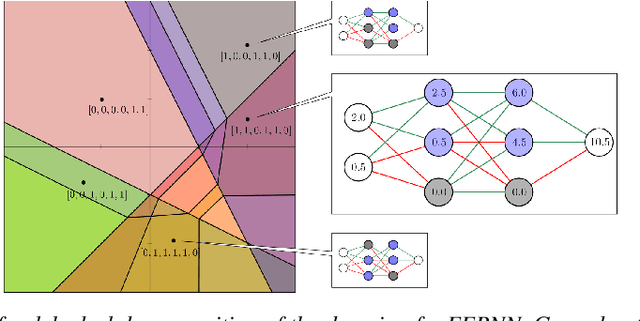

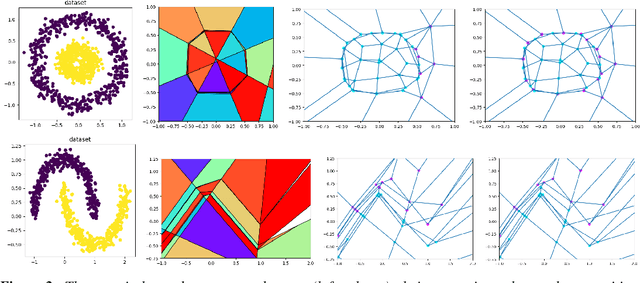

This paper explores the topological signatures of ReLU neural network activation patterns. We consider feedforward neural networks with ReLU activation functions and analyze the polytope decomposition of the feature space induced by the network. Mainly, we investigate how the Fiedler partition of the dual graph and show that it appears to correlate with the decision boundary -- in the case of binary classification. Additionally, we compute the homology of the cellular decomposition -- in a regression task -- to draw similar patterns in behavior between the training loss and polyhedral cell-count, as the model is trained.