 Add to Chrome
 Add to Firefox
 Add to Edge
Discovering Geometric Biases in 3D Face Reconstruction: A Curvature-Aware Spectral Framework for Fairness Evaluation
Jul 08, 2026
3D Morphable Models (3DMMs) remain the standard parametric shape priors for many state-of-the-art 3D face reconstruction algorithms. However, as these models are derived from a finite number of 3D face samples, they inherit the morphological biases of their training data, potentially limiting their generalizability across diverse global populations. In this paper, we propose a novel framework to analyze 3DMM reconstructions through the lens of surface curvature, with the objective to discover, quantify and visualize biases. While standard evaluation metrics often rely on Euclidean distances, our reconstruction error captures subtle surface nuances such as local topology or undulations. To do so, we leverage the Laplace-Beltrami Operator (LBO) to generate high-resolution curvature error maps, providing a localized and geometrically meaningful visualization of discrepancies between ground truth faces and reconstructed meshes. We derive from it an error metric that we validated through a user study, observing a significantly higher correlation to human perception compared to traditional methods. Furthermore, we conduct extensive experiments across several 3DMM bases and fitting algorithms, uncovering systematic age-related biases and providing preliminary evidence of biases associated with gender and ethnicity. Our findings highlight the necessity of adopting curvature-aware evaluation protocols to ensure demographic fairness and geometric precision in future 3D face reconstruction research.

AdBooster: Personalized Ad Creative Generation using Stable Diffusion Outpainting
Sep 08, 2023


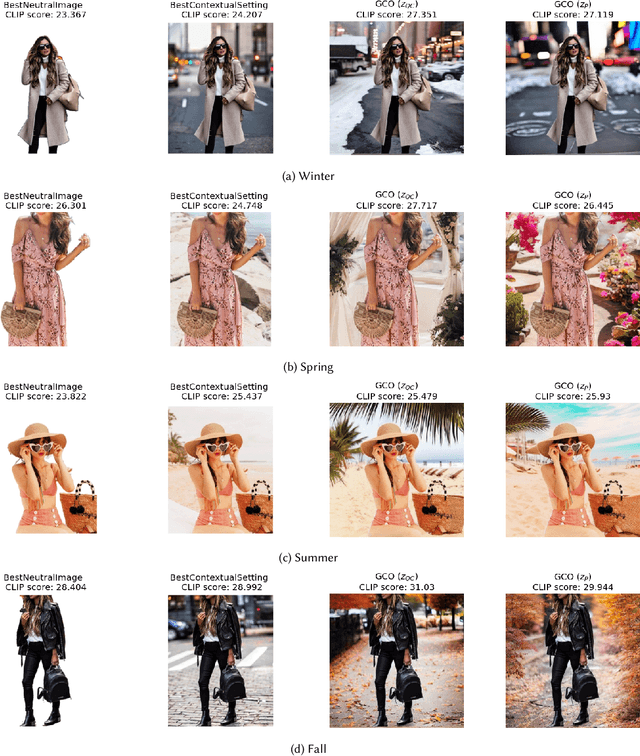
In digital advertising, the selection of the optimal item (recommendation) and its best creative presentation (creative optimization) have traditionally been considered separate disciplines. However, both contribute significantly to user satisfaction, underpinning our assumption that it relies on both an item's relevance and its presentation, particularly in the case of visual creatives. In response, we introduce the task of {\itshape Generative Creative Optimization (GCO)}, which proposes the use of generative models for creative generation that incorporate user interests, and {\itshape AdBooster}, a model for personalized ad creatives based on the Stable Diffusion outpainting architecture. This model uniquely incorporates user interests both during fine-tuning and at generation time. To further improve AdBooster's performance, we also introduce an automated data augmentation pipeline. Through our experiments on simulated data, we validate AdBooster's effectiveness in generating more relevant creatives than default product images, showing its potential of enhancing user engagement.