 Add to Chrome
 Add to Firefox
 Add to Edge
Three Modalities, Two Design Probes, One Prototype, and No Vision: Experience-Based Co-Design of a Multi-modal 3D Data Visualization Tool
Apr 10, 2026
Three-dimensional (3D) data visualizations, such as surface plots, are vital in STEM fields from biomedical imaging to spectroscopy, yet remain largely inaccessible to blind and low-vision (BLV) people. To address this gap, we conducted an Experience-Based Co-Design with BLV co-designers with expertise in non-visual data representations to create an accessible, multi-modal, web-native visualization tool. Using a multi-phase methodology, our team of five BLV and one non-BLV researcher(s) participated in two iterative sessions, comparing a low-fidelity tactile probe with a high-fidelity digital prototype. This process produced a prototype with empirically grounded features, including reference sonification, stereo and volumetric audio, and configurable buffer aggregation, which our co-designers validated as improving analytic accuracy and learnability. In this study, we target core analytic tasks essential for non-visual 3D data exploration: orientation, landmark and peak finding, comparing local maxima versus global trends, gradient tracing, and identifying occluded or partially hidden features. Our work offers accessibility researchers and developers a co-design protocol for translating tactile knowledge to digital interfaces, concrete design guidance for future systems, and opportunities to extend accessible 3D visualization into embodied data environments.

Identifying and Improving Disability Bias in GAI-Based Resume Screening
Jan 28, 2024
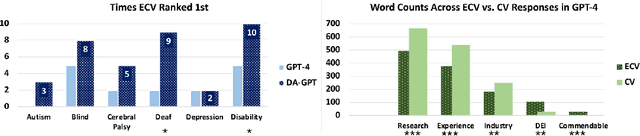


As Generative AI rises in adoption, its use has expanded to include domains such as hiring and recruiting. However, without examining the potential of bias, this may negatively impact marginalized populations, including people with disabilities. To address this important concern, we present a resume audit study, in which we ask ChatGPT (specifically, GPT-4) to rank a resume against the same resume enhanced with an additional leadership award, scholarship, panel presentation, and membership that are disability related. We find that GPT-4 exhibits prejudice towards these enhanced CVs. Further, we show that this prejudice can be quantifiably reduced by training a custom GPTs on principles of DEI and disability justice. Our study also includes a unique qualitative analysis of the types of direct and indirect ableism GPT-4 uses to justify its biased decisions and suggest directions for additional bias mitigation work. Additionally, since these justifications are presumably drawn from training data containing real-world biased statements made by humans, our analysis suggests additional avenues for understanding and addressing human bias.