 Add to Chrome
 Add to Firefox
 Add to Edge
Cross-modal learning for plankton recognition
Mar 17, 2026
This paper considers self-supervised cross-modal coordination as a strategy enabling utilization of multiple modalities and large volumes of unlabeled plankton data to build models for plankton recognition. Automated imaging instruments facilitate the continuous collection of plankton image data on a large scale. Current methods for automatic plankton image recognition rely primarily on supervised approaches, which require labeled training sets that are labor-intensive to collect. On the other hand, some modern plankton imaging instruments complement image information with optical measurement data, such as scatter and fluorescence profiles, which currently are not widely utilized in plankton recognition. In this work, we explore the possibility of using such measurement data to guide the learning process without requiring manual labeling. Inspired by the concepts behind Contrastive Language-Image Pre-training, we train encoders for both modalities using only binary supervisory information indicating whether a given image and profile originate from the same particle or from different particles. For plankton recognition, we employ a small labeled gallery of known plankton species combined with a $k$-NN classifier. This approach yields a recognition model that is inherently multimodal, i.e., capable of utilizing information extracted from both image and profile data. We demonstrate that the proposed method achieves high recognition accuracy while requiring only a minimal number of labeled images. Furthermore, we show that the approach outperforms an image-only self-supervised baseline. Code available at https://github.com/Jookare/cross-modal-plankton.

Combining feature aggregation and geometric similarity for re-identification of patterned animals
Aug 11, 2023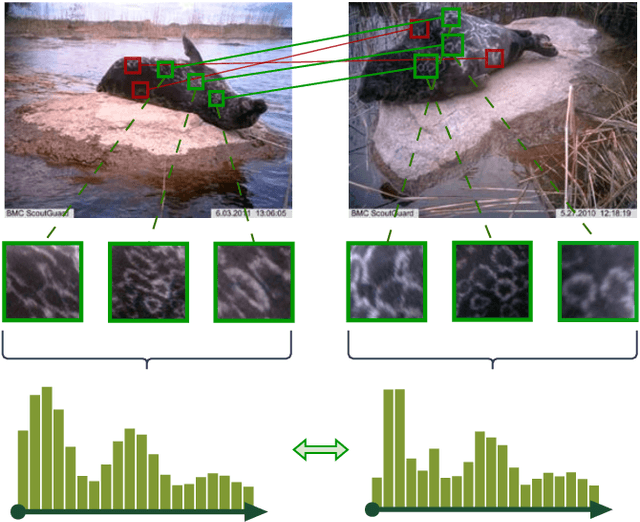
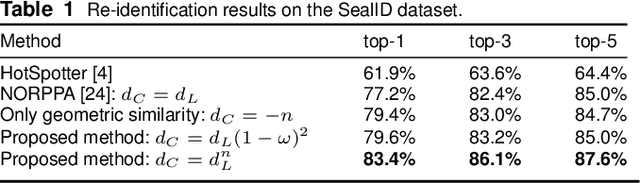
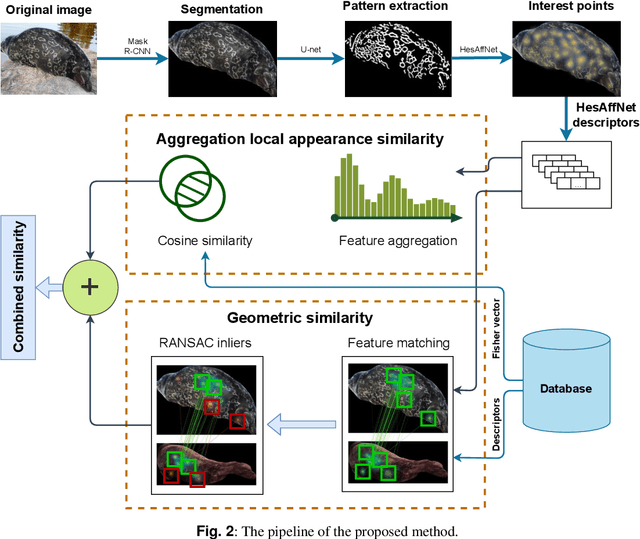
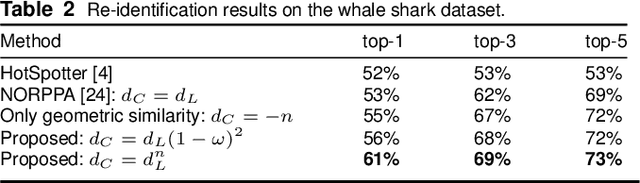
Image-based re-identification of animal individuals allows gathering of information such as migration patterns of the animals over time. This, together with large image volumes collected using camera traps and crowdsourcing, opens novel possibilities to study animal populations. For many species, the re-identification can be done by analyzing the permanent fur, feather, or skin patterns that are unique to each individual. In this paper, we address the re-identification by combining two types of pattern similarity metrics: 1) pattern appearance similarity obtained by pattern feature aggregation and 2) geometric pattern similarity obtained by analyzing the geometric consistency of pattern similarities. The proposed combination allows to efficiently utilize both the local and global pattern features, providing a general re-identification approach that can be applied to a wide variety of different pattern types. In the experimental part of the work, we demonstrate that the method achieves promising re-identification accuracies for Saimaa ringed seals and whale sharks.