 Add to Chrome
 Add to Firefox
 Add to Edge
Stop Thinking, Start Looking: Efficient Post-Training for Multimodal Document Question Answering via Reasoning-Free Alignment
Jul 16, 2026
Efficient multimodal document question answering with explicit visual grounding, locating the precise document region that supports each answer remains an open challenge. Current approaches bifurcate into Supervised Fine-Tuning (SFT), which requires large annotated datasets and reaches optimization plateaus, and reasoning-centric Reinforcement Learning (RL), which depends on verbose intermediate traces that inflate inference token cost without clear benefit. We introduce Perception-RFT, a training framework that applies Group Relative Policy Optimization (GRPO) to multimodal document QA, bypassing intermediate reasoning tokens to directly align visual features with structured grounding outputs. To rigorously evaluate the necessity of reasoning, we construct a reasoning variant under identical reward settings. We find that reasoning-enabled models suppress their reasoning traces during training, converging to direct perception-based policies at the 4B parameter scale, reducing per-query inference token length by more than 60%, while reasoning-enabled RL underperforms perception-only training. Through a fine-grained analysis of Qwen3-VL-4B optimization dynamics, we confirm that SFT saturation and cold-start RL instability established in text-domain post-training extend to multimodal, and identify a previously uncharacterized Grounding Divergence: a selective trade-off between semantic robustness and geometric precision on two out of distribution (OOD) benchmarks (4,828 samples) under joint RL optimization. We further show that an early SFT$\rightarrow$RL transition achieves comparable precision with 65% less training data.

Minimizing Factual Inconsistency and Hallucination in Large Language Models
Nov 23, 2023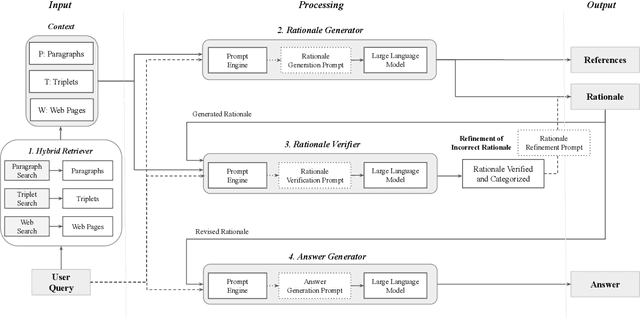
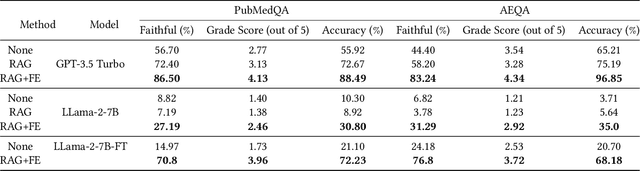
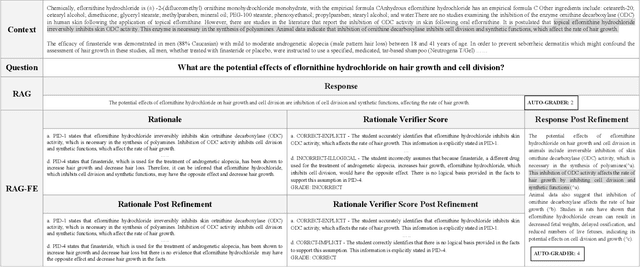
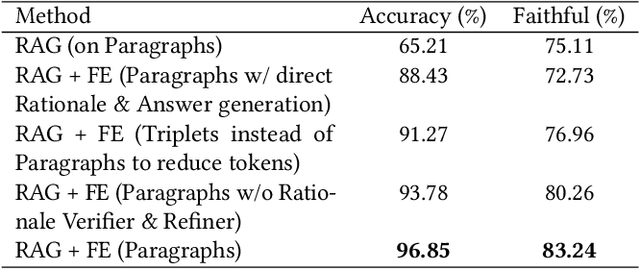
Large Language Models (LLMs) are widely used in critical fields such as healthcare, education, and finance due to their remarkable proficiency in various language-related tasks. However, LLMs are prone to generating factually incorrect responses or "hallucinations," which can lead to a loss of credibility and trust among users. To address this issue, we propose a multi-stage framework that generates the rationale first, verifies and refines incorrect ones, and uses them as supporting references to generate the answer. The generated rationale enhances the transparency of the answer and our framework provides insights into how the model arrived at this answer, by using this rationale and the references to the context. In this paper, we demonstrate its effectiveness in improving the quality of responses to drug-related inquiries in the life sciences industry. Our framework improves traditional Retrieval Augmented Generation (RAG) by enabling OpenAI GPT-3.5-turbo to be 14-25% more faithful and 16-22% more accurate on two datasets. Furthermore, fine-tuning samples based on our framework improves the accuracy of smaller open-access LLMs by 33-42% and competes with RAG on commercial models.