 Add to Chrome
 Add to Firefox
 Add to Edge
Symmetry-Breaking De Novo Crystal Generation via Markovian Jump Diffusion
Aug 13, 2026
Generating crystals has recently attracted significant interest due to their broad applications in materials science. However, existing generative models struggle to produce complete crystallographic specifications, limiting their ability to capture global symmetry and structural dependencies. In particular, current state-of-the-art approaches generate crystals only up to site symmetries and rely on sampling space groups from empirical distributions during generation. Inspired by \emph{spontaneous symmetry breaking} in physics, where crystals break symmetries under external conditions, we propose a novel diffusion-based framework that generates full structure specifications by reversing from the lowest-symmetry priors. Our method leverages a Markovian jump-diffusion process to model these symmetry-breaking dynamics, enabling it to traverse different space groups in a physically motivated manner. Our model, dubbed \emph{Symmetry-breaking Crystal Diffusion} (SbCD), introduces a principled approach to explicitly incorporate inter-space-group transitions into the generative process. In de novo generation experiments on MP20 and MPTS-52, SbCD outperforms its symmetry-preserving counterpart by a substantial margin, offering a promising perspective for generative modeling of crystalline materials.

MING: A Functional Approach to Learning Molecular Generative Models
Oct 16, 2024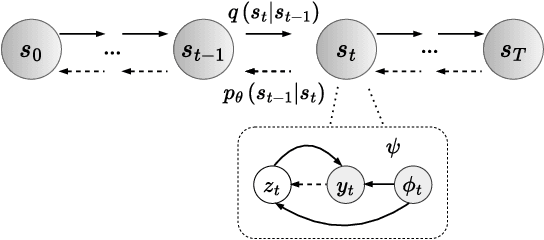
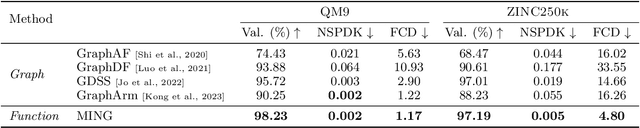

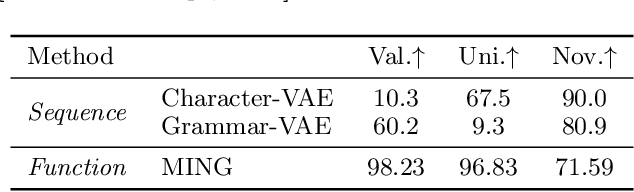
Traditional molecule generation methods often rely on sequence or graph-based representations, which can limit their expressive power or require complex permutation-equivariant architectures. This paper introduces a novel paradigm for learning molecule generative models based on functional representations. Specifically, we propose Molecular Implicit Neural Generation (MING), a diffusion-based model that learns molecular distributions in function space. Unlike standard diffusion processes in data space, MING employs a novel functional denoising probabilistic process, which jointly denoises the information in both the function's input and output spaces by leveraging an expectation-maximization procedure for latent implicit neural representations of data. This approach allows for a simple yet effective model design that accurately captures underlying function distributions. Experimental results on molecule-related datasets demonstrate MING's superior performance and ability to generate plausible molecular samples, surpassing state-of-the-art data-space methods while offering a more streamlined architecture and significantly faster generation times.
Discrete Latent Graph Generative Modeling with Diffusion Bridges
Mar 25, 2024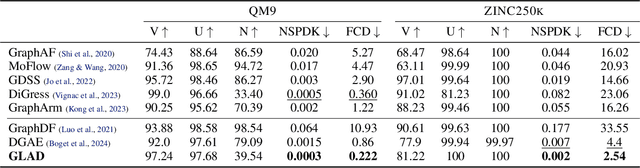
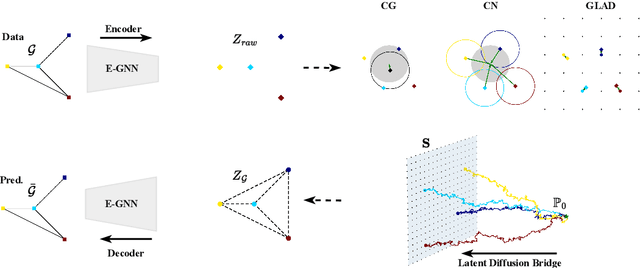
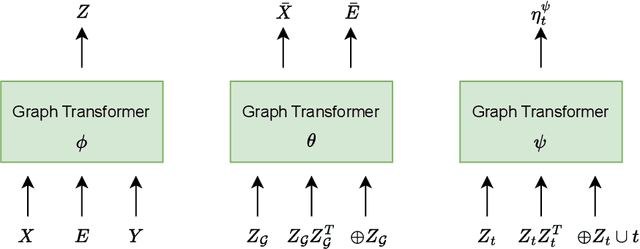
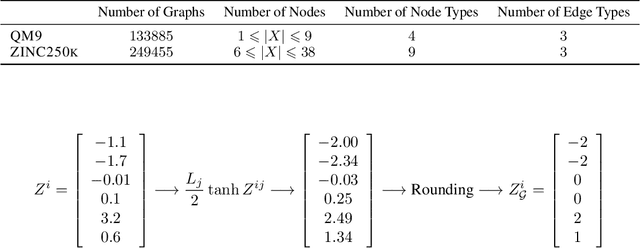
Learning graph generative models over latent spaces has received less attention compared to models that operate on the original data space and has so far demonstrated lacklustre performance. We present GLAD a latent space graph generative model. Unlike most previous latent space graph generative models, GLAD operates on a discrete latent space that preserves to a significant extent the discrete nature of the graph structures making no unnatural assumptions such as latent space continuity. We learn the prior of our discrete latent space by adapting diffusion bridges to its structure. By operating over an appropriately constructed latent space we avoid relying on decompositions that are often used in models that operate in the original data space. We present experiments on a series of graph benchmark datasets which clearly show the superiority of the discrete latent space and obtain state of the art graph generative performance, making GLAD the first latent space graph generative model with competitive performance. Our source code is published at: \url{https://github.com/v18nguye/GLAD}.