 Add to Chrome
 Add to Firefox
 Add to Edge
VoiceChat-TTS: A Low-Latency Continuous Speech Synthesis Model for Interactive Agents
Aug 13, 2026
Spoken dialogue is a natural form of human--computer interaction, yet most speech language models remain limited to turn-based operation and lack real-time adaptability, such as user barge-in. Recent duplex speech-to-speech and speech-to-text models reduce latency by replacing multi-stage pipelines, but often compromise speech quality because accurate ASR, interruption handling, and high-fidelity synthesis must be optimized jointly. We propose VoiceChat-TTS, a low-latency, continuous, and streamable text-to-speech model for interactive agents. VoiceChat-TTS is driven directly by LLM text-token streams, supports explicit interruption via control tokens, and produces silence when no textual input is available. The model enables always-on, responsive speech generation while preserving modularity and high speech quality, and it supports mid-utterance interruptions without resetting the KV cache.

Nemotron 3 Nano Omni: Efficient and Open Multimodal Intelligence
Apr 27, 2026We introduce Nemotron 3 Nano Omni, the latest model in the Nemotron multimodal series and the first to natively support audio inputs alongside text, images, and video. Nemotron 3 Nano Omni delivers consistent accuracy improvements over its predecessor, Nemotron Nano V2 VL, across all modalities, enabled by advances in architecture, training data and recipes. In particular, Nemotron 3 delivers leading results in real-world document understanding, long audio-video comprehension, and agentic computer use. Built on the highly efficient Nemotron 3 Nano 30B-A3B backbone, Nemotron 3 Nano Omni further incorporates innovative multimodal token-reduction techniques to deliver substantially lower inference latency and higher throughput than other models of similar size. We are releasing model checkpoints in BF16, FP8, and FP4 formats, along with portions of the training data and codebase to facilitate further research and development.
Improved Robustness to Disfluencies in RNN-Transducer Based Speech Recognition
Dec 11, 2020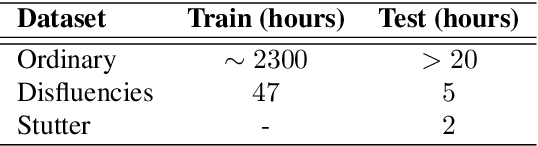

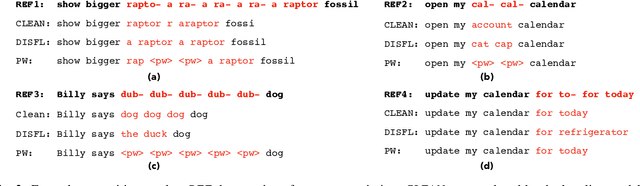

Automatic Speech Recognition (ASR) based on Recurrent Neural Network Transducers (RNN-T) is gaining interest in the speech community. We investigate data selection and preparation choices aiming for improved robustness of RNN-T ASR to speech disfluencies with a focus on partial words. For evaluation we use clean data, data with disfluencies and a separate dataset with speech affected by stuttering. We show that after including a small amount of data with disfluencies in the training set the recognition accuracy on the tests with disfluencies and stuttering improves. Increasing the amount of training data with disfluencies gives additional gains without degradation on the clean data. We also show that replacing partial words with a dedicated token helps to get even better accuracy on utterances with disfluencies and stutter. The evaluation of our best model shows 22.5% and 16.4% relative WER reduction on those two evaluation sets.