 Add to Chrome
 Add to Firefox
 Add to Edge
Template-based Object Detection Using a Foundation Model
Mar 20, 2026
Most currently used object detection methods are learning-based, and can detect objects under varying appearances. Those models require training and a training dataset. We focus on use cases with less data variation, but the requirement of being free of generation of training data and training. Such a setup is for example desired in automatic testing of graphical interfaces during software development, especially for continuous integration testing. In our approach, we use segments from segmentation foundation models and combine them with a simple feature-based classification method. This saves time and cost when changing the object to be searched or its design, as nothing has to be retrained and no dataset has to be created. We evaluate our method on the task of detecting and classifying icons in navigation maps, which is used to simplify and automate the testing of user interfaces in automotive industry. Our methods achieve results almost on par with learning-based object detection methods like YOLO, without the need for training.

3D Face Reconstruction From Radar Images
Dec 03, 2024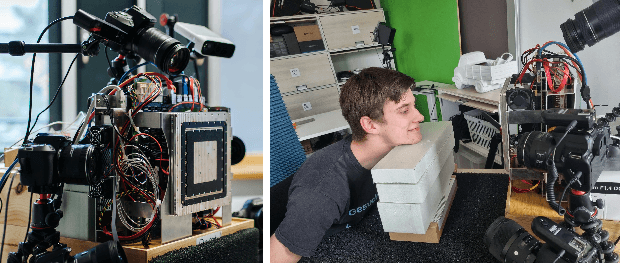
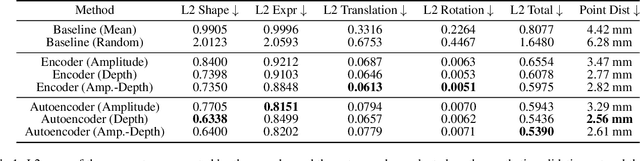
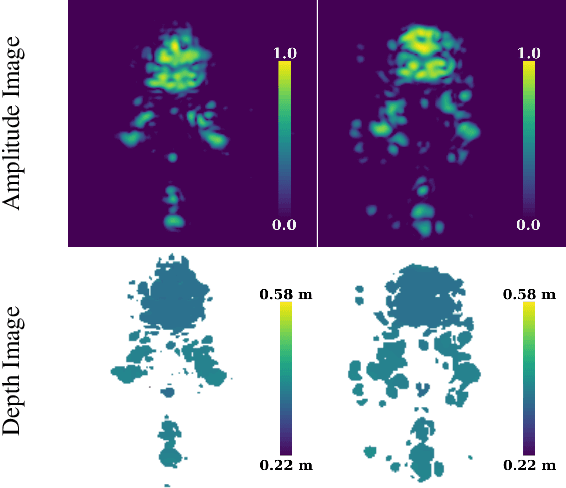
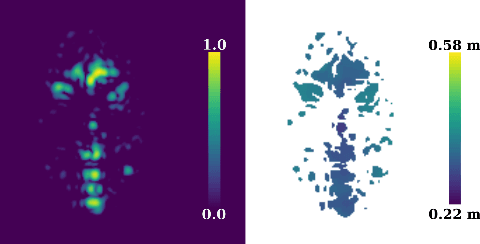
The 3D reconstruction of faces gains wide attention in computer vision and is used in many fields of application, for example, animation, virtual reality, and even forensics. This work is motivated by monitoring patients in sleep laboratories. Due to their unique characteristics, sensors from the radar domain have advantages compared to optical sensors, namely penetration of electrically non-conductive materials and independence of light. These advantages of radar signals unlock new applications and require adaptation of 3D reconstruction frameworks. We propose a novel model-based method for 3D reconstruction from radar images. We generate a dataset of synthetic radar images with a physics-based but non-differentiable radar renderer. This dataset is used to train a CNN-based encoder to estimate the parameters of a 3D morphable face model. Whilst the encoder alone already leads to strong reconstructions of synthetic data, we extend our reconstruction in an Analysis-by-Synthesis fashion to a model-based autoencoder. This is enabled by learning the rendering process in the decoder, which acts as an object-specific differentiable radar renderer. Subsequently, the combination of both network parts is trained to minimize both, the loss of the parameters and the loss of the resulting reconstructed radar image. This leads to the additional benefit, that at test time the parameters can be further optimized by finetuning the autoencoder unsupervised on the image loss. We evaluated our framework on generated synthetic face images as well as on real radar images with 3D ground truth of four individuals.